Pentagon's Break with Elite Universities Leaves Higher Education Bracing for Further Military Program Changes
The Trump administration's campaign to eliminate what it terms "wokeness" within the military is fundamentally reshaping its longstanding relationship with American higher education. This strategic realignment involves severing ties with prestigious universities that have historically trained generations of military leaders while simultaneously forging new partnerships with Christian institutions and public universities.
Defense Secretary Hegseth Drives Realignment of Military Fellowships
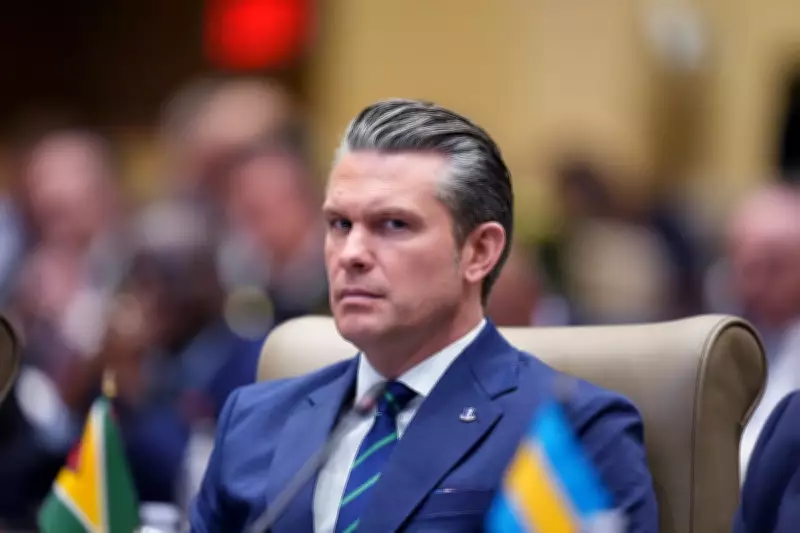
Defense Secretary Pete Hegseth recently advanced this realignment by expelling more than a dozen elite colleges from a prestigious military fellowship program that serves as a critical pipeline to the upper echelons of military leadership. Although the number of affected students is relatively small, this move represents a significant symbolic fracture. University administrators are now anxiously anticipating additional cuts that could potentially withdraw service members from their academic programs entirely.
While Hegseth has made sweeping declarations about cancelling all military attendance at institutions he labels as anti-American, his actions have thus far been more targeted. The initial focus has been on graduate degrees and certificate programs, while preserving the much larger Tuition Assistance program. This program provides financial support for approximately 200,000 active-duty or reserve service members to pursue studies at nearly any college in the United States.

Tuition Assistance Program Reveals Broader Beneficiaries
An Associated Press analysis reveals that schools beyond the Ivy League are far more likely to benefit from Pentagon aid. Major online universities and certain for-profit colleges, some of which have faced fraud accusations, receive substantial funding. For instance, only about 350 military members used Tuition Assistance to attend Harvard, Johns Hopkins, and other targeted elite schools in 2024. In stark contrast, over 50,000 studied at the American Public University System, a for-profit online education provider with a graduation rate of just 22%.
The data further shows that more than a third of students using the benefit attended for-profit colleges, exceeding the number at any type of private, nonprofit institution. Public universities enroll the largest share, with roughly 40% of military students choosing these campuses. The Tuition Assistance program pays a maximum of $4,500 annually per service member.
Targeting the Senior Service College Fellowship
Hegseth's recent memo specifically targeted the Senior Service College Fellowship, a prestigious program allowing military personnel to pursue advanced studies at universities, think tanks, and federal agencies. This fellowship is typically awarded to mid-career personnel destined for leadership or highly specialized roles. The Pentagon memo indicates that fewer than 80 students across 15 universities will be affected this fall.
Banned institutions include several Ivy League campuses, Georgetown University, Carnegie Mellon University, and the Massachusetts Institute of Technology. These universities have produced numerous current and retired commanders, such as retired Army General James McConville, who completed a fellowship at Harvard, and Lt. Gen. William Graham Jr., current chief of the U.S. Army Corps of Engineers, who did one at MIT.
Concerns Over Loss of Technical Expertise and Educational Overreach
Lindsey Tepe, an advisor on military learning at the American Council on Education, criticized the Pentagon's new stance on where service members should enroll as a radical shift and an "incredible overreach." She warned, "This is clearly the start of a broader effort to reshape military education, and I do think that this is a bad precedent to set."
There is growing concern that these cuts could extend to other vital military programs, including Tuition Assistance, the Reserve Officers' Training Corps (ROTC), or specialized schooling in fields like law, medicine, and engineering. Critics argue that by excluding elite campuses, the administration is sacrificing crucial technical expertise in areas such as artificial intelligence, cybersecurity, and quantum computing for ideological reasons.

William Hubbard, a vice president at the bipartisan nonprofit Veterans Education Success and a Marine Corps veteran, expressed dismay: "I’m not sure our enemies would be too upset about this. If I were waking up in Beijing and heard this news, I would be pleased."
Harvard Responds with Deferrals and Expedited Transfers
Harvard University, a frequent target of President Donald Trump, faces deeper sanctions. The Pentagon is barring all graduate-level professional military education at Harvard, along with fellowships and certificates. In response, Harvard's school of government announced this week that it will allow active-duty service members to defer their admission for up to four years. It has also arranged for them to receive "expedited consideration" at other institutions, including the University of Chicago and Tufts University.
Notably, Defense Secretary Hegseth himself earned a master’s degree from Harvard but symbolically returned his diploma during a 2022 Fox News segment.
New Partnerships with Liberty, Hillsdale, and Public Universities
In his memo, Hegseth condemned elite colleges as "factories of anti-American resentment" that undermine military values. He proposed a list of 15 replacement colleges for the fellowship, selected for promoting intellectual freedom and having "minimal public expressions in opposition of the Department."
Topping the list is Liberty University, a Christian school with 16,000 on-campus students and 120,000 online enrollees. Liberty already has a strong military presence, with over 7,000 students using Tuition Assistance. The university stated it has not yet coordinated with the Pentagon regarding a potential partnership but expressed gratitude for Hegseth's leadership.
Also featured is Hillsdale College, a conservative Christian institution partnering with the White House on a campaign for the nation's 250th anniversary. Hillsdale President Larry Arnn asserted, "If officers want serious education in the principles they swear to defend, Hillsdale is exactly where they should be."
The replacement list includes several flagship state universities, such as the University of Michigan—which recently scaled back diversity, equity, and inclusion efforts—and the University of North Carolina. Hegseth contends that redirecting the fellowship will ensure "a more rigorous and relevant education to better prepare them for the complexities of modern warfare."
The ongoing shake-up in military-education partnerships signals a profound ideological shift with potentially far-reaching consequences for how future military leaders are educated and where defense resources are allocated.