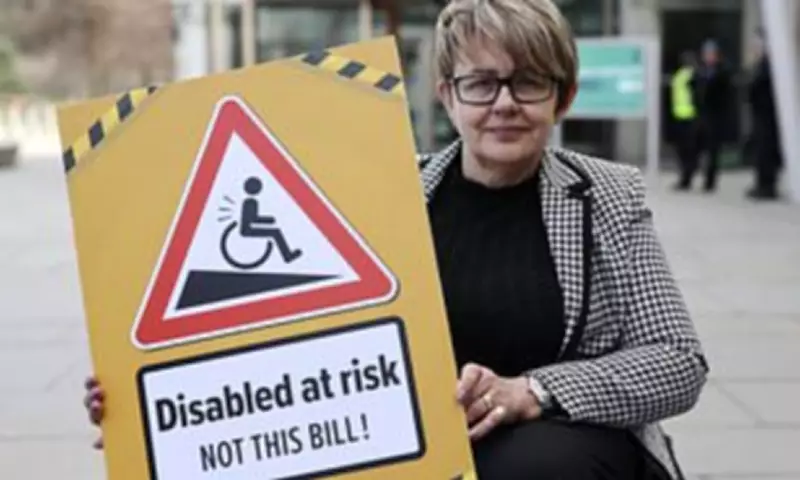
Scottish Parliament Rejects Assisted Dying Legislation
This week, the Scottish Parliament stepped back from what many considered a dangerous precipice by decisively defeating legislation that would have legalised state-sanctioned assisted suicide. Liam McArthur's proposed Bill sought to permit individuals diagnosed with a 'terminal' illness to end their lives through a lethal substance provided by the National Health Service.
The Compassionate Argument Versus Troubling Realities
Proponents of what critics dubbed a 'National Death Service' argued passionately that the policy represented a compassionate approach to end-of-life care. However, beneath this surface narrative lies a more disturbing reality: the persistent societal belief that certain lives hold diminished value. As a lifelong wheelchair user, I have navigated not only physical barriers but also the corrosive assumptions that frequently accompany disability.
I have experienced people looking directly at me and declaring they would rather be dead than live a life like mine. This is particularly striking when you know such statements to be fundamentally false. My own life has been extraordinarily full—competing in five Paralympic Games, winning eleven gold medals, and breaking world records. Yet even these achievements have not shielded me from the presumption that my existence is somehow lesser.

The Ambiguity of 'Terminal' Labels
The definition of 'terminal' illness proves dangerously ambiguous in practice. For instance, if someone like me—a paraplegic—developed a pressure sore that failed to heal, I could technically fall into this category. This creates a scenario where disabled individuals struggling with suicidal thoughts and the psychological burden of feeling like a 'burden' might easily qualify for NHS-provided death.
In the gritty reality of everyday existence, disabled people continue facing profound barriers to full societal participation. Basic accessibility remains inconsistent across the country, support services are critically stretched, and most trains remain inaccessible without assistance. I once had to crawl off a train on my hands and knees due to accessibility failures.
The Burden Argument and Coercion Risks
'Feeling like a burden' ranks among the most frequently cited reasons for choosing assisted suicide in jurisdictions where such laws exist. The financial pressure of requiring costly care would have made disabled individuals vulnerable to being subtly ushered toward ending their lives to avoid burdening families, caregivers, or the NHS.
Recent polling revealed that two-thirds of Scottish citizens expressed concern that disabled people could face coercion into assisted suicide if the legislation passed. Alarmingly, the Bill's own financial memorandum acknowledged that savings would result from shortened lives. Fortunately, Members of the Scottish Parliament recognized that human lives are too valuable to be weighed in such utilitarian terms.
The Urgent Need for Support to Live
This defeat does not conclude the conversation but redirects it toward what truly matters: providing support to live rather than to die. As MSP Pam Duncan-Glancy emphasized during debates, disabled individuals have long battled inflexible care packages that restrict independence. She personally fought for overnight carers to secure the basic dignity of using the toilet independently.
Over 86,000 households with disabled members in Scotland lack suitable home adaptations. Inclusion Scotland calculates that at current construction rates, it will take ninety-five years to meet the housing needs of existing wheelchair users. Employment barriers remain equally unjust—as a youth, a special careers adviser told me the best I could achieve was answering phones and warned against aiming higher.
Structural Barriers and False Choices
Young wheelchair users today continue receiving the same discouraging messages. Significant work remains to dismantle structural and attitudinal barriers in workplaces, education, and all life spheres. Introducing a so-called 'choice' to die would have represented a dangerous misnomer. True choice emerges from improving support systems that enable disabled people to live fully and participate meaningfully in society.

The path to inclusion cannot involve offering to simply remove vulnerable individuals from the equation. All disabled people have requested is respect. Thankfully, our voices were heard during this critical vote. Now, they must continue being amplified. It is time for the Scottish government to fully embrace the decision to choose life by prioritizing policies that genuinely enhance access, care, and support for those who need it most.