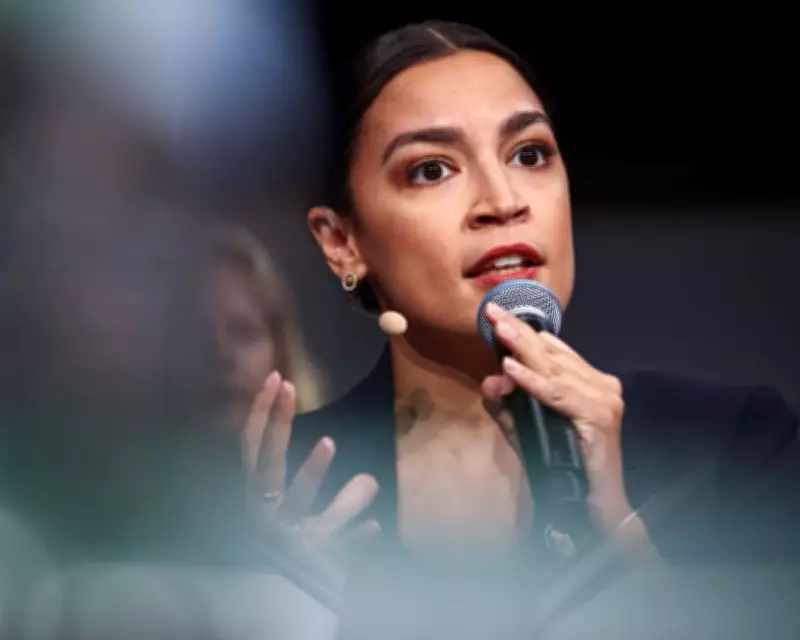
Alexandria Ocasio-Cortez Delivers Scathing Critique of Trump's Foreign Policy at Munich Security Conference
Democratic Representative Alexandria Ocasio-Cortez launched a blistering attack on Donald Trump's administration during the Munich Security Conference in Germany, accusing the former president of actively dismantling transatlantic alliances and ushering in what she termed an "age of authoritarianism." Speaking on a panel about populism on Friday, 13 February, the New York congresswoman presented what she described as an "alternative vision" for leftwing US foreign policy directly to assembled policymakers from allied nations who have grown increasingly concerned about America's shifting global posture.
Condemnation of Specific Foreign Policy Actions
Ocasio-Cortez specifically condemned several controversial Trump administration policies during her remarks. She criticized the US capture of Venezuelan leader Nicolás Maduro, Trump's repeated threats to annex Greenland, and what she characterized as unconditional US support for Israel's military actions in Gaza. "I think that, personally, the idea of completely unconditional aid, no matter what one does, does not make sense," Ocasio-Cortez stated during a separate panel discussion. "I think it enabled a genocide in Gaza, and I think that we have thousands of women and children dead ... that was completely avoidable."
Accusations of Authoritarian Ambitions
In her most pointed criticism, Ocasio-Cortez asserted that Trump and Secretary of State Marco Rubio were "looking to withdraw the United States from the entire world so that we can turn into an age of authoritarianism." She accused them of attempting to "carve out a world where Donald Trump can command the western hemisphere and Latin America as his personal sandbox, where Putin can saber-rattle around Europe and try to bully our own allies there." The congresswoman called for a return to a "rules-based order" without what she described as the "hypocrisies" that have characterized US foreign policy across multiple administrations.

Broader Context of Transatlantic Tensions
The Munich Security Conference provided a prominent international stage for these criticisms as tensions between the US and European allies continue to simmer. A separate dispute has emerged regarding the future of Gaza, with EU foreign policy chief Kaja Kallas warning that Trump's "Board of Peace" initiative functioned as a personal vehicle for the US president that removed accountability to Palestinians or the United Nations. These foreign policy disagreements unfolded against a backdrop of domestic challenges in the United States, including potential Department of Homeland Security shutdowns, ongoing inflation concerns, and controversial voting legislation proposals.
Additional Political Developments
Several other significant political stories emerged alongside Ocasio-Cortez's Munich remarks. The Trump administration faced scrutiny over a racist video posted to the president's social media account, with Trump confirming no staffer had been disciplined for the offensive content. Meanwhile, Representative Ro Khanna faced questions after naming individuals in Epstein-related files who reportedly had no connection to the convicted sex offender. Immigration policies also drew attention as a congressional investigation revealed the administration spent over $1 million per person to deport some immigrants to countries with which they had no connection.
The Munich Security Conference address by Alexandria Ocasio-Cortez represents a significant moment in the ongoing debate about America's role in global affairs, highlighting deepening divisions between progressive Democrats and the Trump administration's "America First" foreign policy approach. Her remarks underscore growing concerns among US allies about the direction of American leadership and the potential erosion of international norms and alliances that have shaped global security arrangements for decades.