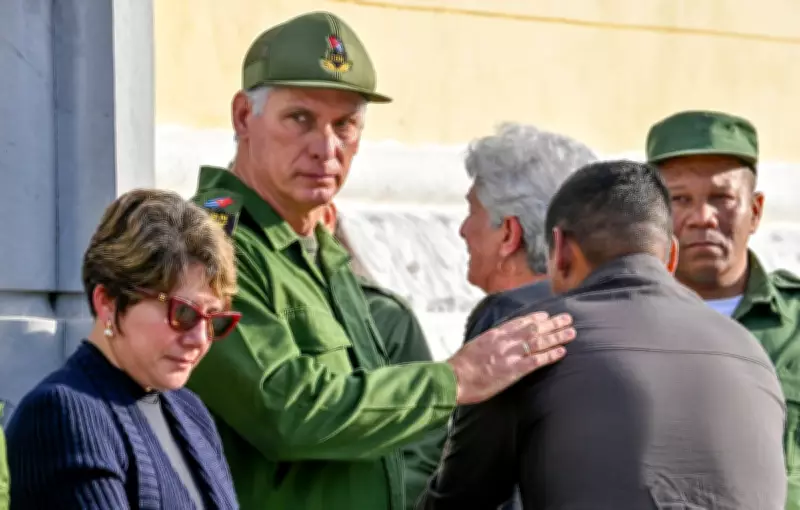
Cuban President Miguel Diaz-Canel has firmly declared that he will not resign under pressure from the United States, during his inaugural television interview with an American broadcaster. This bold statement comes as Russia reaffirms its steadfast allegiance to its long-standing ally, highlighting a deepening geopolitical rift in the Western Hemisphere.
Defiance in the Face of Adversity
In a candid conversation with NBC News on Thursday, Diaz-Canel, aged 65, articulated a resolute stance against US demands. He emphasized Cuba's sovereignty and independence, asserting that the nation is not subject to American designs. "We have a free sovereign state, a free state. We have self-determination and independence, and we are not subjected to the designs of the United States," he stated, with his remarks translated into English for the broadcast.
The Cuban leader went on to critique the moral authority of the US government, which has enforced a hostile policy towards Cuba for decades. "The US government that has implemented that hostile policy against Cuba has no moral to demand anything from Cuba," Diaz-Canel remarked. He further dismissed the notion of revolutionaries yielding to external pressure, adding, "The concept of revolutionaries giving up and stepping down – it's not part of our vocabulary."

Escalating Tensions and Economic Strife
Washington's aggressive campaign against communist-ruled Cuba has intensified, with the imposition of a virtual oil blockade. By threatening tariffs on any country attempting to sell oil to the island, the US has exacerbated an already severe energy crisis. This situation worsened in January when Cuba's primary oil supply from Venezuela was abruptly cut off following US actions against Venezuelan leader Nicolás Maduro.
President Donald Trump has openly speculated about "taking" Cuba and has labeled Havana's leadership as a threat to US national security. Despite these provocations, the Trump administration permitted a Russian tanker, the Anatoly Kolodkin, to deliver 730,000 barrels of crude oil to Cuba in late March. This shipment marked the island's first oil delivery in three months, offering a temporary respite from the fuel shortage.
Russia's Unwavering Commitment
Amid simmering tensions, Russian Deputy Foreign Minister Sergei Ryabkov visited Cuba on Thursday, engaging in high-level talks with President Diaz-Canel. Ryabkov, quoted by Russian news agencies, made it clear that Moscow has no intention of abandoning its interests in the Western Hemisphere, regardless of US objections.
"We cannot betray Cuba. That is out of the question. We cannot leave it on its own," Ryabkov asserted. He indicated that Russia's assistance would extend beyond the recent oil delivery, stating, "It is too early to say what the next steps will be. But it is clear we will not be limiting our supplies to the load that was aboard the tanker Anatoly Kolodkin."
Ryabkov also condemned the US blockade as "illegal and absolutely unacceptable," pledging that Russia would help Cuba navigate the challenges arising from it. "Russia has no plans to walk away from the western hemisphere, no matter what Washington might say," he emphasized, underscoring Moscow's strategic commitment to the region.
Broader Implications and Future Prospects
Cuba's energy predicament remains critical, with the nation producing only 40% of the fuel it consumes. The cessation of Venezuelan oil shipments, triggered by US intervention in January, has left the island heavily reliant on external support. Trump's dismissive comments, such as "Cuba's finished" and accusations of "bad and corrupt leadership," reflect the administration's hardline approach, yet the allowance of Russian oil deliveries suggests a complex interplay of geopolitical calculations.
As Diaz-Canel stands firm against US pressure and Russia bolsters its backing, the situation underscores enduring Cold War-era alliances and contemporary power struggles. The Cuban president's defiance, coupled with Russian assurances, sets the stage for continued friction in US-Cuba relations, with potential ramifications for regional stability and international diplomacy.