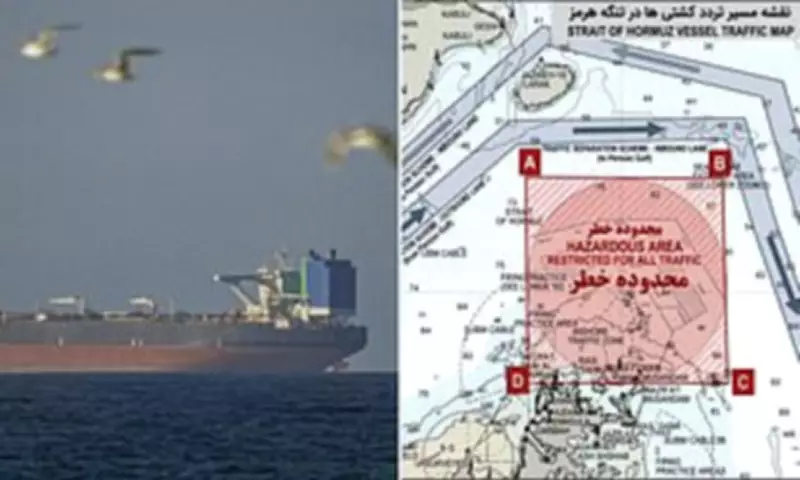
Reports indicate that Iran has deployed sea mines in the strategically vital Strait of Hormuz, while simultaneously demanding substantial cryptocurrency fees from vessels attempting to navigate the passage. This development has triggered a sharp increase in global oil prices and cast significant doubt over the stability of a nascent two-week ceasefire between Tehran and the United States.
Charts Reveal 'Danger Zone' as Tensions Escalate
Semi-official Iranian news agencies, ISNA and Tasnim, published navigational charts on Thursday, April 9, depicting a large circle marked as a 'danger zone' in Farsi over the established Traffic Separation Scheme. This scheme represents the traditional route for maritime traffic through the narrow Strait of Hormuz, a chokepoint for approximately 20% of the world's traded oil and natural gas.
Radio Threats and Cryptocurrency Demands
The Iranian regime broadcast a stark radio message to all oil tankers in the waterway, warning, "If any vessels try to transit without permission, [they] will be destroyed." Concurrently, Tehran is now allegedly requiring shipping companies to pay enormous tolls in digital currencies like Bitcoin to gain access to the strait during the ceasefire period.

Hamid Hosseini, a spokesperson for Iran's Oil, Gas and Petrochemical Products Exporters' Union, outlined the new procedure to the Financial Times. He stated that each vessel must first email Iranian authorities about its cargo. Subsequently, Iran's Supreme National Security Council will determine a toll, reportedly set at $1 per barrel of oil, payable in cryptocurrency within seconds of notification. Hosseini emphasized that this method prevents tracing or confiscation due to international sanctions.
Ceasefire Under Strain as Markets React
The fragile US-Iran ceasefire, announced by President Donald Trump on Wednesday, April 8, appears to be cracking less than a day after its inception. Iran contends that continued Israeli military actions against Hezbollah in Lebanon violate the agreement's terms. In response, Iran has reportedly shut the Strait of Hormuz again, citing the risk from newly laid sea mines, though it announced alternative shipping routes.
This geopolitical uncertainty sent shockwaves through financial markets on Thursday. Oil prices surged dramatically, with West Texas Intermediate crude rising 3.1% to $97.32 a barrel and Brent North Sea crude climbing 3.3% to $97.87 a barrel. Most global equity markets relinquished their previous day's gains, with indices in Tokyo, Hong Kong, Shanghai, London, Paris, and Frankfurt all trading lower.
Diplomatic Wrangling and Military Posturing
Mohammad Bagher Ghalibaf, Iran's parliament speaker, declared on social media platform X that the "workable basis on which to negotiate" had been violated, making further talks "unreasonable." He cited alleged US violations including the Lebanon attacks, a drone incursion into Iranian airspace, and a denial of Iran's right to uranium enrichment.
President Trump, in a post on Truth Social, made the ceasefire contingent upon "the COMPLETE, IMMEDIATE, and SAFE OPENING of the Strait of Hormuz." He insisted a US military presence would remain around Iran until full compliance is achieved, threatening a severe military response if the agreement fails. Conversely, the White House initially rejected the concept of toll payments, though Trump later suggested it could be a "beautiful" joint venture with America.
Shipping Industry Adopts Cautious Stance
The new Iranian demands and threats have prompted extreme caution within the global shipping industry. Western ship owners are awaiting clearer guidance on transit procedures, while data from firm Kpler showed only four vessels with active tracking systems passed through the strait on the ceasefire's first day. This figure excludes the so-called 'dark fleet' of ships that travel with trackers disabled, many of which carry sanctioned Iranian crude oil to market.
Hosseini's statements imply Iran will compel vessels to use a northerly route close to its coastline, raising serious security concerns for Western or Gulf state-linked tankers. The future of not only oil and gas shipments, but also critical commodities like jet fuel, sulphur, urea, and diesel, now hangs in the balance as diplomatic tensions threaten to unravel the temporary peace.