Historic Israel-Lebanon Talks Yield 'Wonderful Exchange' But No Breakthrough
In a landmark diplomatic event, Israel and Lebanon have conducted their first direct governmental discussions in over three decades, with the meeting described by participants as a "wonderful exchange" of views. However, the talks concluded without any immediate breakthrough, leaving the two nations in a state of deadlock amidst ongoing conflict. The discussions took place in Washington on Tuesday, following more than a month of intense hostilities between Israel and the Iran-backed militant group Hezbollah, which operates within Lebanon.
U.S. Secretary of State Hails 'Historic Opportunity'
U.S. Secretary of State Marco Rubio, who facilitated the talks, hailed the meeting as a "historic opportunity" for peace and stability in the region. He emphasized the significance of the dialogue but tempered expectations by making it clear that no swift agreement was anticipated. Rubio acknowledged the deep-seated complexities and decades of history that would not be resolved quickly. "We understand we're working against decades of history and complexities that will not be quickly resolved," Rubio stated. "But we can begin to move forward with a framework where something can happen—something very positive, something very permanent—so that the people of Lebanon can have the kind of future they deserve, and so that the people of Israel can live without fear."
Israeli Ambassador Expresses Optimism Amidst Conflict
Yechiel Leiter, Israel's Ambassador to the United States, expressed cautious optimism following the two-hour exchange. He noted a "convergence of opinion" regarding the critical issue of removing Hezbollah's influence from Lebanon. Leiter described the Lebanese government as making it "very clear that they will no longer be occupied by Hezbollah." He highlighted the weakened state of Iran and Hezbollah as creating a unique opportunity for progress. "Iran has been weakened. Hezbollah is dramatically weakened. This is an opportunity," Leiter asserted, underscoring the potential for diplomatic advancement despite the challenges.

Hezbollah's Opposition and Escalating Attacks
Hezbollah, which was not represented at the talks, vehemently opposed the direct engagement between Israel and Lebanon. As the discussions commenced, the militant group appeared to intensify its attacks on northern Israel, with incoming fire triggering nonstop drone and rocket alert sirens in Israeli communities near the Lebanese border. Hezbollah claimed responsibility for 24 attacks on northern Israel and Israeli troops in southern Lebanon on the day of the talks. Wafiq Safa, a high-ranking member of Hezbollah's political council, told The Associated Press that the group would not abide by any agreements made during the discussions, reflecting its staunch rejection of the diplomatic process.
Humanitarian Toll and Military Developments
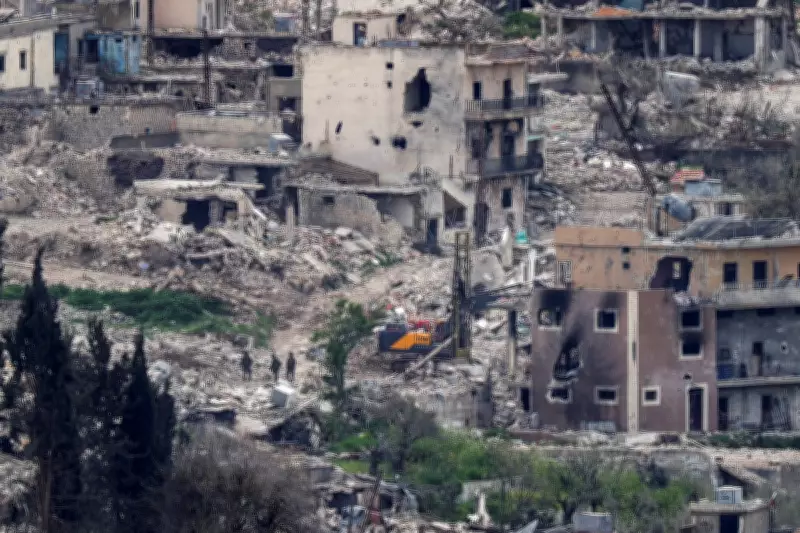
The conflict has exacted a severe humanitarian toll, with at least 2,124 people killed in Israeli strikes in Lebanon, according to the Health Ministry, including hundreds of women and children. More than 1 million people have been displaced, with the deadliest day occurring last week when Israel launched 100 airstrikes across Lebanon in 10 minutes, killing over 350 people, including in the heart of the capital, Beirut. In response, the Israeli military has invaded southern Lebanon, with some officials stating the aim is to create a "security zone" from the border to the Litani River, approximately 30 kilometers to the north. Israel's defense minister has declared that hundreds of thousands of people uprooted from southern Lebanon will not be allowed to return home until the area is demilitarized and Israel's northern communities are deemed safe.

Lebanese Government's Hopes and Challenges
The Lebanese government, led by Ambassador to Washington Nada Hamadeh Moawad, hopes the talks will pave the way to an end to the war. Lebanon insists on representing itself independently, despite Iran's condition that ending wars in Lebanon and the region is a prerequisite for talks with the U.S. Lebanese President Joseph Aoun, who came to power vowing to disarm non-state groups including Hezbollah, emphasized the importance of diplomatic solutions. "Israel's destruction of Lebanese territories is not the solution, nor will it yield any results," Aoun said. "Diplomatic solutions have consistently proven to be the most effective means of resolving armed conflicts globally." However, Hezbollah and other critics argue that Lebanon's government lacks leverage and should instead back Iran's position.
Historical Context and Future Prospects
These talks mark the first direct engagement between Israel and Lebanon since 1993, breaking a long reliance on indirect communication often brokered by the United States or UNIFIL, the United Nations peacekeeping mission in southern Lebanon. The latest round of fighting was sparked by Hezbollah firing rockets into northern Israel on March 2, days after the United States and Israel attacked Iran. Lebanon's top political authorities, critical of Hezbollah's decision to enter the war, proposed direct talks to stop the escalation, but Israel did not respond positively until last week after its deadly bombardment of Beirut triggered international outcry. While Israel has ruled out a truce, it has halted strikes on Lebanon's capital following the bombardment. Foreign Minister Gideon Saar denied having disputes with Lebanon, stating "the problem is Hezbollah," highlighting the central role of the militant group in the conflict.