German Chancellor Challenges US Unilateralism at Munich Security Conference
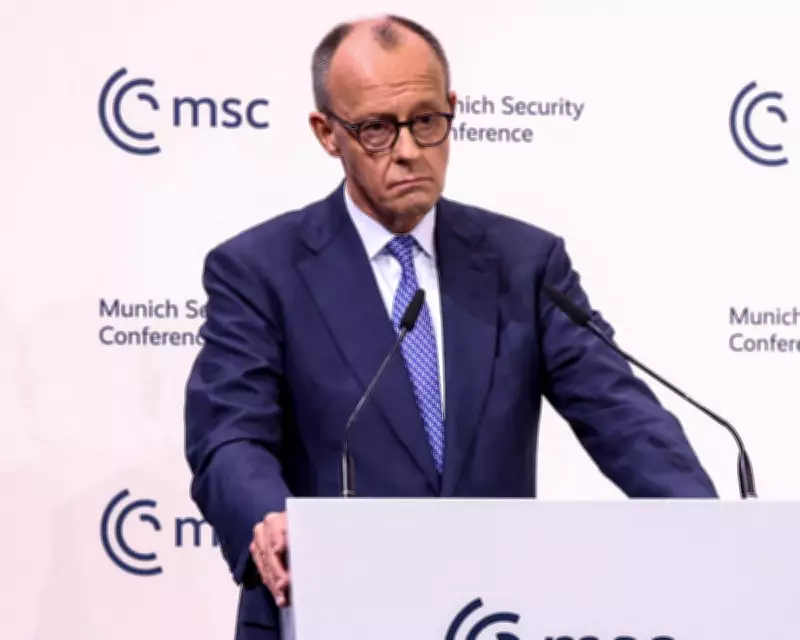
In a significant address at the Munich Security Conference, German Chancellor Friedrich Merz delivered a stark warning to the United States, asserting that America is "not powerful enough to go it alone" in the current era of great power rivalry. Speaking on Friday, Merz directly rebutted notions of American unilateralism, emphasising that democracies thrive through partnerships and allies, not solitary action.
End of the Old Order and Transatlantic Trust
Merz declared that the international rules-based order, "however imperfect it was even at its best, no longer exists in that form." He argued that the old geopolitical framework has ended, ushering in an age where even superpowers like the US face constraints. Switching to English to underscore his message, Merz stated: "In the era of great power rivalry, even the United States will not be powerful enough to go it alone." He highlighted NATO as a competitive advantage for both Europe and the US, calling for joint efforts to "repair and revive transatlantic trust together."
Criticism of US Administration and European Sovereignty
The chancellor received notable applause when criticising the current American administration, distancing Europe from the "culture war of the Maga movement." He affirmed European commitment to free trade, climate agreements, and the World Health Organization, contrasting with US tendencies toward tariffs and protectionism. Merz warned that "freedom is no longer a given" in this age, requiring firmness to assert it. He stressed that Europe must reduce its excessive dependence on the US, but clarified: "We won't do that by writing off NATO."

Ukraine War and European Defence Initiatives
Merz described the Ukraine war as forcing Europe to return from a "vacation from world history," entering an era marked by power politics. He noted that big powers now make their own rules, exploiting resources and supply chains as bargaining tools. In response, Merz advocated for Europe to fully leverage its "enormous" military, political, economic, and technological potential, striving for "partnership-based leadership" without hegemonic ambitions.
He revealed discussions with French President Emmanuel Macron on a European nuclear deterrent, which must be integrated into NATO's framework to ensure equal defence across the continent. Germany aims to establish a "strong, self-sustaining pillar" within NATO, though tensions exist with France over roles in a revised alliance where the US takes a less dominant position. Germany is seeking the chair of NATO's military committee, highlighting its commitment to bolstering European defence capabilities.
Context and Implications
Merz's speech comes amid ongoing strains in US-European relations, following last year's conference where US Vice-President JD Vance criticised European defence efforts. The chancellor's remarks underscore a shifting dynamic, with Europe asserting greater autonomy while maintaining transatlantic ties. His call for partnership-based leadership reflects a broader trend of nations navigating complex geopolitical landscapes, where collaboration is deemed essential for stability and security.