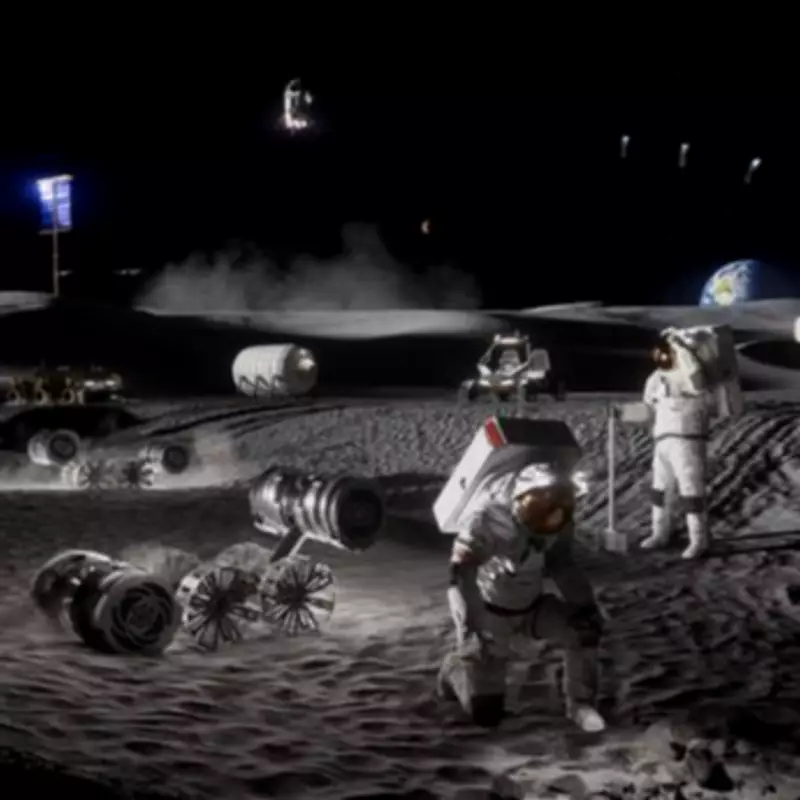
NASA has announced a 'grand return' to the Moon, unveiling plans for a lunar base where humans can live and work within six years. Over half a century since astronauts last set foot on the lunar surface, the American space agency has released images of what would be mankind's first foothold in another world. The plans include details of robotic landers, hopping drones, and vehicles aimed at building a permanently manned base that could eventually span hundreds of square miles.
NASA's Commitment to the Moon
NASA chief Jared Isaacman told a media briefing on Tuesday that the US will 'never give up the Moon again,' adding: 'It means people are looking up again, believing in big things again, and paying attention as America returns to the moon again - and this time to stay.' NASA's last crewed mission to set foot on the Moon was Apollo 17 in 1972, after America won its space race with the Soviet Union. Since then, much of NASA's ambition and funding for sending astronauts into space were scaled back. Now, the US is competing with China, which is forging ahead with its own plans to land humans on the Moon by 2030. On Monday, China launched its Shenzhou-23 spacecraft, sending a crew to the Tiangong space station.
Plans for the Lunar Base
Mr. Isaacman said: 'For those waiting patiently, the grand return is close at hand, and we will not slow down. We are moving with the competence and the purpose to accomplish the missions that only NASA is capable of achieving, and we are really just getting started.' Research at the moon base will develop technologies needed for future deep space missions, including NASA's major long-term ambition to get humans to Mars. Mr. Isaacman added: 'There's certainly going to be a whole lot of inspiration that's coming out of this for the next generation, but number one, we want to be in an environment where we can learn the skills, so that astronauts can go and plant the stars and stripes on Mars someday.'

Timeline and Challenges
The move follows the NASA flyby of the Moon by a manned crew on the Artemis II mission in April. Amazon founder Jeff Bezos's space company Blue Origin has been commissioned to provide a 50-foot tall lunar lander with room for four astronauts for the Artemis V moon mission scheduled to launch in 2029. The US wants to land Americans back on the Moon before President Donald Trump leaves office in 2029. Jared Isaacman is an American billionaire entrepreneur, pilot, and commercial astronaut who was nominated by President Trump to serve as the 15th administrator of NASA. A Moon base would allow the US to carry out scientific experiments and mine valuable resources, but some experts believe NASA's timeline is too ambitious and say China is in pole position to next land humans on the Moon. Dr. Simeon Barber, Lunar Scientist at Open University, told BBC News: 'It would not surprise me at all if China gets there first.'

Location and Environment
The NASA outpost would be located at the Moon's south pole and could eventually have sites spread out over hundreds of square miles. The plan is to establish it in a phased approach, building it up over time. In sunlight, the Moon's surface can heat to more than 121°C, while in darkness it can fall well below minus 128°C. In permanently shaded craters, untouched by sunlight for perhaps billions of years, temperatures can fall well below -240°C. Mr. Isaacman said the aspiration was to eventually have 'a lot of outposts' on the lunar surface, and caves had also been looked at to provide shelter for astronauts from the harsh environment. He said: 'We are leveraging the NASA playbook from the 1960s figuring out what works and what doesn't in this epic science of survival because the moon base is as beautiful as it is hostile. There is no atmosphere to moderate these extremes, no protection from radiation and solar particle events, and the surface is exposed to meteorite impacts. Recognising this reality, I'm often asked why we send our astronauts into such a harsh and dangerous and unforgiving environment of space or the lunar surface and at such great cost. We go for the technology we will pioneer to get there, the science and all that we will learn that will make life better here on earth, to advance humankind on this great adventure, to inspire the next generation to do it better than we can and to be very clear to master the skills for where we will inevitably go next.'
Living on the Moon
The plans would have astronauts live on the Moon in 'semi-permanent' housing by 2032. Rovers would enable them to travel long distances across its rocky surface to retrieve frozen water from lakes near the south pole to be used for drinking water or to produce oxygen. The US space agency announced in March a £15 billion programme to construct a permanent base powered by nuclear and solar energy at the Moon's south pole by 2032.