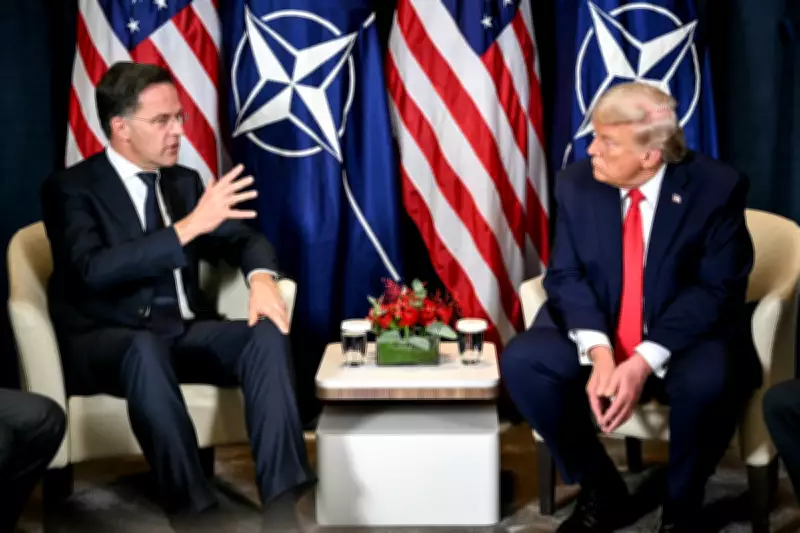
NATO's Resilience Tested Amid Trump's Threats, But Alliance Endures
Collateral damage in war often impacts truth and civilians, but military alliances like NATO rarely face such consequences. However, the United States' NATO allies now fear this may change due to fallout from Washington's decision to team up with Israel in waging war against Iran. Donald Trump has attacked the pact with unprecedented vehemence over what he perceives as disloyalty and failure to assist in re-opening the Strait of Hormuz, which Tehran closed in response to the military onslaught. The conflict is currently paused thanks to a two-week ceasefire brokered by Pakistan.
Escalating Criticisms and Diplomatic Tensions
Trump's criticisms of the 77-year-old NATO alliance are not new; accusations of freeloading against allies for inadequate defence spending date back to his first term. However, the stridency and threatening nature of his complaints have escalated, triggering fears that he could abandon the alliance—an act that would require approval from Congress. This air of panic drove NATO's secretary general, Mark Rutte, into a hurried trip to Washington, where he attempted to soothe Trump's resentments in a closed-door White House meeting on Wednesday.
The two-and-a-half-hour session did not proceed smoothly, despite Rutte's reputation as a "Trump whisperer". An unnamed European official told Politico, "It went shit," describing the encounter as "nothing but a tirade of insults" in which Trump "apparently threatened to do just about anything." Afterwards, Trump resorted to his familiar fusillade of abuse on his Truth Social platform, posting in capitals: "NATO WASN'T THERE WHEN WE NEEDED THEM, AND THEY WON'T BE THERE IF WE NEED THEM AGAIN. REMEMBER GREENLAND, THAT BIG, POORLY RUN, PIECE OF ICE!!!"

Alliance Survival Amid Moral Wounds
Omitted from Trump's outbursts was any definitive declaration of intent to withdraw from NATO, an alliance the US founded in 1949 with 11 other countries as a vital bulwark against Soviet communism. Since the Cold War, it has expanded to include 32 countries. In a speech to the Ronald Reagan Presidential Foundation and Institute a day after the White House showdown, Rutte—a former Dutch prime minister—fluctuated between self-flagellation and self-abasement. He condemned fellow Europeans for previously failing to meet defence costs while voicing understanding for Trump's viewpoint over Iran.
Rutte conceded that NATO members had been "a bit slow, to say the least" in providing support for the US's war against Iran, a campaign about which none were consulted and few supported. Yet, praising Trump for his "bold leadership and vision," Rutte argued that NATO would survive not in spite of the US president's splenetic outbursts, but because of them. He referenced an allied commitment agreed last year for members to spend 5% of GDP on defence by 2035, stating, "President Trump's commitment to progress reversed more than a generation of stagnation and atrophy by reminding Europe that values must be backed by hard power—hard power provided not only by the United States."
However, Rutte acknowledged the pervasive anxiety, asking, "Why, then, does everyone in this room have a knot in their stomach about the future of the transatlantic alliance?" He asserted, "Let me be clear, this alliance is not whistling past the graveyard." Yet, NATO's physical survival may conceal moral wounds inflicted by Trump's rhetorical assaults, which have included belittling NATO as a "paper tiger" and demanding Denmark cede Greenland to the US, potentially putting Washington on a military collision course with other members.

Analysts Weigh In on Trust and Future Risks
Analysts highlight that Trump's demands and accusations, coupled with threats perceived as tantamount to genocide—such as warning that Iranian civilization would be eliminated "never to return" if leaders did not open the Strait of Hormuz—corrode the trust sustaining NATO. Francis Fukuyama, a historian at Stanford University, wrote, "It is hard to imagine that the current war with Iran and the crisis over the strait of Hormuz does not represent a fundamental rupture in the North Atlantic security structure. NATO is an alliance built on trust: its deterrent value rests on the belief that NATO members will come to one another's aid if a member is attacked."
Charles Kupchan, director of European studies at the Council on Foreign Relations, noted that while European members try to keep NATO afloat until Trump's presidency ends, they harbor long-term fears about the alliance's future amid suspicions the US no longer shares their values. He said, "The United States has always tried to be an idealist power navigating a realist world, but you could argue that the world has changed the United States, and now it is just another great power playing by realpolitik rules, like Russia or China. I think that mystifies allies and confounds allies."
Kupchan predicted a domestic backlash against Trump's hostility towards NATO—which retains significant US public support—leading to a more traditional posture from a successor administration. But he warned allied suspicions would persist: "If you are an American ally, you now have to wonder whether the United States is passing through a prolonged period of political dysfunction and unpredictability that forces you to call into question its reliability? My answer is yes. This is about the hollowing out of America's political center and a foreign policy swinging wildly from one extreme to another. The world has whiplash."
Military Realities and Indispensable Dependence
Despite the tensions, Trump's withdrawal from NATO is considered unlikely due to the presence of 80,000 US troops and numerous military bases in Europe, vital for projecting American global power—a hallmark of his second presidency. Kristine Berzina, a NATO specialist at the German Marshall Fund, stated that Trump's attacks risk weakening the alliance when military cooperation within it is at an all-time high. She explained, "The magic of NATO is not only the real military power, but what is the deterrence effect, and how aligned are all of the allies? When there are such open attacks from its strongest member, it's dispiriting and calls into question the military power in a way not reflective of the actual reality."
Berzina warned of a more damaging scenario: western European nations widening the breach with Trump by waging a war of words that could provoke the White House into turning its back on NATO, leaving eastern European members exposed to Russian aggression. She cautioned, "What I'm getting increasingly concerned about is a sense from western Europeans that speaking out against Trump is in their interest. The reality is that Europeans cannot do without the United States when facing a revanchist Russia. The countries loudest in pushing back against Trump are least likely to face consequences on their own soil. Europe is stuck with the United States, and it has to make the best of it. Yes, it's bad right now, but the US is indispensable."