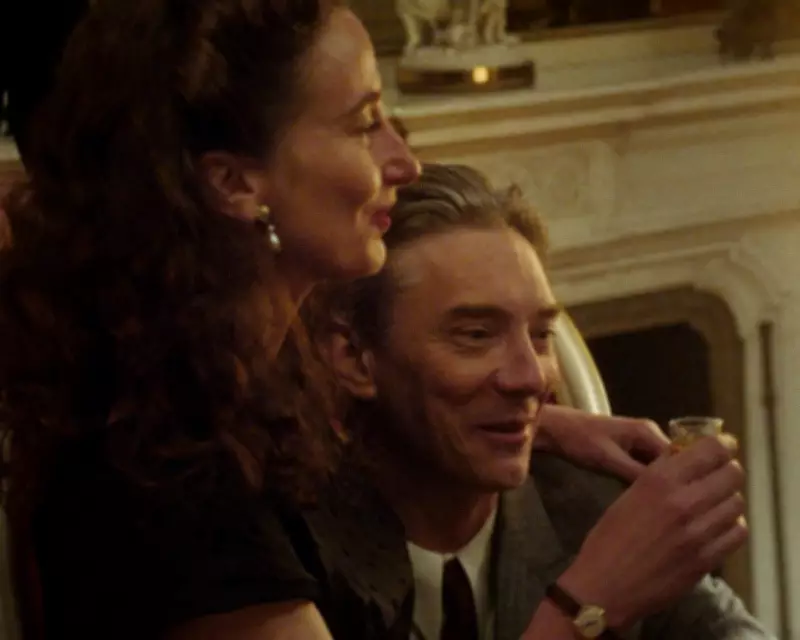
Notre Salut, the second film in the Cannes competition about the Nazi occupation of France, presents a complex and ambiguous study of national humiliation from writer-director Emmanuel Marre. It is more interesting than Laszlo Nemes's rather mainstream drama Moulin, offering an absorbingly intimate, novelistically detailed procedural about the day-to-day lives of Vichy administrators after the fall of France. The film is mostly shot conventionally but occasionally jolts into an anachronistic dreamlike scenario on video.
Centered on a Real Historical Figure
The film focuses on the director's own great-grandfather, Henri Marre, who held a minor but important post in the Vichy ministry of labour. Swann Arlaud delivers an excellent performance, portraying Marre as a sociopathic mixture of haughty idealist, salon intellectual, and conman predator. He is a man who doesn't really believe in anything but his own survival, with only the vaguest idea of what that survival could mean.
The Bureaucracy of Evil
The film follows Marre and his colleagues in almost real time as they busy themselves with seemingly innocuous administrative tasks. However, at frog-boiling speed, they gradually realize that their work involves organizing the transportation of Jews, originally called "ramassage" (roundup) but coyly renamed "rassemblement" (collective relocation). We witness a bureaucratic row about the excessive cost of providing Jews on cattle trucks with straw and chamber pots.

Delusion and Avoidance
The Vichy apparatchiks are delusional and avoidant, grimly seizing on the idea of salvaging some martyred patriotic survival from the catastrophe of the Nazi invasion. They aim to build a new France as reactionary and antisemitic as the Germans, partly to cauterize their mortification and partly to appease the Nazis into allowing the supposed "free zone" in the south under the leadership of World War I hero Marshal Petain.
Marre's Rise and Fall
Marre appears in Vichy France out of nowhere, all but penniless, a slippery but plausible entrepreneur who has squandered his wife's family fortune and trusting investors' money. He has left his wife and children behind, and the film quotes his wife's angry letters to him in voiceover. Now he sees France's catastrophe as a way to reinvent himself as a national visionary, brandishing copies of his self-published manifesto for national renewal, entitled Notre Salut (Our Salvation).
Marre wheedles his way into Vichy soirees, embarrassing his hosts with his indiscreet contempt for the Nazis and excessive Petain hero-worship. Like a petitioner in tsarist Russia, he hangs around ministerial offices hoping for a job, sycophantically endearing himself to a senior figure by rescuing the man's beloved cat from behind the demarcation zone—a farcically undignified and dangerous task.
Middle-Management Leadership
Once employed, Marre demonstrates instinctive flair for middle-management leadership and maudlin patriotic Petain-worship, supervising the hanging of a huge mural about France's new mission. He busies himself with tasks ostensibly to cut costs, but really to impose his own power and curate his career. He schools the public in shouting pro-Petain slogans and auditions secretaries, whimsically choosing the laziest and least competent, perhaps to avoid being shown up. His elegant wife Paulette (Sandrine Blancke) joins him with their children in a handsome new apartment that once belonged to a Jewish family.
Inevitable Descent
With terrible inevitability, Marre realizes that Vichy France's supposed independence is a sham, and his responsibility for forced labour is overruled by the Germans' chilling Organisation Todt. The Germans become more insistent on antisemitic roundups, and Marre's superiors become panicky and shrill in demanding obedience. As D-day dawns, Marre reverts to type, buying up abandoned businesses with government cash and keeping a larcenous commission for himself, a pathetic and lonely figure deserted by his family.

Marre's film gives a shrewd, painful account of what Marcel Ophtils's film called "the sorrow and the pity": the Vichy administrators' self-pity and doomy sorrow at their own misfortune. Arlaud gives an excellent performance as an intelligent, talented man who almost, but not quite, realizes the terrible swamp into which he has descended. Notre Salut screened at the Cannes film festival.