MS NOW Host Lawrence O'Donnell Condemns Defense Secretary's Use of 'Leave No Man Behind' as Sexist and Outdated
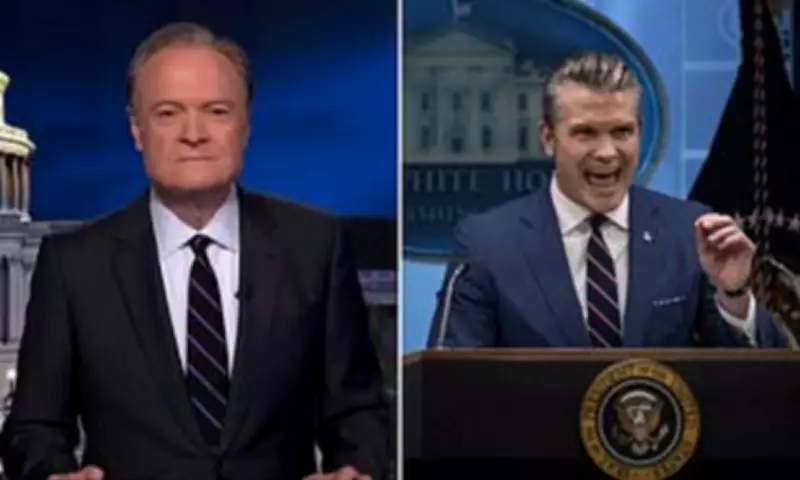
In a fiery segment on Monday's edition of "Last Word," MS NOW host Lawrence O'Donnell, 74, launched a scathing critique against Secretary of Defense Pete Hegseth, 45, for employing the traditional military saying "We leave no man behind." O'Donnell branded the phrase as not only outdated but fundamentally sexist in today's armed forces.
O'Donnell's Critique of Traditional Military Language
The controversy erupted after Hegseth invoked the expression during a White House press conference. He was discussing a recent operation that successfully rescued two Air Force pilots who had been stranded in Iran the previous weekend. O'Donnell responded sharply, stating, "That is, of course, the old school version of the idea back when only men flew American military planes."
To underscore his point, O'Donnell played a clip from the same press briefing featuring General Dan 'Raizin' Caine, 57, who used a more inclusive variation: "We leave no one behind." O'Donnell praised this phrasing as modern and appropriate, noting, "The general knows, unlike Pete Hegseth, that that could have been a woman they were trying to rescue - and it might be a woman the next time."

Historical Context and Broader Criticism
O'Donnell further argued that even General Caine's updated version overlooks historical realities. He pointed out that it "ignores the 120,000 prisoners of war held by German and Japanese forces in World War II for years who were left behind," suggesting that such phrases can obscure complex military histories.
This critique quickly drew mockery from conservative circles on social media, highlighting the partisan divide over language and tradition in military discourse. However, O'Donnell's comments were part of a broader pattern of criticism aimed at Hegseth and the current administration.
O'Donnell's Ongoing Feud with Hegseth and Trump
Elsewhere in the episode, O'Donnell did not hold back in his assessment of former President Donald Trump's recent actions. He labeled Trump's Easter threats to Iran as "evil" and declared, "He has gone insane." This followed a Truth Social post from Trump that used aggressive language toward Iran regarding the Strait of Hormuz.
O'Donnell added, "Our president is not a Christian. There has never been the slightest evidence that Donald Trump is in any real sense a Christian. There is nothing religious about him," further cementing his role as a vocal critic of the former president.
The host's disdain for Hegseth is not new. Last month, O'Donnell mocked the defense secretary for imposing heavy restrictions on the Pentagon press corps, questioning his bravery in facing reporters. In December, he described Hegseth as the "most incompetent and unqualified secretary of defense in history" and highlighted Hegseth's past pledge to stop drinking to secure Senate confirmation.
At that time, O'Donnell took issue with Hegseth using the phrase "fog of war" to defend a controversial airstrike in the Caribbean. O'Donnell's MS NOW colleague Mika Brzezinski has also criticized Hegseth, calling him "unqualified" and "a joke," and suggesting he overcompensates for personal shortcomings.
Recent Developments in U.S.-Iran Relations
Amid this backdrop, Trump announced a temporary ceasefire agreement with Iran on Tuesday. The deal requires Tehran to ensure safe passage for ships through the Strait of Hormuz within two weeks. This strategic waterway, located between Iran and Oman, is crucial for global oil transport, handling approximately one-fifth of the world's oil flow.
Trump had earlier celebrated the rescue of the second airman from Iran's mountains, posting "WE GOT HIM" on Truth Social. The first pilot was recovered on the day of the crash, underscoring the high-stakes nature of military operations in the region.
O'Donnell's critique reflects ongoing debates about language, inclusivity, and leadership in the U.S. military and political spheres, highlighting tensions between traditional values and modern perspectives.