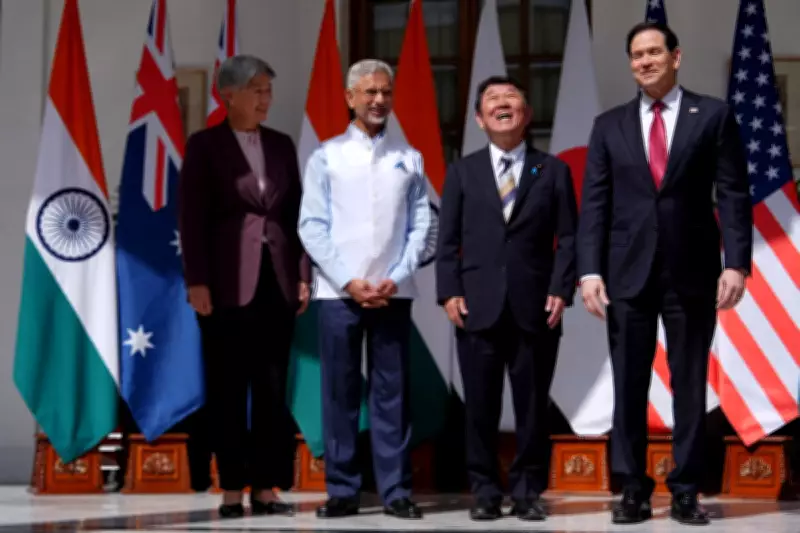
The Quad grouping of India, Australia, Japan, and the United States has unveiled a new energy security initiative as the global fuel crisis deepens following the closure of the Strait of Hormuz. The announcement came during a meeting of foreign ministers in Delhi, overshadowed by the ongoing Middle East conflict that began on 28 February and has severely disrupted maritime trade and energy markets.
Quad ministers address energy security
Australia's Penny Wong, India's S Jaishankar, Japan's Toshimitsu Motegi, and US Secretary of State Marco Rubio met on Tuesday, just hours after the US military launched fresh strikes on an Iranian naval base in the Strait. The ministers issued a statement calling for 'unimpeded freedom of navigation and uninterrupted flow of global commerce' through the vital waterway.
The Quad pledged to maximise efforts to support each other's energy security during crises and announced the formation of a Quad Fuel Security Forum. Mr Rubio confirmed that the US Department of Energy would host the forum 'later this year' to expand on the initiative.

Impact of the Strait of Hormuz closure
Ms Wong highlighted the 'acute economic stress' caused by Iran's effective closure of the Strait, which has choked off about a fifth of global oil and gas flows and driven prices up by 50 per cent. 'We recognise the efforts of Secretary Rubio towards a diplomatic resolution to ensure freedom of navigation is restored,' she said. The ministers also opposed any tolling proposition for the Strait.
The Quad agreed to launch an Indo-Pacific maritime surveillance initiative to integrate monitoring capabilities and share near-real-time data on ship movements, including commercial vessels. Mr Rubio described this as an expansion of the Indo-Pacific Maritime Domain Awareness Initiative.
Joint infrastructure project in Fiji
In a significant move, the Quad announced plans to partner with Fiji on port development, marking what could be the group's first joint infrastructure project. Mr Rubio called it an 'exciting' initiative, citing insufficient port capacity in Pacific island nations. The decision drew immediate criticism from China, with foreign ministry spokesperson Mao Ning stating that Beijing opposes 'bloc confrontation' and that regional cooperation should not target third countries.
Quad's evolving role
Mr Rubio emphasised Washington's desire for the Quad to evolve from a dialogue forum into one focused on concrete action, calling it a 'linchpin and cornerstone of our global strategy.' The Quad is widely seen as a counterweight to China's influence in the Indo-Pacific, though Beijing has previously criticised it as a Cold War-style construct. Policy experts noted that the grouping lost some momentum last year after failing to hold a leaders' summit amid tensions between Donald Trump and Indian Prime Minister Narendra Modi.
Premesha Saha, policy fellow at Asia Society Australia, said: 'The absence of a leaders' summit has raised some doubts, but that doesn't necessarily indicate declining importance. If the Quad can continue delivering at the ministerial and working levels, it can remain relevant.' Mr Jaishankar described Tuesday's meeting as 'substantive and productive,' with a focus on ensuring safe and unimpeded maritime commerce.
The meeting took place against the backdrop of fresh US strikes on Iranian targets near the Strait of Hormuz, which cast a shadow over talks between Washington and Tehran that had appeared close to a breakthrough. The International Energy Agency warned that oil markets could enter a 'red zone' this summer as stocks continue to deplete.