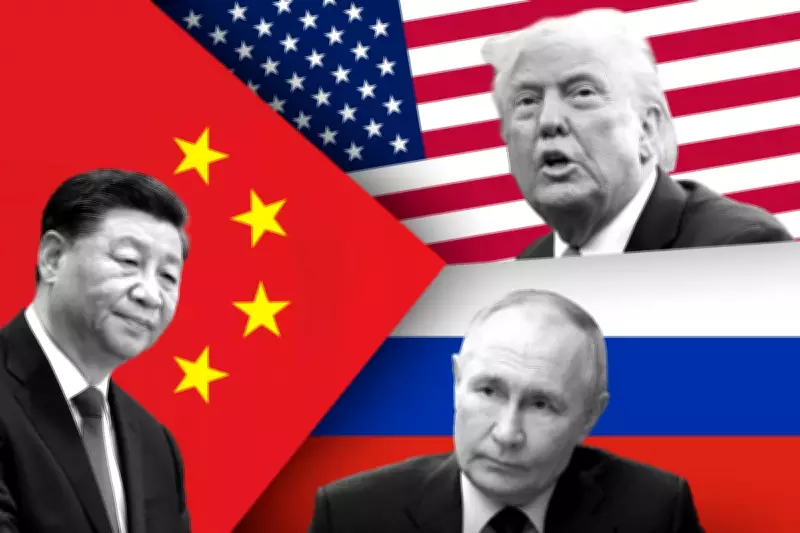
The arrival of Vladimir Putin in Beijing so soon after Donald Trump's visit marks a watershed in international relations. The leaders of the dominant superpowers of the second half of the twentieth century are visibly passing the baton of global pre-eminence to China. Both the Russian and American presidents visit Beijing nowadays as supplicants looking for support and endorsement from the resident in the Forbidden City.
Beijing as the New Imperial Capital
Beijing seems to be returning to the traditional role of a Chinese imperial capital. It is the sun around which all other planets revolve. China would like the wars in Ukraine and Iran to end. It would like to reopen the overland rail links to Europe via Russia and Ukraine just in case relations with the USA, post-Trump, sour. Xi could mediate a settlement between the Kremlin and Kyiv where Trump failed so miserably. That is why every signal to come from Beijing is pored over. This morning the Financial Times reported on Xi's indiscretion to Trump that Vladimir Putin might "come to regret" his invasion of Ukraine that has truly moved the needle – China has now denied this.
Russia's Predicament and America's Impasse
What is certain is that Russia is bogged down in war in Ukraine with growing Ukrainian drone strikes even east of Moscow embarrassing Putin. The USA appears at an impasse in Iran. Donald Trump's announcement on the eve of Putin's arrival in China that he was stalling re-starting the bombing of Iran at the "request" of Gulf Arab leaders was probably a fig-leaf to avoid forcing Xi and Putin to coordinate their response in real time. Maybe Trump hopes that Iran's two major supporters would influence Tehran to make concessions to avoid renewed conflict.

Xi as Chairman of the Global Board
More importantly, President Xi is shepherding the two other nuclear behemoths into global cooperation with him as the chairman not only of the People's Republic of China but of a much more formidable version of Donald Trump's 'Board of Peace' for the Middle East. China wants to avoid the so-called "Thucydides Trap". Xi Jinping has referred to the infamous Ancient Greek model of a great war between a rising power and the established one. The war between Athens and Sparta is seen as an analogy to the Anglo-German rivalries which led to two world wars last century.
American Designs and Spheres of Influence
America has its own designs. Some Trump observers have even speculated that the US president has been "soft" on Russia's invasion of Ukraine because he hoped to draw Vladimir Putin away from Xi's embrace. In effect, Trump was playing a reverse of the Nixon-Kissinger embrace of Mao's China after 1971 to exploit the tensions between Moscow and Beijing. Much more likely is American acceptance of spheres of influence. Russia abandons its allies in the Americas like Venezuela and Cuba in return for Washington's indifference in Eastern Europe. China, too, gets its economic interests respected.
Who Loses When the 'Big Three' Coordinate?
Smaller neighbours certainly face a grim future but the big loser looks set to be Europe. Europe occupies a much lower position in Beijing's hierarchy of importance. Think how China's big bet on electric vehicles has dramatically reduced the German automobile industry's share of world car production. Russia and the USA produce raw materials which China cannot do without. Both supply foodstuffs and Russia sells energy and metals to fuel Chinese industry. Europe competes with Chinese industry but its legacy producers face much higher energy costs because of sanctions on Russia and now Trump's attack on Iran as well as their governments' commitment to Green energy.
Europe's Fading Influence
Europe is fading as a source of Chinese imports and its attempts to assert its economic and intellectual property sovereignty simultaneously vis-à-vis China, Russia and the USA seem doomed. At best, the Europeans can shelter behind a regulatory Great Firewall for a few more decades – but China's own history shows how vulnerable such defences are in an age of rapid technological change. Once "values" united the West versus the rest. But increasingly shrill condemnations of Donald Trump's trampling on them reveal that Europe is as indignant as it is impotent.

The International Criminal Court and Global Justice
For instance, China, Russia and the USA have in common that none of them is a member of the International Criminal Court, though its prosecutors are investigating Vladimir Putin for the consequences of his invasion of Ukraine as well as Trump's closest ally, Israel's Benjamin Netanyahu, for the human cost of the Gaza war. Trump is reported to have suggested that China and Russia join the USA against the International Criminal Court which represents one of Europe's key values – accountability of political leaders. But without support from the key great powers, the ICC is rendered impotent, or at best a place for political small fry to face justice which discredits the idea of global justice.
Xi Jinping's successive summits in Beijing show China is now the linchpin of an emerging global dystopia. Europeans pin their hopes on change in Moscow or Washington rather than their own capacity to influence the way the world is run.