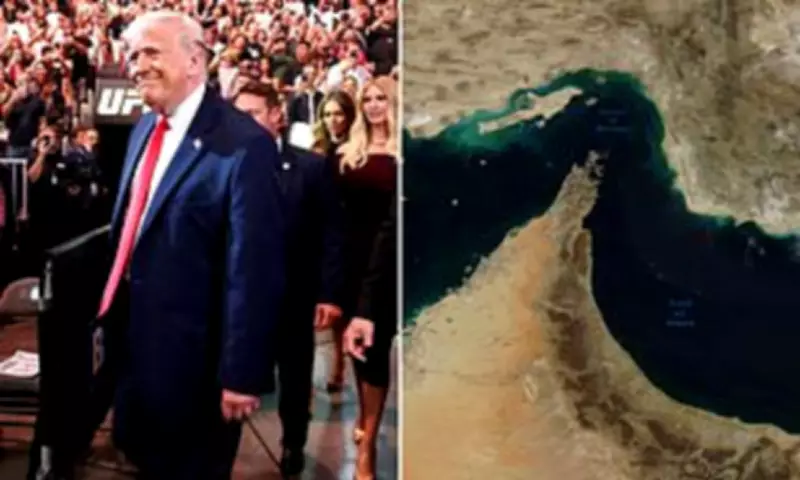
Trump Declares Naval Blockade of Critical Strait of Hormuz
Former US President Donald Trump has thrown global markets into disarray by announcing an immediate American blockade of the Strait of Hormuz. The controversial declaration threatens to severely disrupt the flow of approximately twenty percent of the world's oil and gas supplies through this vital maritime chokepoint.
'Clean Out' Operation and Imminent Enforcement
In a characteristically combative statement, Mr. Trump proclaimed his intention to 'clean out' the strategic waterway. While he provided scant operational details regarding the timing or methodology of the blockade, the US Central Command (Centcom) swiftly confirmed that enforcement would commence at 3pm UK time today.
Centcom issued a formal notice clarifying the scope of the action: 'The blockade will be enforced impartially against vessels of all nations entering or departing Iranian ports and coastal areas, including all Iranian ports on the Arabian Gulf and Gulf of Oman.' The command stressed it would not impede vessels merely transiting the strait to or from non-Iranian ports, aiming to preserve some degree of freedom of navigation.

International Reactions and British Stance
The announcement prompted urgent diplomatic consultations. UK Prime Minister Keir Starmer, in a call with French President Emmanuel Macron, emphasised 'the need to work with a wide coalition of partners to protect freedom of navigation'. Sources indicate Britain will not participate in any blockade operations, distancing itself from the unilateral American move.
Mr. Trump escalated his rhetoric on social media, warning: 'Any Iranian who fires at us, or at peaceful vessels, will be BLOWN TO HELL!' He accused Iran of 'world extortion' and vowed to 'finish up the little that is left of Iran'. In a televised interview, he framed the blockade as an economic weapon: 'We're not going to let Iran make money by selling oil to people that they like, and not people that they don't like.'
Market Chaos and Broader Military Considerations
The geopolitical shockwave triggered immediate financial consequences. Oil and gas prices have soared, while global stock markets experienced significant declines. The aviation industry warned of impending higher ticket prices due to doubled jet fuel costs, and supermarkets anticipated price hikes from increased import and packaging expenses.
Reports suggest Mr. Trump is contemplating resuming limited military strikes against Iran alongside the naval blockade, seeking leverage in stalled peace talks. This comes despite claims from Tehran's foreign minister that a deal with the US was 'inches away' from agreement.
Operational Details and Failed Diplomacy
Mr. Trump outlined that minesweepers, including some from the UK, would be deployed to clear Iranian explosives from the strait. 'We have highly sophisticated underwater minesweepers, which are the latest and the greatest, but we're also bringing in more traditional minesweepers,' he stated, acknowledging anticipated allied support.
This aggressive posture follows the collapse of peace talks led by US Vice President JD Vance in Islamabad over the weekend. Mr. Trump cited Iran's refusal to abandon its nuclear ambitions as the core impasse. 'They want to have nuclear weapons. They're not going to have nuclear weapons... I would never allow that to happen,' he asserted, framing the blockade as pressure tactic to force compliance.
Regional Dynamics and Critical Responses
The situation remains fluid, with Iran having failed to fully reopen the strait since a recent interim ceasefire. Intelligence suggests a handful of tankers, primarily Chinese, have navigated the passage by paying cryptocurrency tolls to Iranian authorities—a practice Mr. Trump vowed the US navy would 'seek and interdict'.

The former President expressed disappointment that NATO allies and major oil-importing nations like Japan and South Korea had not offered assistance. His approach drew sharp criticism from security experts and politicians alike. Former British military intelligence officer Philip Ingram argued Mr. Trump had 'misread the Iranians quite badly', noting they do not respond well to threats. UK Health Secretary Wes Streeting condemned the 'incendiary, provocative, outrageous' language used by the American leader, highlighting the deep international concern over this dramatic escalation.