Trump's NATO Troop Withdrawal Plan Emerges Amid Iran War Fallout
Former President Donald Trump is actively considering a significant military repositioning strategy that would punish NATO member nations he believes failed to adequately support the United States and Israel during the recent conflict with Iran. The controversial proposal involves withdrawing American troops from bases in countries deemed uncooperative and transferring them to nations demonstrating stronger alignment with Washington's foreign policy objectives.
Escalating Trans-Atlantic Tensions
This dramatic plan has gained traction among senior administration officials in recent weeks, highlighting the deepening rift between Trump and European allies. The former president has repeatedly threatened to withdraw America from the 32-member alliance after several NATO countries rejected his calls to help reopen the strategically vital Strait of Hormuz, through which approximately twenty percent of global oil and gas flows.
Trump's frustration centers on what he perceives as insufficient support during Operation Epic Fury, creating what analysts describe as potentially the greatest challenge NATO has faced in its history. The alliance's perceived failure to assist Washington during the Iranian conflict has fundamentally damaged the relationship, with Trump declaring on Truth Social: "NATO WASN'T THERE WHEN WE NEEDED THEM, AND THEY WON'T BE THERE IF WE NEED THEM AGAIN."

Potential Base Closures and Troop Movements
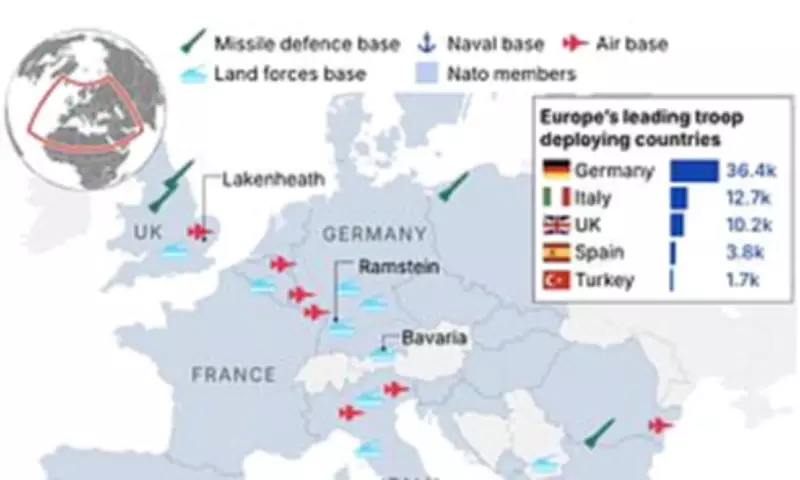
According to administration officials who briefed the Wall Street Journal, the punitive measures could extend beyond troop transfers to include the complete closure of at least one US base in Europe, with Spain and Germany identified as potential candidates. Washington currently maintains approximately 84,000 soldiers stationed across Europe, with these bases serving as critical hubs for global military operations while providing substantial economic benefits to host nations through investment and local spending.
The strategic implications are profound, particularly regarding bases in Eastern Europe that serve as deterrents against Russian aggression. The proposed troop movements could result in deploying more American soldiers closer to Russia's border, a development likely to antagonize President Vladimir Putin and potentially escalate regional tensions.
Targeted Nations and Potential Beneficiaries
While specific countries facing troop reductions remain undetermined, several NATO members have publicly criticized Trump's military campaign against Iran and may consequently be targeted. Spain, the only NATO country that hasn't pledged to spend five percent of its GDP on defense, prevented US aircraft involved in the conflict from using its airspace. Germany has also drawn American officials' ire after top politicians openly criticized war strategy, despite hosting one of the largest and most significant US military hubs supporting Middle Eastern operations.
Italy briefly blocked American use of the Sigonella air base in Sicily, while France permitted US access to a southern base only after receiving assurances that planes involved in Iranian strikes wouldn't land there. Conversely, nations potentially benefiting from increased troop deployments include Poland, Romania, Lithuania, and Greece, all deemed more supportive by the Trump administration. These Eastern European countries maintain some of NATO's highest defense spending rates and were among the first to announce participation in an international coalition to secure the Strait of Hormuz.
Diplomatic Fallout and NATO Response
The relationship between the White House and NATO had already deteriorated before the Iran conflict, largely due to disagreements over Trump's persistent interest in acquiring Greenland, a semi-autonomous territory of Denmark. Following a private meeting with NATO Secretary General Mark Rutte at the White House, Trump escalated his criticism through social media while making veiled threats about Greenland.

Rutte described their conversation as "very frank" and "very open" despite clear disagreements, adopting a conciliatory tone that contrasted sharply with Trump's confrontational approach. The NATO leader praised Trump for achieving a ceasefire agreement in Iran while acknowledging the president's disappointment with allies' refusal to provide military support. Rutte told CNN that degrading Iran's nuclear capabilities remains "really important for yours and my safety here in the US, in Europe and in the Middle East," but declined to comment on whether Trump expressed any desire to leave NATO entirely.
Historical Precedent and Future Implications
This isn't the first time Trump has threatened NATO troop reductions. During his first term in 2020, he ordered the withdrawal of approximately 12,000 troops from Germany, a decision reversed by President Joe Biden after taking office in 2021. White House press secretary Karoline Leavitt emphasized the administration's perspective, stating: "It's quite sad that NATO turned their backs on the American people over the last six weeks when it's the American people who have been funding their defense."
The State Department, when questioned about the proposals, referenced recent statements by Secretary of State Marco Rubio criticizing NATO nations for insufficient support during the Tehran conflict. As the situation develops, the potential restructuring of American military presence in Europe represents a fundamental challenge to trans-Atlantic security arrangements that have defined Western defense policy for decades.