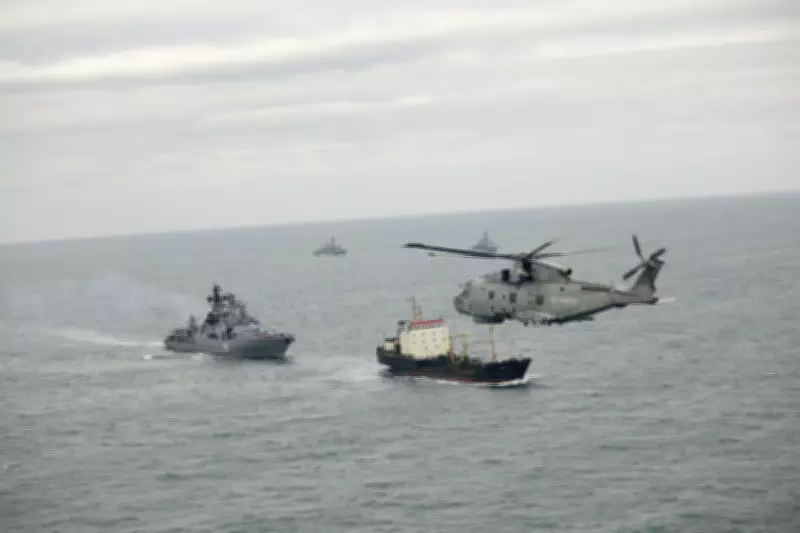
UK and NATO Allies Execute Covert Arctic Operation Against Russian Spy Submarines
While former President Donald Trump intensified military actions against Iran, the United Kingdom spearheaded a clandestine joint operation with Norway to monitor Russian spy submarines in the Arctic region. This strategic move underscores Prime Minister Keir Starmer's commitment to addressing what he perceives as the genuine threat to the NATO alliance, diverging from Washington's current foreign policy priorities.
Defence Secretary Reveals High North Surveillance Mission
Defence Secretary John Healey disclosed that British frigates and surveillance aircraft tracked two Russian spy submarines and an attack submarine as they surveyed critical undersea cables and pipelines in the High North. This area encompasses the Arctic Circle and North Atlantic, representing a vital strategic zone for Western security interests.
Healey emphasized that Russia capitalized on the international focus shifting to the Middle East following Trump and Israel's controversial attacks on Iran to advance its hybrid warfare tactics against NATO. The operation, codenamed Firecrest, will see HMS Prince of Wales lead a carrier strike group into the region later this year, reinforcing Britain's defensive posture.

Growing Rift Between European Allies and Trump Administration
The revelation of this Arctic operation coincides with Starmer's diplomatic visit to Arabian Gulf nations, further illustrating the widening gap between European powers and the current American leadership. Trump has repeatedly threatened to withdraw the United States from NATO entirely, frustrated by member states' refusal to participate in Iranian hostilities or permit U.S. military operations from their territories.
"In the last few weeks, while the eyes of many were trained on the Middle East, the UK, in partnership with Norway and other allies, has responded to increased Russian activity in the Atlantic north of the UK," Healey stated during a London press conference. "Our armed forces left them in no doubt that they were being monitored, that their movements were not covert, as President Putin planned, and that their attempted secret operation had been exposed."
UK Rejects Trump's Strait of Hormuz Proposal
In another clear indication of policy divergence, British officials dismissed Trump's suggestion to transform the Strait of Hormuz into a joint tollbooth with Iran as financially motivated and dangerous. Healey insisted that Britain would advocate for upholding international law and maintaining freedom of navigation, warning that such toll systems could establish dangerous precedents exploitable by other nations.
"It isn't actually doable... a compromise of that freedom of navigation of the seas, and the introduction of any sort of paper passage or tolls, would create a potential principle that could be used and abused by others elsewhere," the Defence Secretary asserted, highlighting fundamental differences in maritime security approaches between London and Washington.
Russia's Continued Threat and American Political Shifts
Healey identified Russia as the primary security threat to both the United Kingdom and NATO, noting that Moscow continues to supply intelligence, training, and drone technology to Iran for attacks against Gulf states, American interests, and other alliance members in the Middle East. Meanwhile, the Trump administration has adopted explicitly anti-European Union and anti-Ukrainian positions over the past year, supporting Russian territorial claims in eastern Ukraine while reducing military aid to Kyiv.
Vice President JD Vance's recent visit to Hungary further complicated diplomatic relations, as he openly endorsed Prime Minister Viktor Orban's reelection campaign despite Orban's pro-Russia stance. Vance has promoted controversial conspiracy theories about European demographic changes and criticized EU energy policies following Russia's 2022 invasion of Ukraine.

UK Asserts European Leadership Within NATO Framework
Without directly naming Trump or Vance, Healey made clear that British strategy prioritizes different threats and alliances than those emphasized by current American leadership. "We recognise Russia as the primary threat to the UK and to NATO, and we will not take our eyes off Putin. At the same time, we act to protect our British interests and our British allies in the Middle East," he declared.
The Defence Secretary emphasized Britain's intention to "step up ... on European leadership within NATO" through operations like the recent Arctic mission, which addresses what UK officials consider the most significant security challenges facing the alliance. This approach represents a strategic recalibration as European powers increasingly coordinate independent of American direction on critical security matters.
Ultimately, the United Kingdom and its NATO partners are intensifying their collaborative defense efforts not only to protect themselves but potentially to preserve the alliance structure from what they perceive as misguided American foreign policy directions under the current administration.