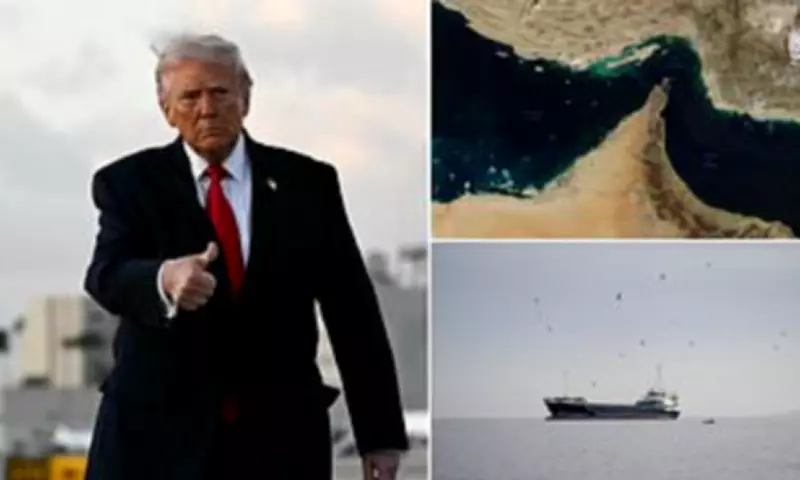
UK Government Confirms Non-Participation in Trump's Strait of Hormuz Blockade
The United Kingdom has confirmed it will not be involved in former US President Donald Trump's proposed military blockade of the Strait of Hormuz, according to official sources. This decision comes despite Trump's public assertions that Britain and other nations were preparing to send minesweepers to assist American forces in the strategically critical waterway.
Trump's Announcement and UK Response
Donald Trump announced on his Truth Social platform that the United States military would begin 'blockading any and all ships trying to enter, or leave, the Strait of Hormuz.' He further declared that US naval forces would 'seek and interdict every vessel in International Waters that has paid a toll to Iran.' The Strait of Hormuz represents one of the world's most vital arteries for global oil and gas shipments, making any disruption potentially catastrophic for energy markets and the international economy.
In a subsequent Fox News interview, Trump specifically mentioned: 'I understand the UK and a couple of other countries are sending minesweepers.' However, British government sources have firmly contradicted this claim. A government spokesperson stated: 'We continue to support freedom of navigation and the opening of the Strait of Hormuz, which is urgently needed to support the global economy and the cost of living back home.'

Diplomatic Efforts and International Coalition
The UK government emphasized its diplomatic approach, declaring: 'The Strait of Hormuz must not be subject to tolling. We are urgently working with France and other partners to put together a wide coalition to protect freedom of navigation.' This statement underscores Britain's preference for multilateral cooperation rather than unilateral military action.
Prime Minister Sir Keir Starmer has previously advocated for involving 'as many partners as possible' to develop a 'viable plan' to ensure the strait remains open. The UK has taken a leadership role in hosting international talks on this issue, with a third such meeting scheduled for this week. These discussions follow a virtual gathering of over forty nations chaired by the Foreign Secretary and a separate meeting of allied military officers.
Regional Context and Political Tensions
The situation follows the collapse of twenty-one-hour negotiations between the United States and Iran in Islamabad over the weekend, which has cast uncertainty over a fragile two-week ceasefire. In a readout of the Prime Minister's call with the Sultan of Oman, His Majesty Sultan Haitham bin Tarik al Said, a Downing Street spokeswoman noted that both leaders 'discussed the peace talks held in Pakistan over the weekend and urged both sides to find a way through.' They agreed it was 'vital there was a continuation of the ceasefire, and that all parties avoided any further escalation.'
Meanwhile, Donald Trump has continued to criticize NATO and the UK for their refusal to support offensive operations against Iran, labeling the defensive alliance as 'shameful.' The Republican leader again drew comparisons between Sir Keir Starmer and former Prime Minister Neville Chamberlain, whose policy of appeasement toward Nazi Germany in the 1930s remains historically contentious. Trump remarked: 'He made a public statement that "we will send equipment after the war is over" - that's a Neville Chamberlain statement.'
Regarding the failed Pakistan talks involving US Vice-President JD Vance, Trump commented that while 'most points were agreed to, the only point that really mattered, nuclear, was not.' This highlights the ongoing diplomatic challenges surrounding Iran's nuclear program and regional security.
The UK's position reflects a careful balancing act between supporting international maritime security and avoiding escalation in a volatile region. With British mine hunting systems already deployed in the area, the focus remains on diplomatic coordination and coalition-building rather than direct participation in any blockade operations.