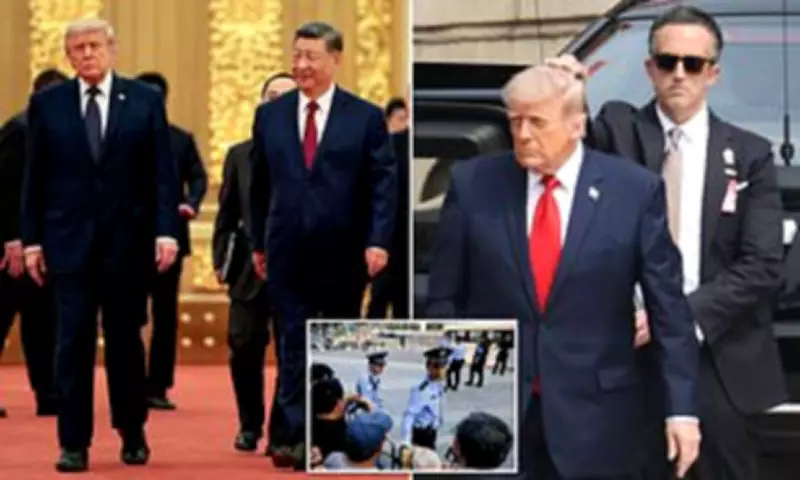
During President Donald Trump's state visit to Beijing, tensions flared between US and Chinese delegations over security and protocol issues, highlighting language barriers and cultural differences as both nations sought to improve bilateral ties.
On Thursday, following a welcome ceremony at the Great Hall of the People and a closed-door bilateral meeting, US and Chinese officials clashed several times. The most notable incident occurred at the Temple of Heaven complex, where US media were delayed for about half an hour due to a dispute over whether a Secret Service agent accompanying the press could carry a firearm inside.
Video footage from Reuters captured US officials expressing frustration. One official asked, "What is it going to take to get us out of here?" Another added, "If you were arriving with Xi, and we told you, you couldn't leave with him, that's the issue." Chinese officials were heard discussing the request among themselves, while a member of the press exclaimed, "We're in the motorcade with the President, do you not understand that?"

The US delegation stressed that they needed to remain with Trump as he traveled. Several officials explained to their Chinese counterparts that they were part of the presidential motorcade and had to depart with him. Voices were raised as US officials and press repeatedly insisted they "need to go." Eventually, a compromise was reached, allowing the delegation to rejoin the motorcade.
This was the second tense interaction of the day. Earlier, before the bilateral meeting, a US official told Chinese media to allow the White House press corps into the event for a spray before closed-door sessions. That exchange also involved yelling and discontent.
Similar incidents have occurred during previous Trump visits. In 2018, a skirmish erupted over the "nuclear football," a briefcase containing US nuclear launch codes, when a Chinese official denied entry to the military aide carrying it. Protocol requires the aide to stay close to the President at all times, and then-Chief of Staff John Kelly instructed the aide to proceed quickly, resolving the issue.
The US Secret Service mounted an extensive security operation for Trump's state visit, given multiple assassination attempts on his life. The agency has been haunted by close calls since his campaign, including a recent incident where a gunman shot an agent targeting the president at the White House Correspondents' Association Dinner.
Security was further complicated by the ongoing war with Iran, which has close ties to China. Agents flew in a $1.5 million, 20,000-pound armored Cadillac with eight-inch thick armor, tear gas cannons, night vision, a sealed oxygen supply, and Trump's blood type on ice—just for airport transport.
Approximately 900 people from the US delegation accompanied the President, including White House aides, Cabinet members, Secret Service, State Department officials, military personnel, and journalists, according to the US-China Business Council.