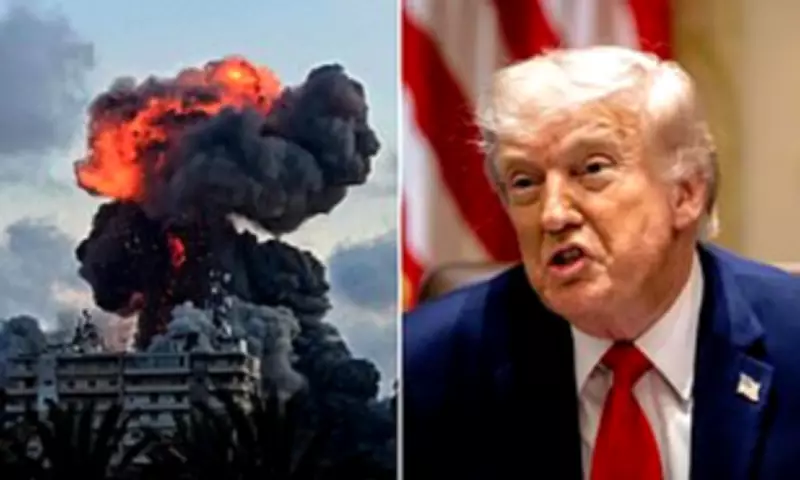
JD Vance has stated that it is 'hard to say when or if' Donald Trump will approve a proposed Iran ceasefire deal, despite U.S. and Iranian negotiators reaching a tentative agreement on terms. A U.S. official familiar with the matter confirmed that negotiators agreed on Thursday to extend the ceasefire in the three-month-old conflict by 60 days and initiate a new round of talks concerning Iran's nuclear programme. Iran has not yet officially confirmed any agreement.
Speaking to reporters on Thursday evening, Vice President Vance emphasized the uncertainty surrounding President Trump's final approval of the deal. 'It's hard to say exactly when or if the president's going to sign,' Vance remarked. He added, 'We're going back and forth on a couple of language points.'
The emerging memorandum of understanding comes at a time when the fragile ceasefire in the U.S.-Iran conflict appeared to be wavering. The latest escalation occurred less than a day earlier, when Kuwait intercepted missiles fired from Iran, according to U.S. Central Command.

The memorandum stipulates that Iran will not be allowed to impose tolls on the Strait of Hormuz and must remove all mines from the vital waterway within 30 days, according to the official, who spoke on condition of anonymity as they were not authorized to comment publicly. During the war, Iran effectively closed the strait, which had been a conduit for approximately one-fifth of the world's traded oil and natural gas. Its closure has caused oil prices to skyrocket globally.
U.S. Treasury Secretary Scott Bessent predicted on Thursday at a news briefing that oil costs could 'come down very quickly' once a deal is finalized. Iran has claimed it is allowing some commercial vessels to pass—about two dozen daily in recent days, compared to over 100 per day before the war—but has also charged tolls for at least some ships. Iran established a formal gatekeeper agency earlier this month, prompting a new round of U.S. sanctions this week.
Under the tentative agreement, the U.S. would gradually lift its naval blockade on Iranian ports and relax sanctions, enabling Iran to sell more of its oil. However, even as word of the potential deal emerged, the U.S. Treasury Department imposed additional sanctions on the Iranian military's oil sales arm. These new penalties, first reported by The Associated Press, extend the Trump administration's economic pressure campaign on the Islamic Republic.
Details of the tentative pact were first reported by Axios. Among the first issues to be negotiated during the 60-day ceasefire is the fate of Iran's highly enriched uranium, according to the first official. The Islamic Republic possesses 440.9 kilograms (972 pounds) of uranium enriched up to 60% purity, a short technical step from weapons-grade levels of 90%, according to the International Atomic Energy Agency.
Vance suggested on Thursday evening that negotiators were attempting to settle general terms on the highly enriched uranium in the tentative agreement, with specifics to be worked out in subsequent talks. 'We're going back and forth on a couple of issues on the nuclear stuff, the highly enriched stockpile, and also the question of enrichment,' Vance said.
Iran has not publicly committed to giving up the stockpile, which is believed to be buried under three nuclear sites that were severely damaged by U.S. airstrikes last year. Nuclear analysts have suggested that Iran might consider China or Russia, both of which have close relations with Tehran, as potential acceptable third parties to take possession of the enriched uranium. However, Trump stated on Wednesday that he 'wouldn't be comfortable' with such a plan.
Although Trump and his team have emphasized from the start of the conflict that one of their primary objectives is to ensure Iran never possesses a nuclear weapon, Vance framed the war's accomplishments as less definitive. 'We're in a position where we could substantially set back their nuclear program, not just during the term of this president but over the long term,' Vance said. 'That's a very, very good thing for the American people.'

Iran, which has long maintained its nuclear program is peaceful, has insisted that any deal must include an end to Israel's military operations in Lebanon against the Iranian-backed militant group Hezbollah. Tensions in Lebanon escalated on Thursday as Israel conducted an airstrike on a southern suburb of Beirut and other strikes in the southern coastal city of Tyre, killing at least 14 people across the country's south.
Kuwait announced that its air-defense systems intercepted incoming missiles and drones on Thursday, without specifying what had been targeted. Iran stated it had retaliated for strikes earlier in the week by firing on a U.S. base in a Gulf state it did not name. The Kuwaiti Foreign Ministry condemned Iran for what it called 'blatant aggression,' and U.S. Central Command described the attack on one of America's top allies in the Persian Gulf as an 'egregious ceasefire violation.'
Kuwait had repeatedly come under fire from Iran and Iranian-backed Shiite militias in Iraq before the April ceasefire began. The exchange occurred after U.S. officials said late Wednesday that American forces launched more strikes on Iran, shooting down four one-way attack drones that posed a threat around the strait and hitting an Iranian ground-control station in Bandar Abbas that was about to launch a fifth drone.
Iran's paramilitary Revolutionary Guard acknowledged the attack near Bandar Abbas International Airport and stated via the state-run IRNA news agency that it launched a retaliatory attack on the air base that conducted the assaults. The Revolutionary Guard did not specify whether the response targeted Kuwait, which houses U.S. Army Central's forward headquarters, air bases, and a naval base.
On Monday, the U.S. conducted what the Pentagon called 'self-defense' strikes on missile launch sites and minelaying boats in southern Iran. Despite trading strikes and accusations of ceasefire violations, Washington and Tehran have not returned to full-scale hostilities and continue negotiations. Vance commented, 'Ceasefires are always a little messy,' but the current one is 'very much holding.'
Later on Thursday, Iran's defenses destroyed 'a hostile aircraft' near the southern city of Jam, according to the area's governor, Masood Tangestani, speaking to state broadcaster IRIB. No further information was immediately available.