This week in history, spanning 11 to 17 May, features espionage, political upheaval, and historic firsts as recorded on The Independent's front pages. The shadows of the Cold War loom large with the death of infamous 'Cambridge Five' spy Kim Philby in Moscow, while a decade later, the digital age brought new security threats with the mass unmasking of MI6 agents online. On the world stage, unprecedented protests challenged the Chinese Communist Party, and in the UK, Gordon Brown's dramatic resignation marked the end of the New Labour era. From the devastating toll of the AIDS epidemic in Africa to a supercomputer outsmarting a human chess grandmaster, these events are charted across the archives.
12 May 1988 – 'Cambridge Five' Spy Kim Philby Dies in Moscow
Kim Philby, a high-ranking British intelligence officer who secretly worked for the Soviet Union, died in Moscow at the age of 76. His passing came 25 years after his defection, marking the end of his role in the 'Cambridge Five' spy ring that passed extensive classified information to the Kremlin during the early Cold War.
11 May 1988 – Gorbachev Pushes Perestroika
Soviet leader Mikhail Gorbachev publicly acknowledged that his ambitious perestroika reform programme was causing widespread confusion and resistance within the highest ranks of the Communist Party. Speaking ahead of a crucial June conference, he directly addressed the mounting pushback from conservative factions opposed to his drive to modernise the Soviet system.

17 May 1989 – Mass Protests Challenge Chinese Leadership
As China formally reconciled with the Soviet Union during Mikhail Gorbachev's landmark visit, the Communist Party faced an unprecedented challenge to its authority from massive protests in Tiananmen Square. Crowds approaching half a million gathered in solidarity with a resolute group of students on hunger strike, and Party leader Zhao Ziyang issued a public appeal, promising the demonstrators they would not be punished.
12 May 1997 – Deep Blue Defeats Chess Champion Garry Kasparov
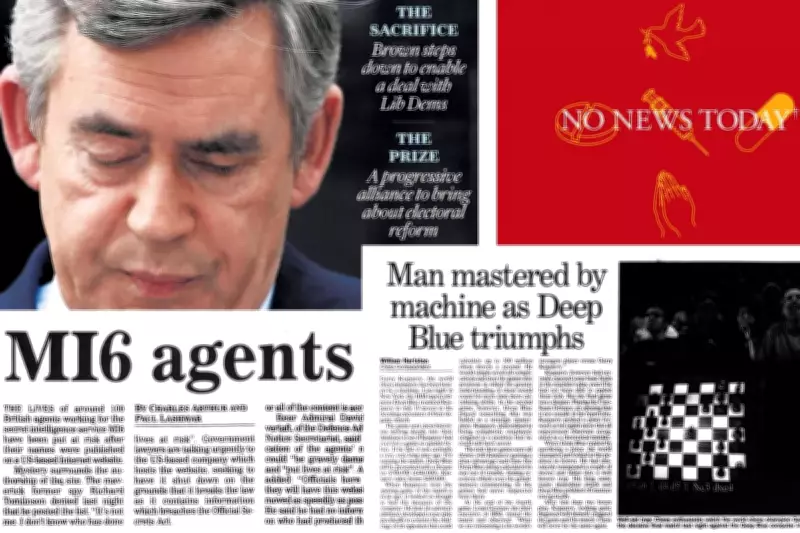
IBM's Deep Blue supercomputer defeated world chess champion Garry Kasparov in New York, winning the deciding encounter of their six-game match. The machine secured its historic overall victory in just 19 moves, a remarkably swift defeat that left experts questioning if the renowned grandmaster had ever lost a game so rapidly.
13 May 1999 – Dozens of MI6 Spies Unmasked on the Internet
As if lifted from the pages of an Ian Fleming novel, 100 covert MI6 agents were exposed, putting lives at risk after their identities were mysteriously published on a US-based website. The Foreign Office urgently requested the British media not to disclose the site's details, and the leak was later traced to Richard Tomlinson, a disgruntled former spy dismissed in 1995 for being a 'loose cannon.'
16 May 2006 – Special Feature on AIDS in Africa
The Independent dedicated a special cover to the devastating impact of the HIV/AIDS pandemic across Africa, highlighting that the disease was claiming 6,500 lives every day. Emphasising that this staggering death toll equated to an entire village being wiped out every 24 hours, the publication issued a stark plea for the global response to urgently match the deadly pace of the crisis.
12 May 2007 – Search Continues for Madeleine McCann
As the search for missing British toddler Madeleine McCann continued in Portugal, a solemn vigil was held on what should have been her fourth birthday. Despite a flurry of reported leads in the local press, investigators remained completely baffled by the disappearance, marking the early stages of an unprecedented, decades-long mystery.
11 May 2010 – Gordon Brown Resigns
Following a dramatic hung parliament in the general election, Gordon Brown announced his resignation as Labour leader in a final attempt to forge a 'progressive alliance' with the Liberal Democrats. However, this proposed pact ultimately collapsed, paving the way for David Cameron to form a Conservative-led coalition and ending 13 years of Labour government.