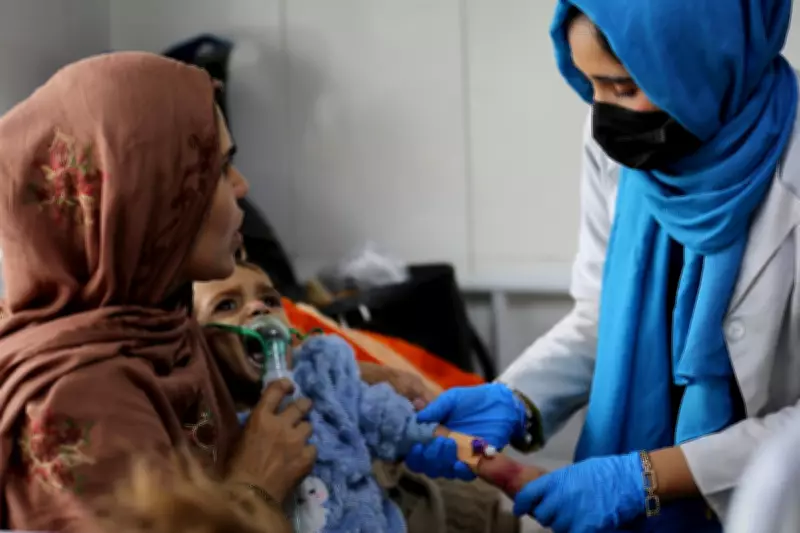
For my child, it means certain death – maybe later today, maybe tomorrow, the young mother, Zarmeena, says, looking down at her baby, who – from the other side of the call – appears to be struggling for breath, his mouth wide open and his eyes sunken. The desperate look of agony on the mother’s face is something I struggle to put into words. But I know what she must be feeling – the way my own mother must have felt watching her baby starve to death. That much I can say, because I saw her lying on my baby brother’s small grave the following day, weeping.
I asked a friend in Afghanistan to visit a clinic – little more than a tent – where mothers and babies had been waiting desperately for whatever malnutrition treatment they could get. I ended that call haunted.
The image of my own little brother, Mohammad, who starved to death in the late 1990s, as we struggled under a Taliban blockade in the central highlands of Afghanistan’s Hazarajat region, has never left me.

Mohammad was a typical baby. Undernourished, given the circumstances, but still full of life, with thick black hair and light brown skin. He never made it from sitting on his own to crawling. He went quiet; his skin began to pale; his thick black hair thinned and lost its colour. His stomach bloated, and his skin tightened against his skeleton. His head seemed to grow as the rest of his body shrank. I was the last person to see him alive. All the energy Mohammad had left in him before his death amounted to a groan as I tried to force a spoon into his mouth. Distressed, he would bite down hard on it.
Then there was another young mother, Laila – just like the one on the call – whose screams and howling, as she struggled for her own life and that of the baby she was too weak to deliver, brought everyone in my village onto their rooftops. Women stood terrified, weeping, as the men carried her on a charpoy on their shoulders towards a clinic that would have been a day’s walk in normal conditions. Others tried to clear the snow ahead of them. Eventually, they stopped and turned back. Laila and her baby had died.
Nearly five million women and children in need of urgent malnutrition treatment, according to the UN’s World Food Programme. Zarmeena, anticipating the death of her baby, did not shock me. What shocks me is that, three decades on, the horror I witnessed is still being experienced by millions of women and children in Afghanistan. The country remains one of the most severe hunger crises on earth – and, given the political circumstances, one of the least supported.
The UN’s World Food Programme has warned that Zarmeena and her baby are among nearly five million women and children in need of urgent malnutrition treatment, and among the 17.5 million people who do not have access to adequate food and face severe hunger.
The situation is getting worse. Afghanistan imports most of its food from Pakistan and Iran. The Taliban has been engaged in a deadly conflict with Pakistan, which has effectively shut border crossings between the two countries. Meanwhile, following the outbreak of war in Iran, the authorities there have banned food exports, making supplies even more scarce and unaffordable. Iran and Pakistan are also the main transit routes for aid agencies.
Food, fuel and medicines – the impacts of the war in Iran are being felt most acutely by the world’s most vulnerable. Afghanistan is among the worst-hit, alongside Sudan. According to the World Food Programme, 70,000 metric tonnes of food assistance is currently affected by disruptions to maritime shipping. Look at any country with a high burden of malnutrition, and the effects of this latest conflict in the Persian Gulf are catastrophic – and unsustainable.
The UK’s decision to make severe cuts to its international development budget – Official Development Assistance (ODA) – means it is no longer able to respond as it once did. The consequences are profound, affecting hundreds of millions of people – as well as Britain’s global standing. In places like Afghanistan, the cost will be measured in the loss of babies like Zarmeena’s. Her pain, however, is beyond calculation.

Avoiding a full-scale deterioration in humanitarian conditions is not only critical in itself. In a world marked by rising conflict and uncertainty, hunger and state failure fuel the instability that eventually reaches our shores – through migration, radicalisation and the erosion of the international system we still depend on. Doing nothing – or doing the bare minimum – will deepen existing conflicts and spark new ones. Conflict breeds hunger; hunger breeds conflict. These are consequences none of us can afford. Now more than ever.
The UK must work with partners and lead the way in providing the resources required – both to ensure the safe transit of humanitarian supplies and to fund those supplies themselves.
What Zarmeena and Mohammad share across three decades is a failure of political will as much as of resources. The UK has systematically scaled back investment in global nutrition and humanitarian funding. The consequences are not abstract – they are measured in babies who never crawl, and in mothers who weep over small graves.
It is more important than ever that the UK prioritises investment in global nutrition and protects flexible, locally delivered humanitarian funding.
In times of financial constraint – and in places like Afghanistan, where the Taliban makes direct involvement impractical – this means investing in mechanisms such as UNICEF’s Child Nutrition Fund (CNF) – co-founded by the UK – which mobilises domestic resources and leverages philanthropic and private-sector capital, multiplying the impact of every pound of taxpayers’ money spent on aid.
Zarmeena’s name has been changed to protect her identity.
Roh Yakobi is a special adviser at United Against Malnutrition & Hunger (UAMH) foreign policy analyst and former Labour parliamentary candidate.