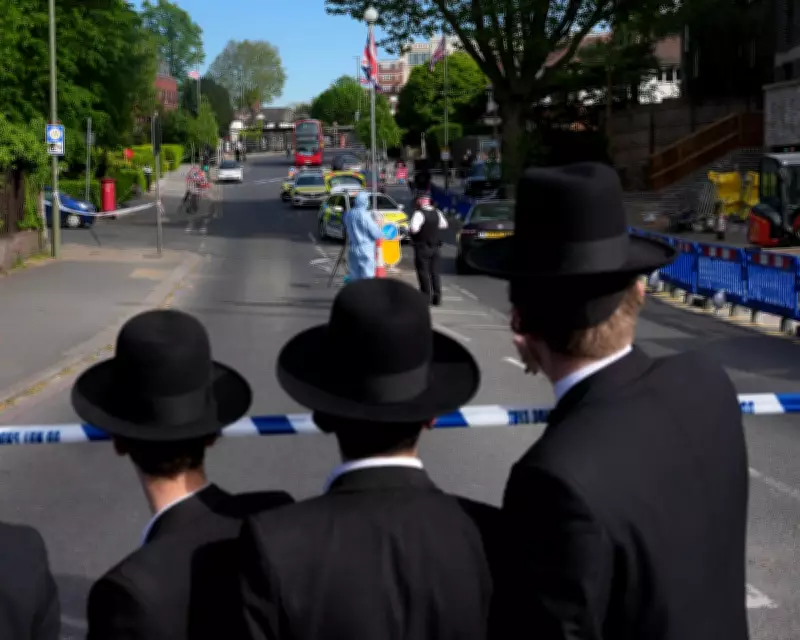
Good morning. It is a terrible fact of life for British Jews that few were surprised by Wednesday’s knife attack in Golders Green, north London, in which two men were stabbed in an area home to a large Jewish community. A 45-year-old man has been charged with attempted murder.
The incident is the latest in a string of antisemitic attacks, on people and property, that have struck fear into many British Jews in recent years. John Mann, the government’s independent adviser on antisemitism, said many in the community are at “breaking point” and feel the UK is no longer a safe place for them to live.
To discuss the attack and what life is like for British Jews amid rising hate crimes against the community, I spoke with Dave Rich, director of policy at the Community Security Trust, which supports Jewish safety in Britain, and the Guardian’s community affairs correspondent, Aamna Mohdin, who has been on the ground in Golders Green.

Five big stories
Iran | Iran’s supreme leader has broken his recent silence with a defiant statement hailing Iran’s control over shipping in the strait of Hormuz and vowing to guard the country’s nuclear and missile programmes.
Environment | Governments have been asked to develop national “roadmaps” setting out how they will end the production and use of fossil fuels, after a landmark climate meeting involving nearly 60 countries.
UK news | Winston Marshall, a former member of the band Mumford & Sons and the son of the GB News co-owner Paul Marshall, has said Britain should construct a mine-laden “floating wall” to stop small boat crossings on the Channel.
Counter-terrorism | More and more young people are being drawn into the world of violent extremism, a senior police officer has warned, as a young neo-Nazi was convicted of planning a mass gun attack after being caught in an undercover MI5 sting.
UK economy | The Bank of England has left interest rates unchanged at 3.75% but said the UK may need to brace for increases later this year, as “higher inflation is unavoidable” as a result of the war in the Middle East.
In depth: ‘Extreme, hateful, violent attitudes have become normalised’
Wednesday’s attack in Golders Green was not a one-off. In March, volunteer-run ambulances operated by the Jewish community were set on fire in the north London suburb, the first in a series of arson attacks that include the firebombing of a synagogue and community symbols across the capital. And police have been investigating groups backed by the Iranian regime in connection with antisemitic attacks.
In October last year, an Islamist terrorist drove a car into a synagogue in Heaton Moor, Manchester before stabbing worshippers on Yom Kippur, which left two men dead. This February, three men were convicted over a foiled IS-inspired terror plot to massacre Jews in Manchester. Jewish people now suffer the highest rate per capita of religious hate crime in England and Wales.
The steady drumbeat of antisemitic incidents has brought fear into mundane, everyday tasks for British Jews. Some hide or remove symbols that might identify them as Jews. Others are too scared to go to particular areas, with a growing number contemplating leaving the country. As Jewish families sit down for Shabbat dinner this evening, many will reflect again on whether the UK is safe for them in the wake of another attack.
“Antisemitism in the day-to-day boring stuff that never makes the news has become utterly normalised in the Jewish experience in this country,” says Dave Rich. “There is a growing frustration that not enough effective action is being taken to deal with it. That covers policing, government and the wider society, where extreme, hateful, violent attitudes and language have become normalised. When you speak to anyone from the Jewish community in Britain, there might be a level of shock, but nobody is surprised that attacks like this are happening.”
Rich recalls a recent Passover dinner with friends who were reflecting on antisemitic interactions in their day to day life: a question at a night club over what one person “thought of the Jews”, another conversation with someone who was convinced “the Jews did 9/11”.

“That’s now a normal part of the Jewish experience in this country,” he says.
‘Legitimised hatred’
Jewish people make up 0.5% of the UK population – and many at the moment feel vulnerable, targeted and alone, Rich tells me. Add to that their sense that the response to recent antisemitic hate incidents has been muted, and many Jewish people say it leaves them with the feeling that others simply do not care that Jews are being targeted.
In particular, Rich highlighted antisemitism among those one would expect to be allies of minorities, people who would otherwise consider themselves progressive liberals, pointing out that too often legitimate criticism of Israel slips into hatred of Jews in the diaspora.
“The 76-year-old Jewish man who was stabbed in Golders Green, he’s not a serving IDF soldier,” Rich says. “It’s ridiculous. There is an atmosphere of legitimised hatred – not criticism, not opposition, but hatred – towards Israel, not as a state and a government but as a nation and people, that has developed and taken root in liberal opinion and left-wing opinion. This atmosphere of hatred by definition is uncontrollable and generates more hatred and more attacks. And it slips very, very easily from hatred of Israel to hatred of Israelis to hatred of Jews.”
Rich also identifies a particular issue with antisemitism among a small portion of British Muslim society, which must be delicately addressed. No doubt it helps that several leading British imams have condemned the Golders Green attack and expressed their solidarity with the Jewish community.
“If you look at opinion polling … in Britain and in other countries, it consistently shows that levels of antisemitism are higher, significantly higher, among Muslim communities than they are in the population as a whole,” says Rich. “I have to stress, not most Muslims. And also not most of the antisemitism in society … but it’s far too high.”
“People are very nervous about raising this issue,” says Rich, and he is keen to stress that “there are genuine sensitivities because anti-Muslim prejudice is a real problem as well in this country, and there are extremist voices on the far right who will always try to exploit these issues”. But he argues the perception of this problem is inflated by avoiding it: “One of the ways that enables the far right to do that is if there is a vacuum because no one else is talking about these issues in an evidenced and measured and constructive way.” Rich points to a rise in antisemitic sermons in some UK mosques after the 7 October massacre in Israel by Hamas, and the subsequent war in Gaza.
“We need measured, evidence-based, proportionate and effective policy measures, working with people in Muslim communities and across society as part of a broader counter-extremism effort,” he says.
Actions, not words
The prime minister, Keir Starmer, has said the stabbings on Wednesday were “an attack on all of us”, urging swift action from the criminal justice system, and promised his government would do “everything in our power to stamp this hatred out”. The UK terrorism threat level was raised on Thursday to “highly likely”, its second-highest level, and the home secretary, Shabana Mahmood, has committed an extra £25m to increase security for Jewish communities.
But many are unconvinced. Starmer was heckled during a visit near the site of the attack yesterday, with a crowd of around 100 people chanting “Keir Starmer, Jew harmer”.
The London mayor, Sadiq Khan, has said Jewish Londoners want to see actions, not words, and said he was in discussions with the Met police to establish a new unit countering extremism in the capital.
Shock and fear
In Golders Green, many in the community expect another attack, says Aamna Modhin, who was on the ground after the incident. She said people in the leafy London suburb were in shock, gripped by fear, and were openly questioning their place in Britain, with families cordoned off from reentering their homes after the stabbing.
“People I spoke with said this was an attack on Britain, not only Jews, and there was a sadness that the feeling wasn’t shared. There was also defiance. Others said to me that nobody was going to scare them off from wearing a star of David or a kippah in public,” she said.
Mohdin points to chronic government underinvestment in community relations that have led to this point, saying that they have not taken cohesion seriously for more than two decades. Big reductions in funding for interfaith exchanges have helped foster distrust, leaving a gap for extremists. While there are no easy answers, the pockets of interfaith cooperation had to be encouraged and provided with more resource, she said.
“Almost every religious and community group I speak with talks about their distress, isolation and loneliness,” says Aamna Mohdin. “A feeling that they have been abandoned by the government. What does that say about the British state right now?”