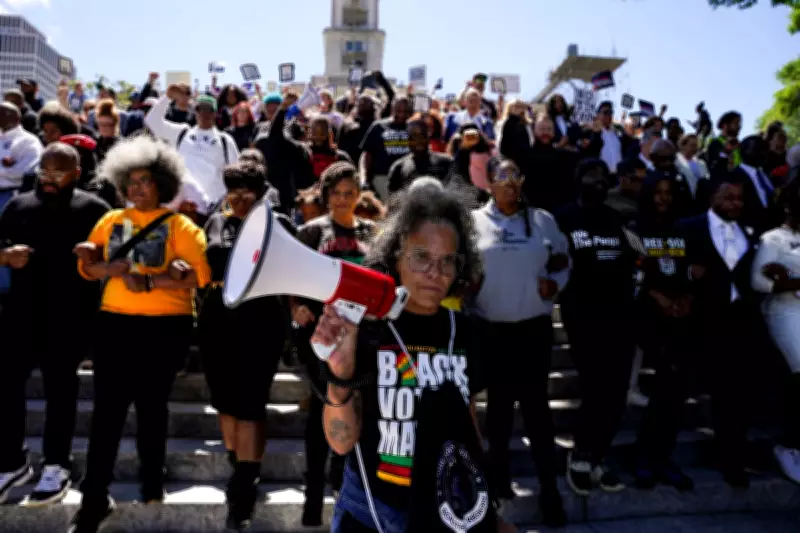
Voting rights advocates are scrambling to respond to rapidly gerrymandered congressional maps that dilute Black political power across the Southern United States. Following a Supreme Court ruling that weakened key protections of the Voting Rights Act, states have moved swiftly to redraw boundaries, eliminating majority-Black districts. Critics describe this as a revival of Jim Crow-era tactics.
Supreme Court Ruling Sparks Wave of Changes
The Supreme Court's decision in Louisiana v Callais opened the door for a new wave of racial gerrymandering. Davante Lewis, a member of the Louisiana Public Service Commission, stated, 'They gave them a defibrillator to the heart of Jim Crow.' Black voting rights advocates are now preparing to fight back, with Lewis adding, 'We're prepared to make noise.'
Tennessee became the first Southern state to pass a new redistricting map that eliminated its only majority-Black district, just one week after the ruling. The hastily drawn map splits Memphis, a city over 60 percent Black, into three separate districts, diluting Black voters' influence. This move has been condemned as a 'political lynching' by Tennessee state Rep. Justin Pearson.

Historical Pattern of Suppression
Anneshia Hardy, director of Alabama Values, noted, 'Every time Black communities get close to political power, we see this shift. The rules are recalibrated.' She traced the current situation to the Southern Strategy after the Voting Rights Act of 1965, when Republicans weaponized racial resentment. 'It has not disappeared. It has evolved,' she said.
Other Southern states are following suit. In Virginia, the state supreme court overturned a Democratic redistricting plan. Florida faces lawsuits over its partisan gerrymander, despite a constitutional ban. South Carolina is moving to eliminate its only Black-majority district, and Alabama seeks to reinstate a map previously rejected by the Supreme Court for diluting Black voting power.
Legal and Political Battles Ahead
The Supreme Court ruling allows partisan gerrymandering as long as it is not explicitly racial, but critics argue the effects are the same. Amir Badat, a voting rights attorney with Fair Fight Action, warned that the new maps 'rob the political power of Black people in the South.' Advocates are preparing legal challenges and grassroots campaigns to resist these changes.
Matia Powell of Civic Tennessee stated, 'This was not the will of the people. It wasn't the people who called the governor for a special session; it was the president.' The fast pace of changes has caught some advocates off guard, but they remain determined. As Hardy concluded, 'History has receipts.'