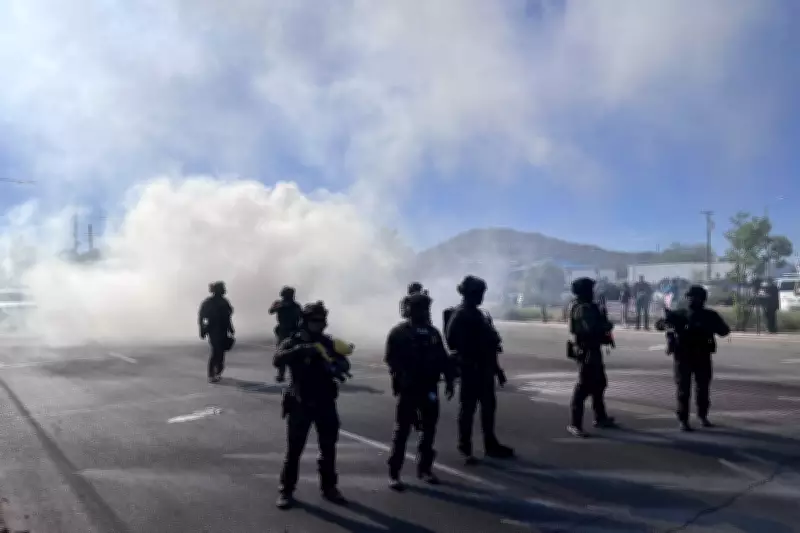
Migrant advocates in Arizona have developed a new tool to monitor immigration-related enforcement in and around Tucson as arrests increase under President Donald Trump's mass deportation initiative. The Tucson Migra Map allows individuals to document and visualise activities by Immigration and Customs Enforcement (ICE) and other federal agencies, revealing patterns while raising questions about safety, transparency, and the limitations of public tracking tools.
Community Response to Rising Enforcement
“It indicates the level of chaos and how disruptive it is to our community,” said activist Lucia Vindiola, who launched the mutual aid group La Bodega to provide groceries and other assistance to those affected by heightened enforcement. “We are seeing firsthand the impact on families, limiting them from shopping for groceries and supplies.”
Since President Trump took office, immigration-related detentions have more than tripled in fiscal year 2025, surging from fewer than 200 in late 2024 to over 800 by June 2025. In response, community groups like the Tucson Rapid Response network have organised to monitor and track federal immigration actions on the ground.

How the Map Works
Geographer Dugan Meyer, a Ph.D. student at the University of Arizona and volunteer with Tucson Rapid Response, is one of the map's creators. “This project came out of the documentation work that Rapid Response is doing, but also around the city,” Meyer said. “It is a community research project, community mapping project.”
The data is drawn from spreadsheets maintained since January 2025, tracking federal enforcement actions in greater Tucson, including raids, vehicle stops, and aerial surveillance. Incidents are vetted and classified as “confirmed” or “credible but unconfirmed” based on evidence. “If we have photographs of, say, an agent wearing a tactical vest that says ICE, that’s confirmed,” Meyer explained. “Credible unconfirmed, we’re very confident something happened.”
Hundreds of people, including non-citizens, have contributed eyewitness accounts. Information is sourced from local news, reports by Rapid Response and neighbourhood networks like Migra Watch, as well as social media and WhatsApp groups. As of late April, the team had reviewed around 562 incidents, with about 300 meeting the inclusion threshold.
Accuracy and Limitations
Rapid Response member Steven Davis has documented five incidents, including one where he was pepper sprayed by law enforcement. “The value of the observation is that we take this out of the shadows and get it out into the public,” Davis said. “The Migra Map is a public facing map that makes visible this activity that is mostly behind the scenes.” He emphasised the importance of accuracy: “There’s the saying garbage in, garbage out. I want to make sure that the information that I’m providing is the most accurate information that I can possibly provide.”
Meyer acknowledged that the map is an undercount. “We know that the map is an undercount by any estimation,” he said. The map also includes police facilities, immigration detention centres, and flight paths of surveillance aircraft. Repeated vehicle reports often confirm instances of surveillance, enhancing accuracy.
Legal and Ethical Considerations
Federal officials have argued that such tracking puts officers at risk. Previous tracking sites like ICEBlock were taken offline after the Trump administration called for their removal. However, Meyer believes the Constitution’s free speech protections will safeguard the Migra Map. Unlike earlier trackers, it does not provide real-time alerts but reports actions after the fact. “It doesn’t tell you where ICE is active right now. It tells you where ICE has been active in the last months,” Davis said. “You could file a Freedom of Information Act for the Tucson District Office and get the exact same information that we’re providing on the map.”
Some contributors report anonymously out of fear. Meyer noted, “I think that anyone paying attention is at the very least concerned” about the current administration, adding that he feels privileged to be publicly associated with the project.

The Tucson Migra Map follows a similar initiative called People over Papers, which was shut down by its host site for policy violations. Meyer hopes the map will encourage similar efforts elsewhere, serving as a platform for public information. “It really helps us think about directly when we can see these things in relation to each other,” he said, enabling identification of trends and hotspots like El Super grocery store on Tucson’s south side, which has seen a high concentration of enforcement.
This story was originally published by Arizona Luminaria and distributed through a partnership with The Associated Press.