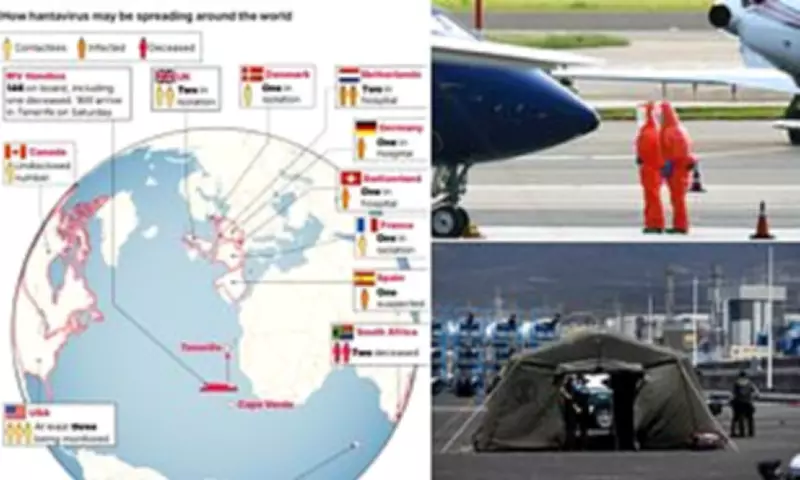
A luxury cruise ship struck by a fatal rat-borne disease is heading towards the Spanish island of Tenerife, where health officials will evacuate more than 140 passengers and crew members still on board. The MV Hondius is expected to dock at the weekend after days of being marooned off the coast of Cape Verde following an outbreak of the lethal hantavirus.
Global Tracing Underway
Now, countries worldwide are scrambling to trace the 29 passengers of 12 nationalities who disembarked from the ship at St Helena after its first leg on April 24, who may have unwittingly spread the deadly virus back home. Five cases have now been confirmed, including three deaths - a Dutch couple and a German passenger - with many more reporting symptoms. But given the incubation period of this disease - which can be up to six weeks - it is possible more cases may be reported, the World Health Organisation (WHO) warned.
Andes Strain Spreads Between Humans
While people usually become infected with hantavirus through contact with infected rodents or their urine, droppings or saliva, the rare Andes strain is spreadable between humans, and has been identified in passengers evacuated from the vessel. The WHO is in touch with officials in at least 12 countries who are urgently monitoring citizens that returned home, including Canada, Denmark, Germany, the Netherlands, New Zealand, Saint Kitts and Nevis, Singapore, Sweden, Switzerland, Turkey, the United Kingdom and the United States.

British Nationals Affected
Three British nationals have suspected hantavirus, including a former passenger who is now on the remote South Atlantic island of Tristan da Cunha. The UK Health Security Agency did not disclose further details of the new suspected case on the British overseas territory where the cruise ship made a stop on April 15. Tristan da Cunha, home to only around 200 people, is halfway between South Africa and South America and the world's remotest inhabited island, more than 1,500 miles and a six-day boat ride from St Helena, its nearest inhabited neighbour.
The two other British men have confirmed cases. One is Martin Anstee, a 56-year-old retired police officer and expedition guide on the MV Hondius, who was evacuated from the ship on Wednesday and remains in stable condition in the Netherlands. He was evacuated alongside a 41-year-old Dutch crew member and a 65-year-old German passenger, who was asymptomatic. The other British patient, 69, remains in intensive care after being flown to South Africa last month when he fell sick on the cruise ship.
UK Response
The UK Health Security Agency (UKHSA) said it was aware of seven British nationals who disembarked from the cruise at St Helena on April 24. Two of these individuals have since returned to the UK independently and are self-isolating, while four have remained in St Helena. The seventh individual has been identified outside the UK. Spain says officials are in advanced talks with the British government to send a repatriation flight for the remaining UK nationals on the vessel. When they return, they will likely be asked to self-isolate for 45 days, a UK health official said.
Spanish Suspected Case
A woman in the southeastern Spanish province of Alicante, part of the region of Valencia, has symptoms consistent with a hantavirus infection. The suspected case involves a woman who was a passenger on the same flight as a 69-year-old Dutch woman, who died in Johannesburg after travelling on the MV Hondius cruise ship and contracting the virus. The Spanish woman has been taken to a hospital in Alicante, where she remains in isolation with symptoms including coughing and 'general malaise'. She had been sitting two rows behind the Dutch cruise ship passenger, but the contact between them 'was brief' since the passenger had only been 'on board for a short time' during the flight, Secretary of State for Health Javier Padilla said. Padilla added that health authorities in the Valencia region were tracing the people the woman has been in contact with over the past few days.

Origin of Outbreak
The deadly outbreak that has wreaked havoc aboard the cruise ship is believed to have originated in a seagull-plagued rubbish tip in the Argentine town known as 'the end of the world'. The country's government's leading hypothesis is that the Dutch couple who later died contracted the virus during a bird-watching outing at a garbage dump in Ushuaia before boarding the vessel. The first two cases 'travelled through Argentina, Chile and Uruguay on a birdwatching trip which included visits to sites where the species of rat known to carry the virus was present,' said WHO Director General Tedros Ghebreyesus.
Other International Cases
After boarding the vessel in Ushuaia, Argentina, American passengers who disembarked from the cruise early after its first leg are being monitored in Georgia, California and Arizona. A Danish citizen who travelled on the MV Hondius and also disembarked on April 24 has gone into self-quarantine, the Danish Patient Safety Authority said Thursday. The health authority said the person showed 'no symptoms of illness', adding that the authority was in contact with the person who had gone into 'self-isolation'. The person, whose age and gender were not disclosed, had returned to Denmark at the end of April and had not been in close contact with the people on the MV Hondius who developed the disease. In the health agency's assessment, the risk of the person having contracted the virus was 'low', but it said it was in regular contact with the person and monitoring the situation.
Another man who returned home after the first leg of the trip in late April tested positive in Zurich, Switzerland and is receiving medical attention. And two Singapore residents who had been on board the cruise ship have been isolated as they await test results for the disease. 'Two Singapore residents had been on board the cruise ship MV Hondius, which has reported an outbreak of Andes hantavirus. Both individuals have been isolated at the National Centre for Infectious Diseases, where they are being tested for hantavirus,' the Communicable Diseases Agency statement said on Thursday. 'Their test results are pending. One has a runny nose but is otherwise well, and the other is asymptomatic. The risk to the general public in Singapore is currently low.'
While those remaining on the vessel are following strict hygiene measures, others who disembarked on April 24 resumed normal life - not realising they may be carrying the rare illness and spreading it back home. 'The Australian went back to Australia, the one from Taiwan to Taiwan, the Americans to all corners of North America. The Englishman to England, the Dutch to their homes... I don't remember the rest, but no Spaniards,' a Spanish passenger still on board the ship told the newspaper, El Pais.