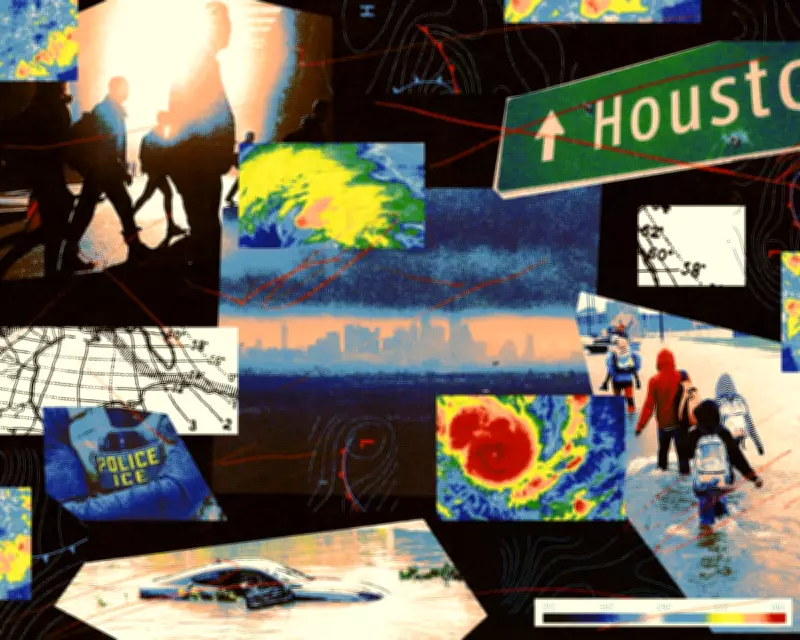
Houston’s immigrant community is facing a convergence of crises, including immigration raids, chemical spills, massive floods, and costly healthcare, leaving less-affluent residents struggling to survive in one of the most diverse US cities.
A Reluctance to Seek Medical Care
Cándido Álvarez, a 47-year-old undocumented immigrant from Honduras, has a policy of never visiting the doctor, even when seriously ill. During a sweltering Houston summer, his body temperature reached 120F while working at an unventilated bodega, and blood in his urine indicated kidney damage from heat exposure. Still, he avoided the emergency room, remembering a $7,500 bill from a four-hour hospital visit for Covid-19. He fears dying not from illness but from the stress of paying rent.
Álvarez has lived in the US since 2015 and in Houston for almost as long. Unlike his wife and three children, he lacks health insurance despite constant job risks like mold and insulation debris, exacerbated by employers who fail to provide safety equipment. He often remodels homes flooded by Houston’s notorious storms or cleans up storm-related waste. At home, he is near a major airport and chemical plants, and doubts the city’s assurances that the air is safe.

The Intersection of Climate, Pollution, and Poverty
Álvarez’s situation exemplifies how the climate crisis, industrial pollution, and environmental disasters disproportionately affect lower-income immigrant communities in Houston. Public health suffers, and the second Trump administration has further restricted healthcare access due to rising costs and a hardline mass deportation agenda that deters people from seeking treatment.
Where Álvarez lives is where much of Houston’s pollution accumulates, contributing to a 21-year life expectancy gap between the lower-income, primarily Black and brown residents on the east side and wealthier, whiter neighbors on the west. This is illustrated by a phenomenon known as “the arrow,” which shows key indicators of wellbeing on a map. The arrow points from wealthy western neighborhoods to the east, where prosperity is lacking. Inside the arrow lie luxury stores, green spaces, and the richest Texas suburb, while outside, to the south and east, poverty rates, childhood asthma, and the number of solid waste sites and facilities using harmful chemicals are higher. Median home values and college degree attainment are lower.
Extreme Weather and Petrochemical Hazards
Houston’s vulnerability to extreme weather—cyclones, severe thunderstorms, winter storms, hurricanes, floods, and heat—combined with its status as the epicenter of North America’s petrochemical industry, disproportionately affects immigrants. Norma Gonzalez, a community advocate at Woori Juntos, notes that homes flooded up to their windows remain in precarious condition without added infrastructure. After repeated disasters, people become more isolated and reluctant to ask for help.
Roughly 30% of Houston’s 2.4 million residents are foreign-born. Nearly a third of immigrants lack legal status, while 64% are green card holders or naturalized citizens. The city is extremely diverse, with Vietnamese, Urdu, Tagalog, Arabic, and other languages coexisting with Spanish and English. Ginny Goldman of Organizing Resilience says the city beats to the pulse of immigrants and is shaped by them.
Disaster Vulnerability and Health Impacts
Texas is disaster-prone, and Harris County, the largest in the Houston area, is more vulnerable to disasters’ negative impacts than 72% of other US counties. Summers bring excruciating heat, with days above 95F increasing substantially. Hurricane Harvey in 2017 dropped up to 60 inches of rain, made 15-38% worse by climate change, killing 89 people and causing $158.8 billion in damages. Following Harvey, other massive storms and the Covid-19 pandemic compounded adversities.
More than half of Harris County residents surveyed endured blackouts during Harvey and the 2021 winter storm. About 900,000 lost power during the May 2024 derecho, and 3 million homes and businesses went dark during Hurricane Beryl two months later.

Petrochemical Pollution and Health
Natural hazards mix poorly with petrochemical industry emissions in Harris County, where 2.6 million barrels of crude oil are processed daily. Houston’s east side contends with a 52-mile shipping channel labeled a “racial sacrifice zone,” with over 400 petrochemical facilities causing respiratory issues. Before big storms, refineries and plants burn off fuel and chemicals, and flooding contaminates water, soil, and air. During Harvey, a trillion gallons of floodwater mixed with sewage and 340 tons of air pollution from plant malfunctions. A gasoline spill of 461,000 gallons occurred near a predominantly Latino neighborhood.
Nearly a quarter of Vietnamese participants in a study suffered injuries or illness from Harvey, and those with damaged homes were more likely to experience poor mental health. After the derecho and Beryl, mold and debris in homes worsened health issues.
Barriers to Healthcare
In a 2017 survey, nearly a quarter of immigrants in Texas Gulf Coast counties said they needed more help with medical care. Over half lacked health insurance, and more than four in ten had no doctor to visit. These barriers have deepened under the second Trump administration’s immigration crackdown, which advocates liken to a disaster. Since January 2025, 48% of likely undocumented immigrants, 14% of lawfully present immigrants, and 8% of naturalized citizens have skipped medical care due to immigration-related fears, according to KFF research. The mass deportation campaign also adds stress for patients with chronic diseases or mental health concerns.
Long-Term Recovery Challenges
Melissa Villarreal, who researched Harvey’s impact on Mexican-origin women, found that lack of access to FEMA assistance or affordable loans left many families in unsafe conditions. Undocumented immigrants face challenges opening bank accounts and building credit. Families blocked off rooms due to mold or used only one bathroom because they couldn’t afford repairs. Villarreal notes that many never recovered financially, and with each subsequent disaster, the situation worsens. Experts call the mental health effects the “recovery from the recovery,” as people of color facing FEMA denials feel expected to live in unsafe conditions.
Community-Led Solutions
Local organizations and grassroots activists are devising better-targeted aid and advocating for proactive prevention. Hilda, an undocumented immigrant and environmental advocate in northeast Houston’s Settegast neighborhood, hopes to mitigate soil contamination and flood risks by planting more vegetation to absorb water and reduce impermeable surfaces. After Harvey, city flood reduction plans for wealthy west Houston far exceeded those for northeast Houston. When Hurricane Beryl hit in 2024, Hilda became ill after running out of diabetes medication.
Hilda lives in a historically Black area where lower costs attract immigrants without credit or social security numbers. They buy cheaper houses to pay off quickly, retaining an asset even if detained or deported. She has noticed increased volatility in recent years—more dryness followed by heavy rain.
Industrial waste is also a concern. Hilda points to a nearby “mountain,” a grassed-over dump. A 2023 study found 40 of 46 soil samples in northeast Houston had chemical levels posing a cancer risk, with lead levels unsafe for children.
In southwest Houston, infrastructure is similarly poor, says Alain Cisneros of Fiel. After Harvey, his organization found newborn babies in flooded first-floor apartments. Immigrants stuck in dangerous conditions often cannot move due to low income.
Healthcare Access and Immigration Enforcement
The Ibn Sina Foundation’s community clinics provide invaluable low-cost care, including specialists, ultrasound, bloodwork, dentists, and an on-site pharmacy. Staff have waded through floodwaters to deliver supplies. However, clinic manager Mariela Soberanis notes that waiting rooms have emptied as immigration enforcement officers patrol the streets. People avoid leaving home unless absolutely necessary.
This article was produced as a project for the USC Annenberg Center for Health Journalism and the Center for Climate Journalism and Communication’s 2025 Health and Climate Change Reporting Fellowship.