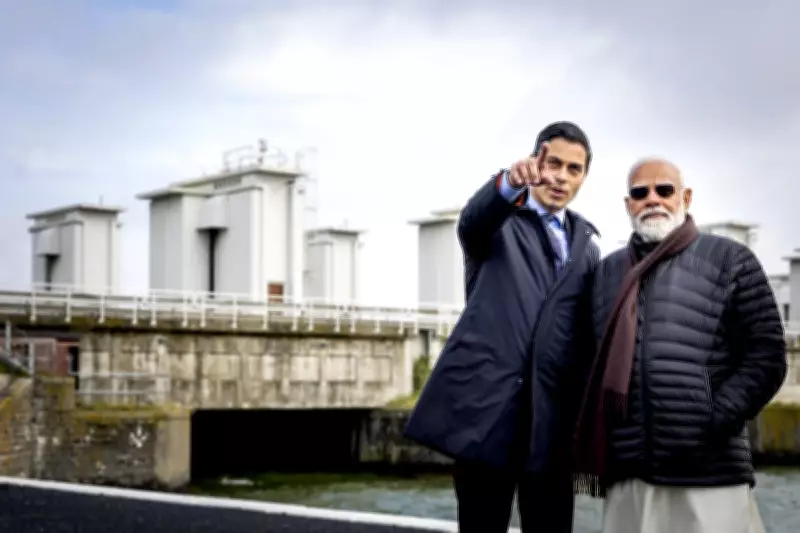
India has reacted sharply after Dutch Prime Minister Rob Jetten expressed concern over press freedom and minority rights in India ahead of his meeting with Prime Minister Narendra Modi. Delhi dismissed the remarks as stemming from a 'lack of understanding' of the country's diversity.
Diplomatic Tensions Over Rights Concerns
Jetten, speaking to reporters before his meeting with Modi on Saturday, highlighted worries about the erosion of press freedom and the rights of minorities in India. 'It is not only about press freedom but also about the rights of minorities, who are under severe pressure. That applies in the first place to the Muslim community but also to many other smaller communities,' Jetten was quoted as saying by De Volkskrant. He added that such concerns were 'regularly raised' with the Indian government.
In response, Indian foreign ministry secretary Sibi George told a press briefing in The Hague that such questions reflected 'a lack of understanding' of India's history and diversity. 'India is a country of 1.4 billion people, the largest populated country in the world. A country of civilization of more than 5000 years old. It's a diverse country,' George said, highlighting diversity in culture, languages, food, and religion. 'Every religion, whenever any part of the world there was persecution in the past, they all came to India and thrived in India. This is the beauty of India.'

Press Freedom and Democracy
On press freedom, George described India as a 'noisy democracy' where 'everyone has the freedom of expression, freedom of press in the country.' He noted that Jews in India never faced persecution, Christianity arrived soon after the resurrection of Jesus Christ, and Islam came during the lifetime of Prophet Muhammad. 'We are one-sixth of the total population of the world, but not one-sixth of the problems of the world. This is the beauty of India, which makes us proud. Every minority thrives,' he added.
According to the Indian Express, the issue was not discussed during the Jetten-Modi meeting, which elevated the Indo-Dutch relationship to a 'strategic partnership.'
World Press Freedom Index
India ranks 157th out of 180 countries in the 2026 World Press Freedom Index by Reporters Without Borders (RSF), falling into the 'very serious' category. The country dropped six places from its 2025 ranking. RSF blamed Modi and his Hindu nationalist Bharatiya Janata Party for rising violence against journalists and growing media concentration, noting that billionaire Mukesh Ambani owns over 70 media outlets, while Gautam Adani's takeover of NDTV in 2022 marked a decline in media pluralism.
Human rights groups have also expressed concerns about the ruling party's rhetoric against minorities, sectarian violence around Hindu festivals, and state-sponsored demolitions of mostly Muslim properties. The US Commission on International Religious Freedom reported that religious minorities continue to be attacked in India, with authorities using discriminatory anti-conversion and cow slaughter laws to target minorities, especially Muslims. India has denied the report as biased.
Abduction Case Raised During Visit
Separately, the case of Insiya Hemani, a Dutch girl abducted by her father and taken to India in 2016, was raised during the visit. George confirmed the matter was discussed but declined to comment as it is sub-judice. The girl's mother, Nadia Rashid, protested during Modi's visit outside the Huis ten Bosch Palace.