A new report has uncovered the extreme measures British children are taking to circumvent online age verification checks. Since July 2025, Ofcom has enforced stringent age checks for websites hosting pornography and harmful content under the Online Safety Act. Now, a report by Internet Matters has revealed the creative tactics under-18s are employing to bypass these restrictions.
Common Bypass Methods
According to the report, some children opt for simple approaches, such as entering a different birthday or uploading a photo of a parent's ID. Others use more sophisticated methods, including submitting a video of another person's face or using a Virtual Private Network (VPN). In some cases, children are even drawing facial hair on themselves to trick verification tools, which has proven effective for some youngsters.
'I did catch my son using an eyebrow pencil to draw a moustache on his face, and it verified him as 15 years old,' said an unnamed mother of a 12-year-old boy.

Online Safety Act Requirements
Since July 25, the Online Safety Act has required operators of online platforms to prevent children from viewing harmful content. This includes explicit material like pornography, but also content that encourages self-harm or suicide, promotes dangerous challenges, shows serious violence, or incites hatred. Platforms offer various age verification methods, including photo-ID matching, facial age estimation, mobile-network operator (MNO) age checks, credit card checks, email-based age estimation, digital identity services, and open banking.
Survey Findings
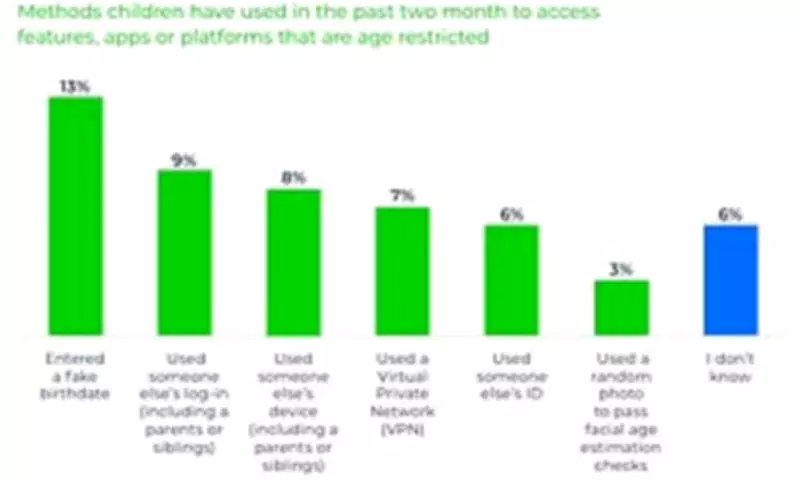
For the report, Internet Matters surveyed 1,000 British children and their parents about how they are getting around these measures. The survey found that nearly half (46 per cent) of children perceive age checks as easy to bypass. Focus groups revealed a range of methods:
- Entering a fake birthday (13 per cent)
- Using someone else's login (nine per cent)
- Using someone else's device (eight per cent)
- Using a VPN (seven per cent)
- Using someone else's ID (six per cent)
- Using random photos (three per cent)
- Drawing on fake moustaches
One 13-year-old boy said: 'If going live needed an ID, I'd use my parent's ID and then if they wanted to upload a photo, I'd go online and upload any.' An 11-year-old girl added: 'I've seen clips of people online where they'll get clips of video game characters like turning their head and use it for age verification.' A 12-year-old boy explained: 'On Roblox there's a thing where you put your face in and only allowed to chat with that age group... I got 15 when I'm 12, so I'm chatting with people older than me when I shouldn't be.'
Parental Involvement
The report also found that many parents have helped their children bypass age checks. A 12-year-old girl said: 'I have one account on TikTok I go live on, so I got my mum to put her ID in. She says it's because she trusts me. I don't show my face on it so I don't get banned.' A mother of a 13-year-old non-binary child added: 'I have helped my son get around them. It was to play a game, and I knew the game, and I was happy and confident that I was fine with him playing it.'
Calls for Stronger Measures
Based on the findings, Internet Matters is calling for online age checks to be strengthened. 'While age verification measures are positive, they are not always accurate or stringent in practice,' the report states. 'This is concerning because without robust verification and enforcement, children may continue to access content and features that are unsuitable for them, leaving the burden of protection largely on parents and carers. If age verification is to be used to keep children safe online, then platforms, government and the regulator need to ensure it is effective.'