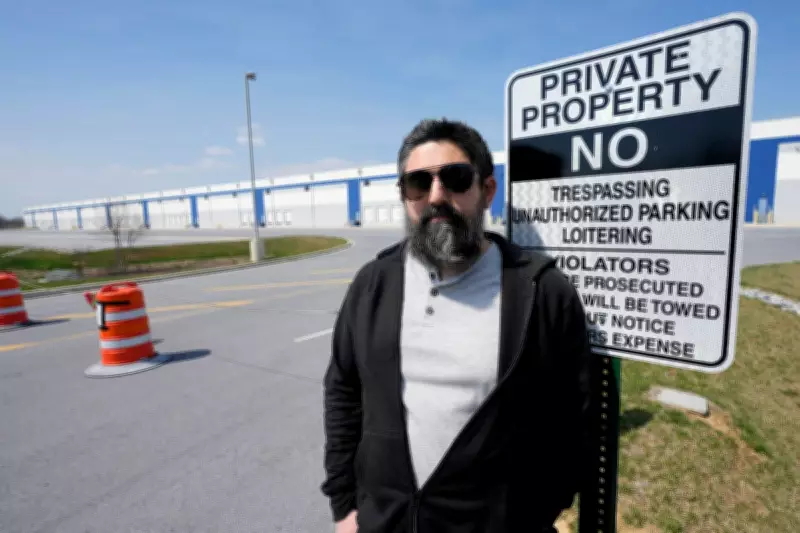
Maryland Immigration Detention Facility Plan Paused Amidst Fierce Protests
Protesters have been rallying against a planned immigration detention facility in Washington County, Maryland, where county officials recently discussed mundane issues like the solid waste budget amidst loud demonstrations. Horns blared and chants of "Stop ICE!" echoed outside the meeting, reflecting ongoing community outrage since the Department of Homeland Security purchased an 825,000-square-foot building as part of a broader initiative to convert warehouses across the United States into detention centers for tens of thousands of immigrants.
Community Opposition and Federal Review
Patrick Dattilio, founder of the anti-ICE group Hagerstown Rapid Response, emphasized the facility's unsuitability, stating, "This is a facility built for packages, not people." The federal government has encountered fierce resistance in communities where it spent $1.074 billion on 11 warehouses under a plan currently under review by Homeland Security Secretary Markwayne Mullin. Washington County, despite being described as the most welcoming community with officials expressing support for ICE, has seen its processing center project paused due to a court battle, mirroring delays in other warehouse-to-detention conversions nationwide.
Questions are swirling about whether Mullin will proceed with the facilities project or adopt a different approach as he advances President Donald Trump's mass deportation agenda. The sprawling blue-and-white warehouse in Washington County has become a focal point of intense debate, particularly after county commissioners approved a proclamation on February 10 declaring their "unwavering support" for DHS and ICE. This move was met with booing and yelling, leading to the room being cleared by the commission president.

Legal and Financial Complexities
In a strategic move, the county forwarded the proclamation to former Secretary Kristi Noem, accompanied by an email requesting hundreds of millions of dollars for sewer, airport, and highway upgrades, as revealed through public records obtained by local resident and congressional candidate Ethan Wechtaluk. ICE, bolstered by a substantial congressional appropriation, has signed a $113 million contract to renovate the building for 500 to 1,500 detainees. However, a judge temporarily halted work after Maryland's Attorney General filed a lawsuit, with a hearing scheduled for April 15.
County commissioners have not responded to requests for comment, and County Administrator Michelle Gordon stated that all interview requests are being declined. Many residents, including Civil War enthusiasts who visit the Antietam battlefield, are outraged over both moral objections to the facility and the lack of prior notification about the purchase. Carroll Sager, a resident, expressed frustration, saying, "We have had no voice in this," as protesters gathered behind crime scene tape set up by the sheriff's department.
National Backlash and Federal Scrutiny
Similar pushback has emerged in other communities across the United States. Lawsuits in New Jersey and Michigan challenge DHS's communication and alternative site considerations, while officials in Salt Lake City and Pennsylvania have threatened to limit water access. In Georgia, the town of Social Circle placed a lock on the water meter at a purchased warehouse. Additionally, questions have arisen about DHS's spending, with reports indicating it paid double the tax-record value for a New Jersey warehouse and nearly five times more than the assessed value in Social Circle.
During his confirmation hearing, Mullin was pressed on whether he would continue Noem's policy of converting warehouses into detention facilities. He responded noncommittally, stating the department aims to "be good partners" with communities. Shortly after being sworn in, DHS paused new warehouse purchases intended for immigrant housing and is scrutinizing all contracts signed under Noem. In a recent court filing in Maryland's lawsuit, the federal government noted that "ICE is reconsidering the plans and scope of the warehouse." When asked about potential changes for the Maryland facility, DHS issued a statement: "As with any transition, we are reviewing agency policies and proposals."

Local Impact and Resident Concerns
The original plan involved transforming the Maryland warehouse into an ICE processing facility to hold recently arrested immigrants before their transfer to long-term detention centers. ICE officials have stated that the Washington County warehouse would address detention space needs for the Baltimore ICE office, where concerns have been raised about the George H. Fallon Federal Building due to Legionnaires' disease bacteria found in the water.
Activists and residents near the warehouse are closely monitoring developments. Nica Sutch, a long-time resident of western Maryland, initially saw the warehouse as an economic boon driven by online shopping demand. However, with ICE's purchase, she is now considering moving, lamenting, "I love the area. I love everything. This has been my home for 28 years." As the legal and political battles unfold, Washington County residents await clarity on the future of the controversial detention facility project.