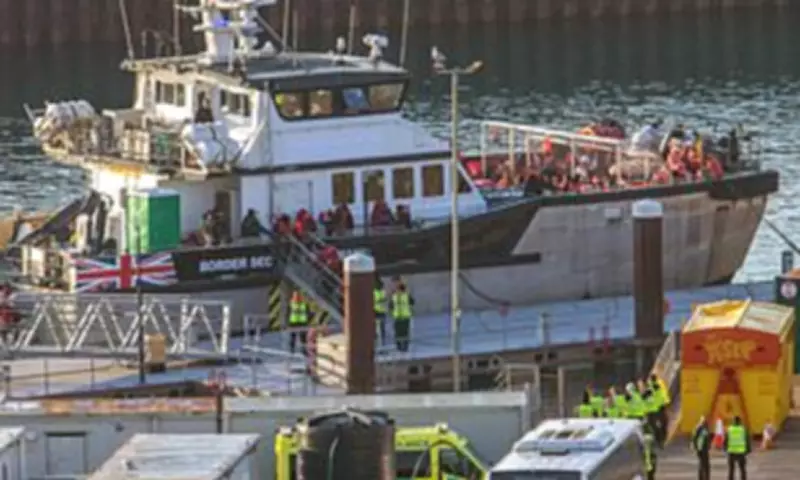
Hundreds of Channel migrants have arrived in Britain over the bank holiday weekend as warm weather sparked a surge in small boat crossings. More than 900 migrants crossed the Channel in 13 boats between Friday and Sunday, with 394 arriving on Friday, 287 on Saturday and a further 231 yesterday.
Migrants were seen smiling and making peace signs as crowded dinghies reached the Kent coast after making the dangerous journey across the Channel. One person was even pictured arriving on crutches. On arrival in Dover, migrants wrapped in blankets could be seen walking around the docks while Border Force officials tended to the new arrivals and began processing them.
Border Force vessels escorted the migrants into Dover Docks, Kent, before helping them ashore. Many of those onboard had been rescued in the middle of the Channel as they attempted to reach Britain during a spell of calm weather and flat seas. The good conditions over the bank holiday weekend are understood to have made it one of the best opportunities for crossings in recent weeks.

Meanwhile, French police officers equipped with riot shields stood and watched as dozens of migrants – including some carrying children wearing life jackets on their shoulders – waded into the sea before climbing aboard overcrowded boats.
The latest arrivals bring the provisional yearly total of Channel migrants to 9,169 so far this year, although that remains more than 5,000 lower than at the same point in 2025. Kemi Badenoch claimed this weekend that 'a lot' of those arriving by small boats 'should not be here'. Speaking to LBC, she said migrants were targeting Britain because they viewed the country as a 'soft touch'. 'They are not refugees,' she said. 'They are people who see our country as a soft touch, and they exploit our kindness.'
The crossings come after new figures revealed that UK net migration dropped to an estimated 171,000 last year – the lowest level since the coronavirus pandemic. The Office for National Statistics said the figure for the 12 months to December was down 48 per cent from the previous year's total of 331,000. It is the first time net migration – the difference between the number of people arriving and leaving the country – has fallen below 200,000 since the Covid-19 outbreak. The figures could trigger renewed pressure on Home Secretary Shabana Mahmood over Labour's immigration policies. Marley Morris, from think-tank the Institute for Public Policy Research, said the Government's progress 'should prompt a more measured debate'.
Last month, Shabana Mahmood signed a three-year agreement to pay France £662million to help fund beach patrols aimed at reducing Channel crossings. The Home Office said the arrangement would see officers 'targeting and detaining' migrants on the French coast with the aim of removing hundreds from beaches each year. Under the deal, Labour will hand over £501million to cover five police units and enforcement activity on French beaches, with an additional £160million only being paid if new tactics to curb crossings prove successful. The Home Office said the extra funding would stop after a year if the measures failed.
It was also confirmed that French authorities' new powers to stop boats at sea will only apply to dinghies carrying fewer than 20 migrants. Under the agreement, the extra £53million-a-year payments will partly depend on the number of boats intercepted at sea. British funding will also pay for a new specialist vessel for the French to use during interceptions, as well as 20 extra trained maritime officers. Two new helicopters for surveillance operations along the French coastline will also be funded by the UK.
A Home Office spokesperson said: 'This Government is bearing down on small boat crossings. The Home Secretary has signed a landmark new deal with France to boost enforcement action on beaches and put people smugglers behind bars. This builds on joint work that has stopped over 42,000 illegal migrants attempting to cross the channel since the election. We have removed or deported almost 60,000 people who were here illegally and are going further to remove the incentives that draw illegal migrants to this country.'