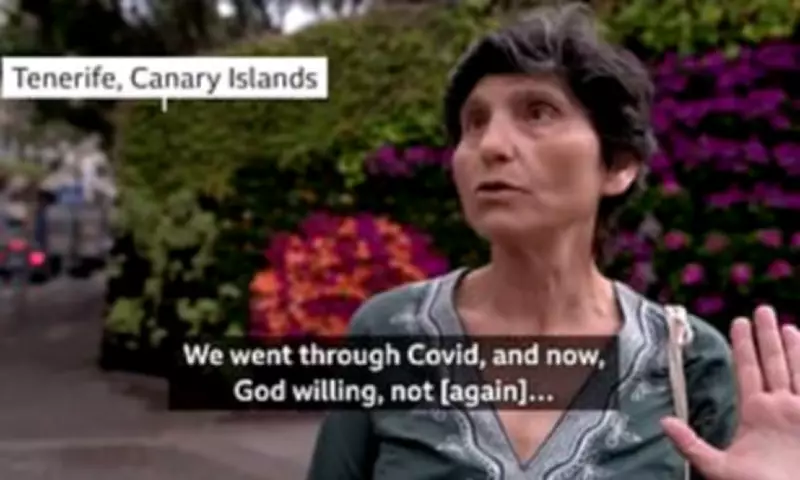
Residents of Tenerife are expressing deep concern as a luxury cruise ship carrying a deadly hantavirus outbreak prepares to dock at the Canary Islands port, with some fearing this could mark the onset of a 'Covid 2.0' scenario. The vessel, currently en route to the archipelago, has already claimed three lives due to the Andes strain of hantavirus, a rare but severe disease that can spread between humans.
Port Workers Voice Concerns
Joana Batista, a representative of the Port Workers' Union, told Reuters that her colleagues are 'really worried because they basically haven't been given any information at all.' She added, 'They haven't been told anything about what safety measures are going to be put in place, whether they're going to have to wear face masks and protective equipment. We're not quite sure what's going on, but it looks as though we're facing a COVID 2.0.'
Local Residents React
A local woman speaking to the BBC said, 'We had Covid, and now, God willing not [again]. They are saying this is very dangerous.' Other residents have condemned the government's decision to allow the ship to dock. One resident stated, 'I think the most sensible thing would be for them to worry about us and not allow that ship into the Canary Islands. It should stay where it is... or they should take it to mainland Spain or to Africa.' Another added, 'I think letting them disembark is reckless.'

Political Dispute Over Docking
The president of the Canary Islands, Fernando Clavijo, has fiercely opposed the Spanish government's decision to permit the Dutch MV Hondius vessel to dock, insisting it is not safe for the local population. 'I cannot allow it to enter the Canary Islands,' he said, adding that the 'decision is not based on any technical criteria and nor have we been given enough information.' Clavijo also criticised the Spanish government for its 'institutional disloyalty' and lack of professionalism in failing to keep him informed.
At a meeting on Thursday afternoon, Clavijo told local media that 'under no circumstances will passengers leave the ship until the aircraft is at the airport,' and their transfer will be carried out 'with all necessary safeguards' and personal protective equipment.
Memories of Pandemic Quarantines
The arrival of the ship is reviving memories for residents of Spain's Canary Islands of the quarantines they experienced during the Covid pandemic. The archipelago was one of the first places in Europe to undergo quarantines during the early days of the pandemic, with more than 700 holidaymakers stranded in a hotel in Tenerife for 14 days in February 2020 after authorities cloistered the compound to prevent the spread of the virus.
'We are a community that's already quite flexible when it comes to helping others and being accommodating to people, but I think this is excessive,' said local resident Margarita Maria, 62. 'People are scared, people are worried. Spain is a huge country with plenty of ports where the cruise ship could go.'
Current Situation on the Ship
A total of 146 people from 23 nationalities are still on board the ship, which departed Cape Verde at 6.15pm Wednesday and is now heading north. Under the current plan, the vessel will sail for the Canary Islands and dock at Tenerife's Granadilla port in around three days, where the remaining passengers will be sent home to quarantine for up to eight weeks.
It emerged on Thursday that a stewardess on a flight that a hantavirus-infected cruise passenger tried to board before dying a day later is now feared to have caught the fatal disease. Additionally, a guest still stuck on the MV Hondius has revealed that social distancing has only been in place for three days, with staff organising a 'big barbecue as if nothing had happened', despite the deadly rat-borne virus.
Health Authorities Respond
Health authorities said passengers on the MV Hondius ship tested positive for the Andes strain of the hantavirus. While people usually become infected with hantavirus through contact with infected rodents or their urine, droppings, or saliva, the Andes strain is spreadable between humans.

Professor Robin May, chief scientific officer at the UK Health Security Agency (UKHSA), said hantaviruses as a group are widespread around the world. 'This one, in particular, the Andean strain, is the only one for which there is some evidence in the past of human-to-human transmission, and so that's obviously our primary focus here,' he told BBC Breakfast. He said it has been studied intently because it is 'such a severe disease' and there are efforts globally to try to develop vaccines against it.
'So with all transmissible diseases, we undertake contact tracing after the first case is identified. And this one, of course, has been a very intense effort... From the first identification, we've been tracing individuals on the boat, contacts they have made on shore in South America who may have been associated and, of course, for the individuals who've returned home, earlier contacts they have made too on the flights or since they've been at home. So it's been quite a mammoth effort. We will continue to do that if other information arises.' He added 'this is not a virus that spreads easily between humans' but given it can spread between individuals, 'we are contact tracing everyone who might have been in close contact'.
Origins of the Outbreak
The cruise first set sail from Ushuaia in Argentina on April 1, destined for Cape Verde, and cost £10,000 per person. Now, experts in Argentina are scrambling to determine if their country was the source of the deadly outbreak, and are sending genetic material from the Andes virus and testing equipment to aid Spain, Senegal, South Africa, the Netherlands and the UK in detecting it.
Officials are investigating whether the rat-borne virus was brought onto the vessel by the birdwatching Dutch couple, who apparently visited a landfill site to snap birds in the city of Ushuaia before boarding the cruise. The Ushuaia landfill is a popular, albeit unconventional, birdwatching site as it attracts rare Patagonian species that are difficult to spot elsewhere, such as the White-bellied Seedsnipe, as well as seagulls. Before boarding, the Dutch couple went sightseeing in Ushuaia and travelled elsewhere in Argentina and Chile, WHO said. Ushuaia is the capital of Tierra del Fuego, where the vessel docked for weeks before departing. The province has never seen a case of hantavirus.
Timeline of Deaths
The first stricken passenger, a 70-year-old Dutch man, died on April 11 as the ship steamed towards Tristan da Cunha. His body remained on board until April 24, when it 'was disembarked on St Helena, with his wife accompanying the repatriation,' Oceanwide Expeditions said. The man's 69-year-old wife later felt sick on a flight from St Helena to South Africa, and she died on April 26 upon arrival at the emergency department of Johannesburg hospital. The next day, a British passenger on the cruise became 'seriously ill and was medically evacuated to South Africa,' the company said. On May 2, another passenger of German nationality died on board the ship.
Symptoms and Precautions
According to the UK Government's hantavirus advice, symptoms typically appear between two and four weeks after exposure, but can range from two days to eight weeks, meaning illness may develop in other passengers in the coming days or weeks. Early symptoms can include fatigue, fever, muscle aches and intense headaches. They are not usually spread person-to-person and are typically only transferred via bodily fluids and close contact.
Footage from Wednesday's evacuation showed medics wearing hazmat suits boarding the luxury MV Hondius off the coast of Cape Verde, in a desperate attempt to get three patients to specialist treatment in Europe. Separate videos and images show the patients - also wearing personal protective equipment - lying on stretchers as they are wheeled into an ambulance.
The vessel has been at the centre of an international health scare since Saturday, when the WHO was informed that the rare disease was suspected of being behind the deaths of three of its passengers. As others fell ill, passengers and crew have been in isolation after Cape Verde authorities barred the ship from docking. The ship has been anchored just off the island nation's capital, Praia, for days. New footage from inside the vessel showed the ship's decks mostly deserted, with only a few people wearing medical masks moving about. Common spaces were empty as passengers were isolated in their cabins.