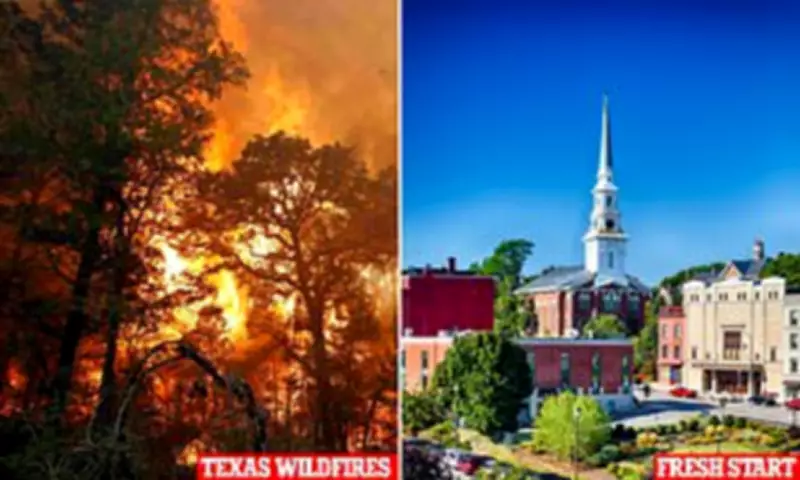
A Texas couple who fled Austin to escape climate change have revealed that their fairytale fresh start in a quaint Maine neighborhood wasn't quite what they expected. Shawn and Sara Good moved to leafy Little City in Bangor in late April, an area known for its historic 19th-century architecture and charming walkable streets.
However, just a few days into their new life, they woke up to find human excrement on the front porch of their home after a homeless person slept there overnight. The couple had left cushions for outdoor furniture that they hadn't yet unpacked on the stairs to the 126-year-old property, which were immediately seized upon by somebody with nowhere to sleep.
Homelessness in Bangor has spiraled in recent years to such a level that city councilors unanimously passed an ordinance Monday banning the storage of belongings on sidewalks outside public spaces like the library. Despite the unsavory clean-up job the Goods were greeted with during their first days in the city, the couple said they don't regret their move.

'When looking at global news, I'm so lucky that the big event I experienced recently was someone sleeping on my porch,' Sara told Bangor Daily News. Shawn added that Bangor was much more affordable than Austin, and the climate change crisis had forced them to flee Texas after more than a decade living there.
'We had a lot of reasons to move away from Austin, but the one that hit us the hardest was the weather,' he told Bangor Daily News. 'We were facing our fourth catastrophic event in five years and nobody was doing anything to address it.' 'We see it more as fleeing Texas rather than leaving,' Sara added. 'We haven't been here for very long, but we're really happy with it.'
Shawn and Sara said they grappled with extreme heat, tornadoes, and deadly snow and ice storms while living in Texas, and the situation was only getting worse. The Goods are part of a growing movement of climate refugees—people who leave their home due to extreme weather events like wildfires, sea levels rising, and natural disasters like hurricanes.
California natives James and Ellie Holden also relocated to another state with their children in 2022 after their home was destroyed by wildfires in 2018. After the Camp Fire in Paradise, northern California which reduced their home to rubble while killing 85 people, the family set their sights on the east coast. They initially moved to New York, before settling in Proctor, Vermont, a town of fewer than 2,000 near the Green Mountain National Forest.
'I felt excited to go to a new place and be out of the fire place,' said 10-year-old Soraya Holden, one of their five children. Soraya said she enjoyed rock climbing, gymnastics and living in a climate which is 'not burning hot'.
Climate change is set to reshape American cities over the next few years as people increasingly abandon flood, heat and wildfire 'danger zones' for calmer climes. Areas of Minneapolis, Indianapolis, Milwaukee, Providence and Las Vegas are named as the top metro regions forecast to experience the biggest proportional exodus due to flood risk.
Meanwhile, relatively 'safe zones' such as Jefferson County in Louisville, Kentucky, Macomb County in Detroit, Michigan, and Newark County in Passaic, New Jersey are seeing an influx of new residents. Dr Jeremy Porter, who is head of climate implications at First Street Foundation which produced the peer-reviewed report, previously told the Daily Mail that people are increasingly basing their relocations on climate factors.
'Over the past five years, people have really started to pay attention to the climate data as something that impacts their moves,' he said. 'If you couple flood risk with what we are already seeing from population projections from NASA, we are seeing there are going to be some places that do look dramatically different.' Polls back this up. A 2024 Zillow report found 80 percent of Americans consider climate risks when searching for a new home, while Forbes released a study showing that 30 percent of homeowners say climate change was the reason for their move.