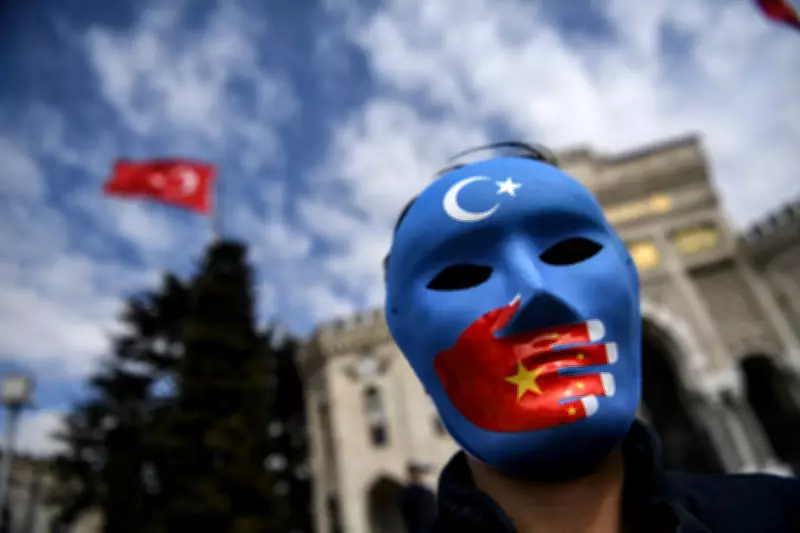
For years, Uyghurs have told the world what is happening to our people: mass detention, forced indoctrination, torture, cultural erasure, and the systematic dismantling of our faith and identity. We have spoken about families torn apart, loved ones disappearing without explanation, and entire communities living under fear. Too often, these testimonies have been met with hesitation, diplomatic caution, or silence.
Trump's Visit Marks a Turning Point
Donald Trump’s visit to China is another example of this. In 2021, the Trump administration formally recognised the CCP’s atrocities against Uyghurs as genocide, a determination that remains the official position of the United States today. For many Uyghurs living in America, that recognition offered a rare sense of hope that the suffering of their loved ones would neither be denied nor forgotten. High-profile Uyghur American activists such as Rushan Abbas, whose sister remains imprisoned, and the children of detained intellectuals including Rahile Dawut and Yalqun Rozi had hoped President Trump’s visit would bring moral clarity and renewed pressure on Beijing. Instead, the silence surrounding genocide and forced labour has been deeply painful. When genocide is officially recognised yet left unspoken at the highest level, it sends a devastating message: that the suffering of millions can once again be overshadowed by strategic and economic interests.
New Testimony from Inside the System
Now, yet another voice from inside the system has confirmed what we have long known. Last month, Der Spiegel published an interview with a former Chinese police officer who fled the Uyghur region and chose to speak publicly. Nothing in his account was new to Uyghurs. But seeing it confirmed from within the machinery of repression was still deeply painful. Because behind every report, every statistic, every leaked document, there are faces I know – my brother, my cousins, my friends, my neighbours – each of them dear to me, each of them part of my life.

I have not spoken to my family directly for over nine years. Contact has been reduced to fragments carried by strangers – someone who travelled, someone who heard something, someone brave enough to whisper a name. Each fragment is both relief and heartbreak. I learned of my eldest sister’s death through an informer. My uncle’s passing came through someone in exile. More recently, I heard of my nephew’s wife dying years earlier. One by one, people disappear not only from life, but from reach, from memory, from possibility.
This is what repression looks like beyond the headlines. It is not only detention. It is absence. It is the slow erasure of a people.
Testimony of Atrocities
The former officer’s testimony confirms what survivors have long described over years. During his interview with Adrian Zenz, he reported witnessing detainees beaten, tortured, and in some cases killed in custody during the height of the mass internment campaign. He also described severe overcrowding in detention centres and instances of sexual violence, including rape during interrogation. His account, given in the same interview report, reflects how repression has evolved – less visibly concentrated in camps, but still deeply embedded in everyday life.
He described how, over time, traditional Uyghur life in his area of deployment was effectively dismantled. Religious practice – reading the Qur’an, praying at home, observing Ramadan – was banned. Mosques were destroyed or left under permanent surveillance, with at least one reportedly guarded around the clock to prevent access. He also described coercive political loyalty measures, including pressure on Uyghur officials to consume pork as a test of compliance.
Ongoing Repression
Today, repression in the Uyghur region is less visible but more deeply embedded. What was once mass detention has become a wider system of control, operating through policing, digital surveillance, informant networks, and administrative coercion. Tourism and economic development are often presented as signs of normality. But for many Uyghurs, this normality is built on enforced silence.

As a Uyghur saying goes, in chaos, stealing bread becomes easy. In moments of global distraction, repression becomes easier to hide. While the world’s attention shifts between Ukraine, Gaza, Iran, and other crises, the Uyghur region risks slipping further from scrutiny. Yet absence from headlines does not mean absence of suffering.
International Inaction
The United Nations High Commissioner for Human Rights concluded in its 2022 assessment that credible allegations of serious human rights violations had taken place in the Uyghur region and warned that they may constitute crimes against humanity. Since then, meaningful international action has remained limited, constrained by geopolitical divisions.
For years, Uyghur women have been targeted by these alleged genocidal policies, subjected to forced sterilisation, sexual violence, and constant surveillance. State practices have extended deep into homes and communities, eroding any boundary between public authority and private life. In its findings, the Uyghur Tribunal concluded that such measures, particularly the widespread use of forced sterilisation, were part of a deliberate effort to reduce the Uyghur population.
Children are separated from families and placed in state boarding schools, where language, culture, and identity are systematically diluted. These are not abstract policies. They are lived ruptures in family life.
A Former Officer's Words
The former officer stated: “Xinjiang is effectively a prison, where everyone is persecuted to some degree. I had no choice but to leave. After all, who doesn’t love their own hometown?” His words are striking not only for what they reveal, but for what they carry – attachment to place, and grief at what it has become. He also confirmed that by the time he left the police force in 2023, traditional customs and religious life had been almost entirely dismantled in his area. Even basic expressions of faith were no longer safe.
These accounts are consistent with broader patterns documented by researchers, human rights organisations, and parliamentary inquiries. The system has simply been repackaged at the surface to appear normal.
Cultural Erasure
I am a singer and cultural advocate. I have spent my life carrying Uyghur songs, poetry, and language across borders. To many outside, culture may appear symbolic. For us, it is survival. Our language carries memory. Our poetry carries history. Our music carries grief and joy that cannot be translated without loss. To fear their disappearance is to fear the erasure of everything that makes us recognisably ourselves.
This is why what is happening is not only a political issue. It is an existential one.
Recognition Without Action
Governments have acknowledged the evidence. Parliaments have debated it. Tribunals have examined it. The UK Parliament formally recognised the Uyghur genocide in 2021. Several other legislatures have adopted similar determinations, while others continue to avoid legal framing despite extensive documentation. And yet policy has not caught up with recognition.
At the United Nations, repeated calls for stronger scrutiny of the Uyghur region have been blocked or diluted, reflecting wider geopolitical tensions. Diplomatic and economic considerations continue to shape responses, even as evidence has accumulated through survivor testimony, leaked documents, and independent investigations.
For those of us with family still inside, delay is not abstract. It is time measured in silence, in absence, in the daily uncertainty of not knowing who is still alive.
Conclusion: Time to Act
Testimonies like the former officer’s matter because they break enforced silence. They confirm what Uyghurs have long said at great personal cost. But recognition alone is not enough. If the international community continues to treat evidence as something to be acknowledged but not acted upon, accountability becomes rhetorical rather than real.
There is still time to act. But it is narrowing. Because silence, once normalised, is no longer the absence of speech. It becomes acceptance.
And yet humanity has not disappeared. It lives even in those who once enforced the system and who now choose to speak. The former officer revealed that he is now facing transnational repression. Like us, his family, colleagues, and friends are at risk. Cutting off contact has become the only way to protect them, just as it has for me, and for so many Uyghurs in exile.
In that shared reality – across fear, across systems, across imposed divisions – there remains something the system could not erase. Humanity.
Rahima Mahmut is director of the World Uyghur Congress (UK) and Adviser to the Inter-Parliamentary Alliance on China.