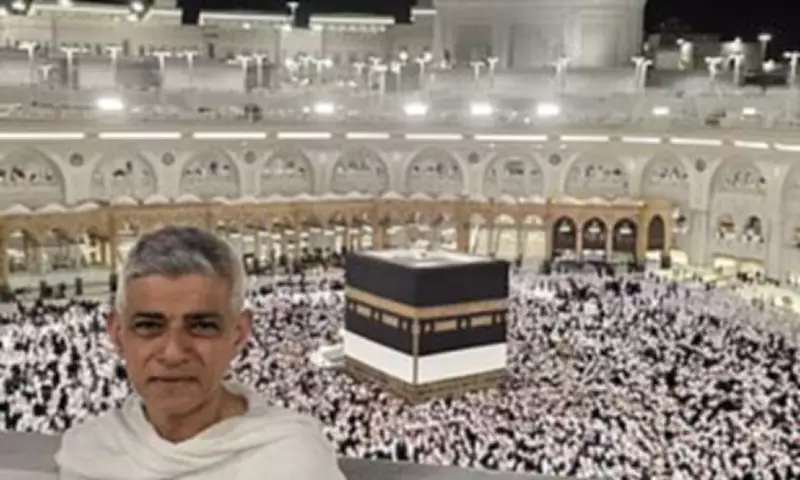
Sadiq Khan has expressed that he feels 'truly honoured and blessed' to undertake the annual Islamic pilgrimage of Hajj in Mecca. The Mayor of London shared photographs on Instagram of himself at the Kaaba, located at the centre of the Masjid al-Haram, the largest mosque in the world and the holiest site in Islam.
Hajj is a spiritual obligation and one of the Five Pillars of Islam, requiring all adult Muslims who are physically and financially capable to complete the journey at least once in their lifetime.
In a social media statement, Mr Khan, who has served as London Mayor since 2016, wrote: 'Hajj is a profoundly life-changing journey symbolising equality, unity and our collective humanity. Standing in the state of ihram - a simple unstitched garment - with so many millions of pilgrims from right across the world is a beautiful reminder of how we are all equal before God.'

He added: 'Hajj in its essence symbolises humility, forgiveness and rebirth through self-improvement. It is not just about the physical rituals - which has many challenges in the hot desert heat – but also the spiritual journey which is a once in a lifetime opportunity to reflect and engage with faith on a much deeper level. I will of course be remembering all those in need in London and around the world in my prayers and duas.'
Mr Khan, born in London to Pakistani parents, previously travelled to Mecca in 2022 to perform Umrah, a pilgrimage that can be undertaken at any time of the year. In contrast, Hajj occurs annually during the month of Dhul Hijjah, the twelfth month of the Islamic calendar.
Saudi authorities have reported that approximately 1.51 million pilgrims arrived from outside the kingdom, an increase of 11,000 compared to last year. This rise comes despite regional concerns over the ongoing conflict between the US, Israel, and Iran.
Prior to a fragile ceasefire taking effect last month, Iran launched multiple missile and drone attacks on Saudi Arabia and its Gulf neighbours in retaliation for US and Israeli air strikes. Two civilians in al-Kharj, southeast of Riyadh, were killed in an Iranian attack on March 8, along with an American service member stationed at Prince Sultan Air Base.
Last week, the Saudi defence ministry posted a video on social media showing air defence batteries on the outskirts of Mecca, located in the Hejazi region of western Saudi Arabia. The post stated: 'The air defence forces are responsible for protecting the skies over the holy sites and dealing with all aerial threats, ensuring the safety and peace of mind of the guests.'
During Hajj, pilgrims perform the 'tawaf', walking seven times around the Kaaba, the giant black cube at Mecca's Grand Mosque. Men wear a seamless white garment that emphasises unity among believers regardless of social status or nationality, while women wear loose dresses, exposing only their faces and hands. Pilgrims then walk seven times between the hills of Safa and Marwa before moving to Mina, approximately three miles away, ahead of the main rite at Mount Arafat.
The climax of Hajj occurred on Tuesday with the gathering at Mount Arafat, about six miles from Mina, where it is believed the Prophet Mohammed delivered his final sermon.
Mohammed Chahada, an Egyptian in his 50s, said as he walked through a crowd exiting the Grand Mosque: 'The war in Iran has affected the entire world. Nobody wants wars or harm to countries and peoples.'
Despite the heat and uncertainty over the war, pilgrims in Mecca were ecstatic. Jreish Mohammed, a 68-year-old from Morocco wearing traditional attire, said: 'I have wanted to perform the pilgrimage my entire life, for 40 or 50 years. And this year, my dream came true.'