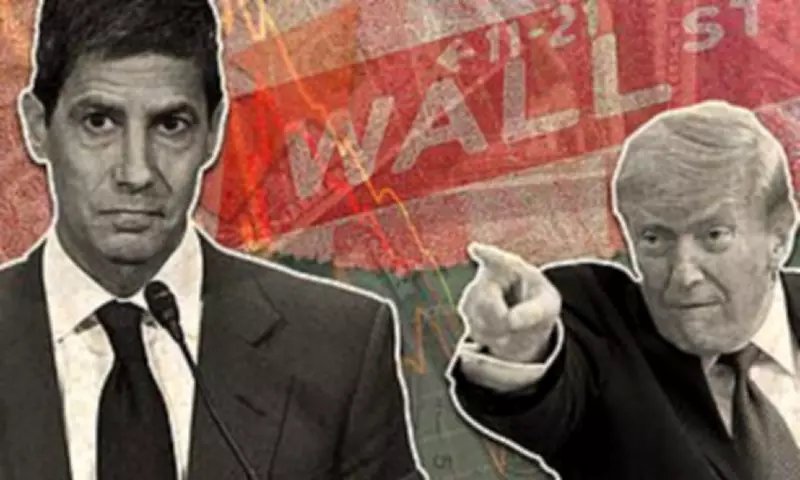
Kevin Warsh is the new boss of the Federal Reserve, but it might be more accurate to call him the dog who caught the car. After years of chasing the top job at the Fed, Warsh now faces an impossible mission: surging inflation suggests he needs to hike interest rates, but President Donald Trump is already pressuring him to cut rates.
On the very day of Warsh's confirmation hearings before Congress, CNBC asked Trump if he would be disappointed if he did not immediately cut rates. Trump responded: 'I would. We should have the lowest interest rate in the world.' Remember, central banks fight inflation's rapidly rising prices by hiking interest rates, while cutting rates makes inflation much, much worse.
Wall Street analysts and political experts agree that Trump and Warsh are not a marriage made in heaven. One we spoke to thinks it is more likely that Warsh's Fed will have to raise rates in the next six months than cut them, teeing up a major confrontation with the White House.

'The relationship between Warsh and Trump reminds me of one of those weddings where you just know it's doomed from the very beginning,' Deon Strickland, a professor of finance at Wake Forest University, told the Daily Mail.
Nic Puckrin, market expert and former Goldman Sachs analyst, told the Daily Mail that if Warsh bows to Trump's pressure, he risks looking like a puppet, endangering the very reason investors still trust the Fed — its political independence. 'Kevin Warsh has spent months fighting for the Fed chair, but he's about to find out he's stuck between a rock and a hard place,' said Puckrin.
The Senate confirmed Warsh as the new Fed chair on Wednesday, taking over after the eight-year term of Jerome Powell. He was confirmed with just 54 votes — only two Democrats supported him — the lowest vote total ever for a Fed chair nominee, underscoring the political tensions surrounding the role.
'Somebody's making a huge mistake, either the bride or the groom, and one side of the family knows it's headed for disaster,' said Strickland.
Warsh is no blushing bride, however: He was a long-serving Fed governor during the 2008 financial crisis, earning a reputation for defending the Fed's independence, and nearly became chair in 2018 when Trump picked Powell over him. Last fall, many analysts believe he started auditioning for the role by changing his tune and advocating rate cuts in a Wall Street Journal op-ed, in contrast to his long-held conviction that the Fed should have a bias towards higher interest rates.
But that very shift in his outlook has trapped him now that he is serving under a president who breaks norms and does not feel bound by convention — or economics. 'The president never once asked me to commit to any particular interest rate decision, period,' Warsh told the Senate in his nomination testimony. 'Nor would I ever agree to do so if he had. ... I will be an independent actor if confirmed as chair of the Federal Reserve.'
Strickland believes that Warsh will not be able to stay on Trump's good side for very long — especially because he thinks it is more likely they raise rates in the next six months than cut them. 'Warsh isn't the dog that caught the car — he caught an 18-wheeler,' Strickland told us. 'And I think the best way I could put it is, if I were using Kalshi or any of the other betting platforms, a great bet would be how many months until Trump has a derogatory nickname for Warsh.'
Trump bestowed a condescending nickname on Warsh's predecessor: 'Where is the Federal Reserve Chairman, Jerome "Too Late" Powell, today? He should be dropping Interest Rates, IMMEDIATELY, not waiting for the next meeting.' That was Trump's message to Powell in mid-March, demanding that he cut interest rates immediately as the Iran war started juicing oil prices — rather than wait for the next scheduled Fed meeting.
Much like a real dysfunctional marriage, said Strickland, both sides get a portion of blame: Trump's is starting the war in the Middle East, which has lit a raging fire under prices. 'The Fed has two mandates, employment and inflation, and right now inflation is too high,' said Strickland.

The truth is that there is no need for a rate cut right now, said Puckrin, noting that the Fed cuts rates when inflation is low and the economy needs a boost, or when unemployment spikes and households need a helping hand. 'But unemployment is relatively steady and inflation is on the rise again,' he said. 'A rate cut into this environment could be dangerous, because it could make inflation materially worse.'
There is another spoiler waiting for Warsh: His predecessor Powell has stayed on as a member of the Fed's seven-member governing board, an uncomfortable arrangement that has not occurred since the late 1940s. That means Powell will still have a say on interest rates, depriving the White House of a crucial seat on the Fed's powerful board. Powell has said he intends to keep a low profile, but still experts say his presence gives Fed officials skeptical of rate cuts or other major policy changes a figure to rally around.
'I expect Kevin Warsh to hold rates steady, most likely for the rest of the year,' said Puckrin. While that is bad news for anyone looking for a cheaper mortgage or car loan, it is good news for savers, who will keep earning a decent return on cash sitting in savings accounts or money market funds.
'Some people are saying that maybe the war in the Middle East will end and energy prices come down, giving Warsh some runway,' said Strickland, noting that the problem with this view is that energy prices tend to go up faster than they come down. Puckrin believes Warsh might start by reducing the Fed's balance sheet, something he has already hinted at. 'This is another lever the Fed sometimes pulls, and it could give Warsh room to eventually cut rates without the overall policy stance becoming too loose,' said Puckrin. 'More importantly, it avoids a major fight with the White House on day one.'