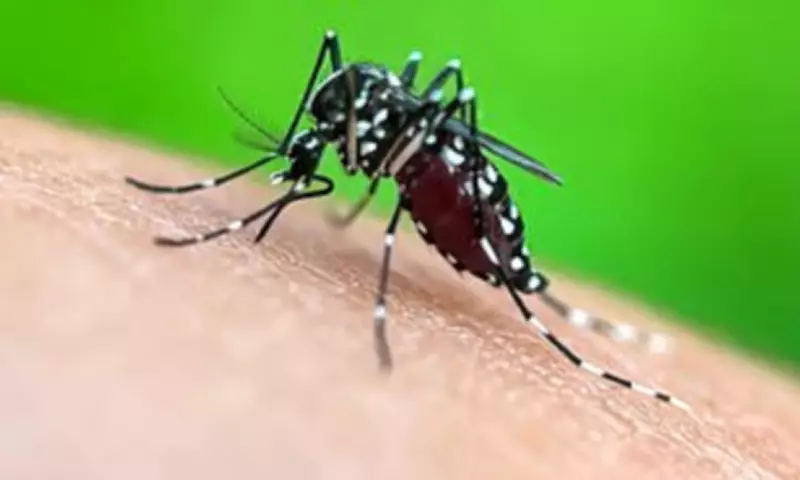
Mosquitoes can learn to love the smell of the world's most common insect repellent, scientists have found. DEET, chemically known as N,N-diethyl-meta-toluamide, is used globally and recommended by the UK Health Security Agency as a first choice to protect against bites. However, a new study by American and French scientists published in the Journal of Experimental Biology discovered that mosquitoes can, under certain circumstances, learn that DEET indicates the possibility of a blood meal.
Experiment Reveals Surprising Results
The experiment began with a swarm of Aedes aegypti mosquitoes placed in a fabric mesh enclosure. Researchers presented them with a bag of warm sheep's blood to observe their feeding behavior. Initially, the mosquitoes quickly feasted on the blood, but when the smell of DEET was introduced, they moved away. Next, the scientists fed the insects warm blood for 20 seconds, releasing DEET during the last 10 seconds. This was repeated three times before exposing the mosquitoes to solely the scent of the repellent.
This time, more than 60 percent of the insects tried to bite the fabric even though there was no blood. Then, one scientist offered their hands—one clean, the other coated with DEET—to the trained mosquitoes. The mosquitoes almost unanimously flocked to the hand covered in repellent, results described as 'beyond doubt.' Similar results occurred when the experiment used sugar instead of blood, as mosquitoes mostly feed on plant nectar in the wild.

Paradigm Shift in Understanding Repellents
Co-author Clement Vinauger of Virginia Tech said, 'The common assumption has always been that repellents work because of their chemistry.' He explained that the study reveals 'it's not the chemistry of the molecule itself which is toxic' to the insects, but rather how they 'interpret the chemical information.' Vinauger added, 'What we are showing is that the mosquito's brain can rewrite that response based on experience. What the insect has learned matters just as much as what the chemical does. That, I think, is the paradigm shift.'
However, co-author Claudio Lazzari of the Insect Biology Research Institute in France insisted that 'very specific conditions' would be required for the findings to be replicated outside the lab. He emphasized that DEET, developed in the US around 80 years ago, remains 'the absolute gold standard for repellents' and that the study does not 'call into question the effectiveness' of the repellent.
Expert Advice for Travellers
Dr. Nina Stanczyk of ETH Zurich University said the findings show mosquitoes' impressive capacity for learning. 'Mosquitoes have been shown to have impressive learning abilities, but the fact they can associate such a strong repellent smell with their food and are then attracted to it afterwards is remarkable, and important for us to be aware of for the future.' She stressed that travellers should not ditch their DEET supplies. 'People should understand that DEET does not lose its effectiveness through normal use, but only under specific laboratory conditions designed to reveal how it works on mosquitoes,' she added.