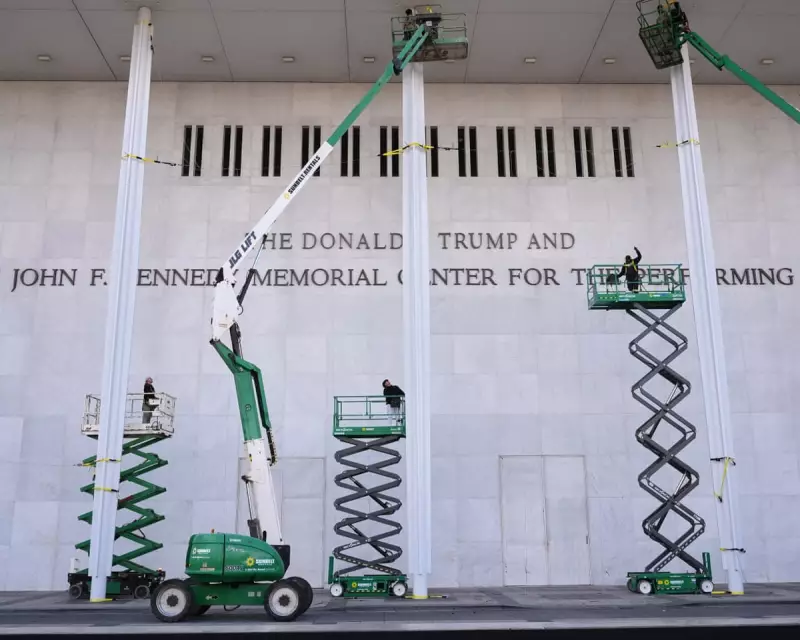
The prestigious John F. Kennedy Centre for the Performing Arts in Washington DC has become the centre of a political and cultural storm, as a growing number of musical acts withdraw from performances in protest at a decision to rebrand the venue.
Artists Take a Stand Against Name Change
This week, the Cookers, a Grammy-nominated jazz septet, became the latest act to cancel a booking, pulling out of a New Year's Eve gig with just two days' notice. While the group did not explicitly cite the controversy, they released a statement saying, "Jazz was born from struggle and from a relentless insistence on freedom: freedom of thought, of expression, and of the full human voice."
Their decision follows that of drummer Chuck Redd, who cancelled a Christmas Eve performance. Redd faced a severe backlash from the centre's management, with Kennedy Centre president and Trump appointee Richard Grenell threatening to sue him for $1m in damages, labelling the cancellation a "political stunt".

The exodus began after the centre's board voted earlier in December to rename the institution the "Trump-Kennedy Center". New signage displaying the former president's name was installed on 19 December, provoking immediate public outcry and prompting legal challenges.
A Wider Wave of Cancellations and Political Fallout
The protest is not confined to jazz. Folk singer Kristy Lee announced she had cancelled a concert scheduled for next month, stating on social media that "when American history starts getting treated like something you can ban, erase, rename, or rebrand for somebody else’s ego, I can’t stand on that stage and sleep right at night."
The controversy at the Kennedy Centre coincides with several other significant political developments involving the Trump administration. A US district judge in Boston, Angel Kelley, granted an emergency request to halt the ending of Temporary Protected Status for South Sudanese immigrants, scheduled for 5 January. This ruling marks a temporary setback for the administration's efforts to curtail the humanitarian programme.
Furthermore, the future of the Consumer Financial Protection Bureau (CFPB) is in doubt after President Trump reiterated a vow to shutter the watchdog agency, which supporters argue protects US consumers from powerful financial institutions.
International Diplomacy and Denials
On the global stage, the Israeli president's office flatly denied a claim by Donald Trump that a pardon was "on its way" for Prime Minister Benjamin Netanyahu, who faces corruption charges. The denial came after Trump made the assertion ahead of a meeting with Netanyahu in Florida.
Meanwhile, Iran's foreign minister, Abbas Araghchi, has urged President Trump to defy Netanyahu and re-engage with nuclear talks, suggesting the Republican base desires a deal over further conflict. In Asia, Trump stated he was "not worried" by China's large-scale live-fire military drills surrounding Taiwan, emphasising his strong relationship with Chinese leader Xi Jinping.
The Kennedy Centre boycott underscores a deepening cultural rift, demonstrating how a symbolic act of renaming a national arts institution has triggered tangible consequences, uniting artists in a stand against what they perceive as the politicisation of cultural heritage.