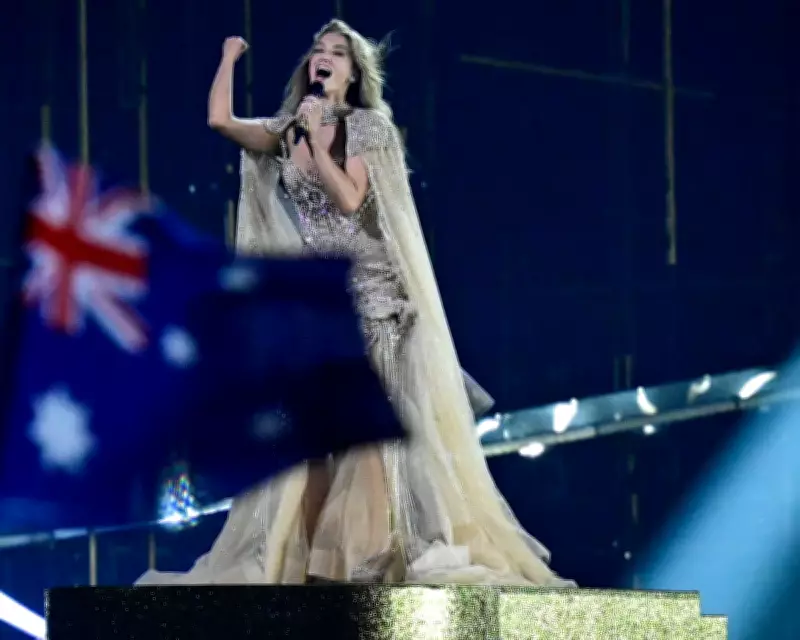
As a beautiful woman with big hair and a bigger voice, armed with a nonsensical, precision-engineered power ballad, Delta Goodrem was always going to appeal to the camp tastes of Eurovision. After her performance of Eclipse in Eurovision 2026’s second semi-final on Thursday, Australia’s odds shot up from fourth to second, rocketing past Greece and Denmark to rank behind the favourite to win, Finland.
Why is Australia included in Eurovision?
Australia has competed since 2015. The European Broadcasting Union (EBU) allowed Australia to join due to strong viewership on multicultural broadcaster SBS, which had aired Eurovision since 1983. The business case also included hopes that Australia would help establish a regional Asia Pacific song contest. According to Jess Carniel, associate professor at the University of Southern Queensland and author of Understanding the Eurovision Song Contest in Multicultural Australia, the narrative of European ties helped build the case, but viewership is driven by migrants from various backgrounds, including Asian Australians who enjoy the song competition format.
How does Eurovision’s scoring system work?
The winner is decided 50% by jury votes and 50% by televotes from each participating country, plus a “rest of the world” vote. Each country’s jury of seven music industry professionals ranks songs based on vocal capacity, performance, composition, and overall impression. The public votes by phone, SMS, or app. Countries cannot vote for themselves. The top ten receive points: 12 for first, 10 for second, then 8 to 1. Carniel predicts Goodrem will do well with juries but is uncertain about public vote enthusiasm.

Is there an art to winning Eurovision?
Spotify analysis suggests the perfect tempo is 127 BPM; Goodrem’s Eclipse is 134 BPM. However, Carniel warns against overly formulaic songs, as winning requires an emotional connection. She cites Romania’s unique entry as an example of something that cannot be produced in a lab.
If Australia wins, does it host?
No. EBU rules require Australia to co-host with a full member country in Europe. Australia is only an associate member. If Australia wins, the runner-up (likely Finland) would host, similar to when Ukraine won in 2022 and the UK hosted in Liverpool.
Will juries vote against Australia for being non-European?
Unlikely. In 2016, Dami Im received the most jury votes (320) but lost on public vote. Carniel notes that juries score based on quality, and any bias would indicate a larger problem. Geopolitical concerns are more pressing, as seen with Israel’s high public vote after the October 7 attack.
Eurovision Asia and Australia’s future
Eurovision Asia launches in Thailand in November. EBU rules allow countries to participate in only one contest, forcing Australia to choose. Carniel sees diplomatic benefits in both and would be sad to leave either.
Will Delta’s piano levitation help?
It should. Australia’s strategy involved flashy production after failing to qualify for the last two years. The federal government contributed undisclosed funds, and Prime Minister Anthony Albanese praised Goodrem. Carniel says the goal was to bring a showstopper with pyrotechnics and a cherrypicker to prove Australia belongs.
The Eurovision grand final airs in Australia on SBS from 5am AEST on Sunday 17 May.