On the day local election results began pouring in, showing that the county of my birth — Essex — had turned turquoise, my WhatsApp groups exploded. One schoolfriend told me her mother and neighbours, living in rural Essex where the Conservative Party lost control of the council for the first time in 25 years, decided to vote Reform together 'as a protest'. Alternative candidates, such as the Green Party, were 'invisible' in areas near Epping, Chelmsford and Harlow, where England flags cling to lampposts like limp confetti. Wanting change, they opted for the beer-swilling loudmouth who has undergone a prime ministerial 'glow up': Nigel Farage.
Farage's Essex Strategy
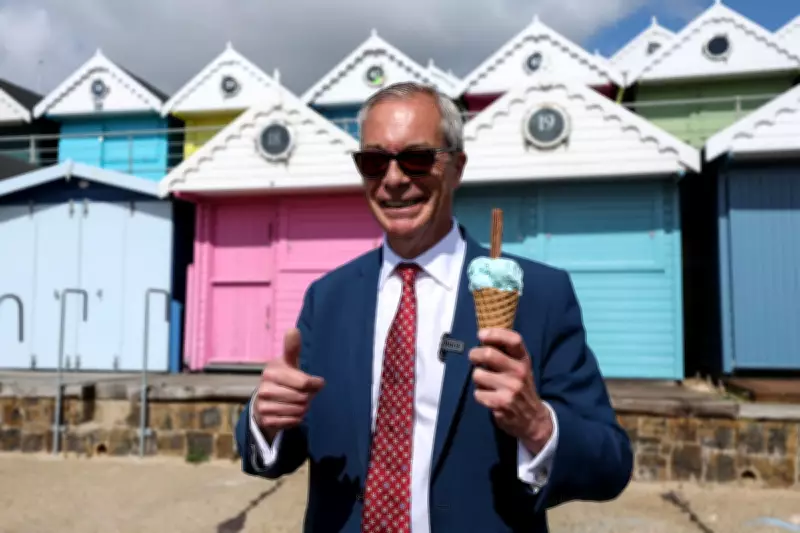
Farage has had his eye on Essex since he began the electoral campaign he hopes will usher him in as prime minister — and for good reason. People like my friend's mother and her friends were discontented sitting ducks; fed up with Labour's inactivity and the country's perceived decline. They were desperate for new blood — and who better than the 'everyman' who pops into the local Wetherspoons to hear complaints about lack of jobs, soaring crime rates, and 'multiple occupancy houses' filled with people who don't look like them? Nigel Farage — the man who eats ice-cream on the seafront in Walton-on-the-Naze, chain-smokes while lamenting the smoking ban and the nanny state, eats chips and dodges seagulls while 'bantering' with construction workers like a 'bloke's bloke' — he looks like them. He sounds like them, too, when he wants to.
The Hypocrisy of the 'Man of the People'
Yet of course, Farage isn't like them — he isn't actually anything like the typical 'Essex man' shoring up support for his party. As the UK's most senior union chief Paul Nowak warned a year ago, he is a 'political fraud and hypocrite' who is 'cosplaying' as a working-class champion to win votes. Farage, the real Farage, is a public school-educated, ex-metals trader who fawns at the feet of Donald Trump and shares an £885,000 second home in Frinton-on-Sea, Essex, owned by his partner, Laure Ferrari. Yet somehow, it's working.

Why? He is appealing to — and taking advantage of — the county's core values. Essex is the heartland of the working-class-man-made-good; home to a generation whose parents and grandparents were on the breadline before and after the Second World War in places like Stepney, Whitechapel, Bow, Bethnal Green and Mile End. Many ancestors worked on docks and in factories, at metal and paint refineries and printworks. Some were grifters, but most were grafters and traders, selling goods at Brick Lane, or fish pedlars and butchers. They were horribly poor. My mother recounts a 1950s-style childhood where the entire family sat around the dinner table with only enough food for one person: the breadwinner (my grandfather), while his wife and kids subsisted on licking the dripping from the small joint of meat. It was only later that some of them 'made good' and moved out from the East End to Essex.
Fear and Protectionism
Today, thanks to Reform pushing fear as a voting strategy and talk of mass deportations, the 'Essex man' is deeply afraid — and inherently protectionist. He is scared of losing everything, of having his hard-won possessions snatched away; genuinely frightened of returning to the meagre beginnings of his forefathers. It underpins everything. In Essex, you learn to cling to what you've got, because just a fraction of a generation ago, you had nothing. This is not Farage's background — his father was Guy Justus Oscar Farage, a City of London stockbroker. Farage was born in Kent and had a typical middle-class upbringing, attending fee-paying Dulwich College, playing cricket and rugby, and going to work in the City at 18.
Yet it is there, perhaps, that his path merges with the classic 'Essex man', because in working-class Essex, you don't go to university, but straight to work. I was the first in my entire family to pursue higher education — and it wasn't a popular decision.

The Aspirational Appeal
In that way, Farage as a hardworking 'man of the people' — a sort of gruff, Alan Sugar-esque straight-talker with cash in his pocket (£5m of it a previously undeclared gift donation, apparently) and an axe to grind — works. In a county where appearances are everything — one drive through Chigwell reveals a sea of faux-Grecian pillars and stone doorstep lions, plus enormous 115-inch flatscreen TVs glinting through windows like fairy lights — the guy with the showy Churchillian cigar is king. Farage appeals to the aspirational Essex man who mistakenly believes migrants are the reason he doesn't drive a Porsche — because that's what Farage tells them.
I have been travelling in and out of Essex my whole life, noticing my home county's visual, visceral changes. When I was young, it was full of nail shops and beauty salons, TOWIE stars and fake tans. Today, there are flags and barriers; the latter erected outside the Bell Hotel in Epping, where violent protests broke out last summer in response to news that it was being used to house asylum-seekers (one of whom was arrested and later jailed for sexual offences, including against a 14-year-old girl).
I used to be ashamed of telling people I was from Essex. I would say 'north-east London' to offset any white stiletto stigma and jokes about driving a white Ford Fiesta. Now, I know I need to shout it louder than ever before.