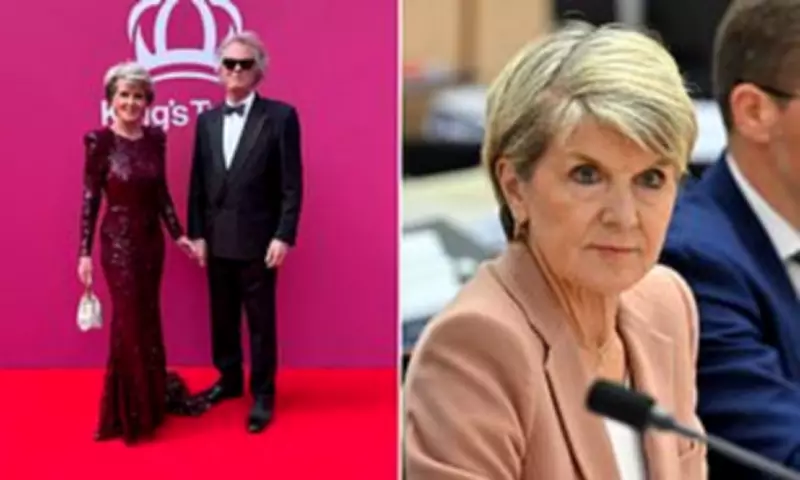
Former Australian foreign minister Julie Bishop made a defiant first appearance since stepping down as Chancellor of the Australian National University, dazzling on the red carpet at The King's Trust Gala in London on Tuesday.
Glamorous Appearance at Royal Albert Hall
Bishop, once dubbed 'Minister for Fashion' due to her love of designer labels, looked anything but downtrodden following her resignation. Joined by her partner Stephen Gray, she stunned in a dark pink sequined gown by Meraki worth $1,300, paired with a gold evening bag and statement drop earrings. Her hair was styled in a bouffant, while her makeup was dramatic with pink lipstick, blush and eye shadow. Gray sported a black suit, bow tie and a pair of sassy sunglasses as they posed side-by-side on the red carpet.
Sharing a photo on Instagram, Bishop wrote: 'The King's Trust celebrating 50 years of supporting the limitless potential of young people with a special awards event in the presence of His Majesty King Charles III at Royal Albert Hall with Aussie Shannon Lemanski a proud recipient and a line up of stars.'

Resignation Amid Regulatory Intervention
The sighting comes days after Bishop resigned as Chancellor of the Australian National University on Friday. She had been the target of sustained criticism during her six-year tenure at the Canberra-based institution, which began in January 2020 and was due to end in December. She informed Prime Minister Anthony Albanese and the university of her decision to resign effective immediately on Thursday night, citing 'unprecedented and coordinated interference'.
This came after the Tertiary Education Quality and Standards Agency (TEQSA) last week took the unprecedented step of intervening following months of turmoil at ANU, marked by concerns over governance, internal culture, and leadership. Bishop was stripped of her role in selecting the next chancellor, which goes against long-standing practice in the university's history. It is the first time the higher education regulator has intervened so directly in the appointment of a university chancellor.
Bishop's Statement and Reactions
In a statement, Bishop said she was 'deeply privileged' to have held the role while taking aim at TEQSA. 'I continue to regard the ANU as a truly national treasure,' she said. 'Following unprecedented and coordinated interference, the ANU Council is no longer able to discharge its legal and ethical obligations.' She added: 'The higher education sector is at a crossroads of regulatory overreach in the governance of our institutions or autonomy and academic freedom. I fear the collateral from this regulatory overreach will be the next generation of students and staff.'
The decision was welcomed by various sides of parliament. ACT Senator David Pocock said: 'In stepping aside, the chancellor is acting in the best interests of the ANU. When things go so terribly wrong at the helm of such an important institution, especially one governed by Commonwealth law, there must be accountability.' ACT senator and Albanese government frontbencher Katy Gallagher called on ANU to work openly with staff, students and the broader community to rebuild confidence. Other sources in the Albanese government told the Sydney Morning Herald that Bishop's resignation 'did not come as a surprise'.
Background of Controversy
Her resignation follows a year of escalating controversy at ANU, including the abrupt departure of vice-chancellor Genevieve Bell, public allegations of bullying and intimidation raised in a Senate inquiry, and mounting doubts over whether the university's council could be trusted to handle senior appointments independently. Under the agreement, a selection panel with a majority of independent members will oversee the search for the next chancellor and recommend their preferred candidate to the ANU Council, which retains the formal power of appointment under the Australian National University Act 1991.

TEQSA will take an active role in designing and supervising the process in what critics have called a direct response to 'a breakdown in governance and trust at the university'. The regulator said: 'The next Chancellor will have a key role in setting the strategic direction and culture of the ANU. We are satisfied the terms of the undertaking will ensure the selection process has the integrity and independence required to have the trust and confidence of the ANU community and other stakeholders.'
Appointed in 2020, Bishop has faced criticism from staff, unions and some politicians for her leadership during a $250 million cost-cutting drive that triggered mass redundancies, sweeping restructures and plummeting staff morale. Tensions spiked in September 2025 when vice-chancellor Genevieve Bell resigned after just 18 months in the role, following fierce opposition to the 'Renew ANU' restructure. Bell's exit came days after allegations of bullying and toxic leadership, some directly naming Bishop, were raised before a Senate inquiry into university governance. Bishop had repeatedly denied all allegations and refused to stand aside, insisting she enjoyed the full confidence of the ANU Council. 'I have the backing of council and I intend to see it through,' she said last September. Bishop served as Australia's foreign minister in the former Coalition government between 2013 and 2018.