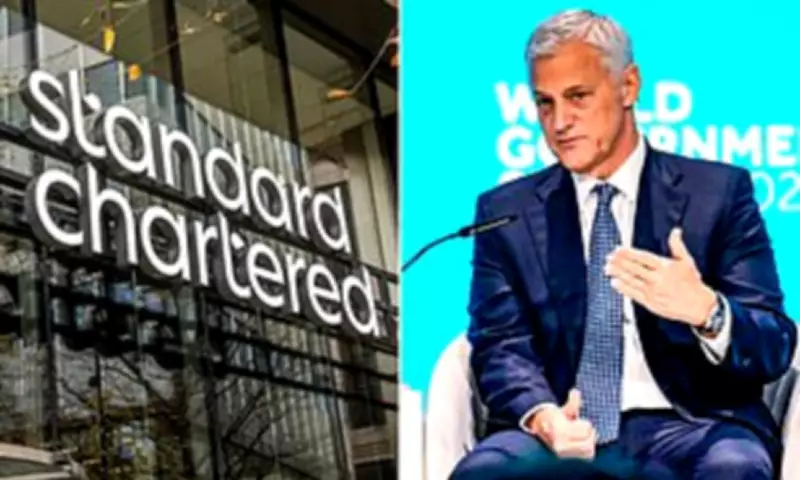
The CEO of a major British bank has been compelled to apologise after stating his intention to replace 'lower-value human capital' with artificial intelligence. Bill Winters, the chief executive of Standard Chartered, faced intense criticism for his comments made to journalists in Hong Kong during a presentation of the bank's latest financial targets, which included plans to reduce support staff roles by more than 15 per cent by 2030.
'It's not cost-cutting. It's replacing, in some cases, lower-value human capital with the financial capital and investment capital we're putting in,' Winters said.
As anger grew over the remarks and the prospect of over 7,800 job losses, Winters issued a memo to staff. 'Many of you will have seen media coverage following the investor event in Hong Kong, particularly the reporting around automation, AI, and workforce changes,' he wrote. 'I know this may be unsettling when reduced to simple headlines or a quote out of context ... Where roles do fall away, it reflects changes in the work, not the value of our people.'

He has now been forced to apologise for his controversial remarks in a LinkedIn post, writing: 'I have received a lot of support for the messages in my previous post, but still get questions about my choice of words, which I know has caused upset to some colleagues. For that, I am sorry.' Winters also included a transcript of his comments to journalists in Hong Kong, hoping to offer 'a better understanding of the important point I was raising.'
Banking Industry Shift
Winters' initial comments reflect the rapidly changing realities in the banking industry as AI firms continue to pitch automation tools to financial institutions, fuelling fears about the future of white-collar jobs. Winters took the helm of Standard Chartered in 2015, and since then, he has focused on boosting cross-border transactions and services for affluent clients across Asia and the Middle East.
At a 2024 conference, Winters lamented the bank's lagging stock performance compared to larger rivals, including HSBC. Since then, the bank's stock has nearly tripled, driven by aggressive cost-cutting measures and rising profits—gains that could be accelerated further under his AI-focused strategy.
AI Implementation Plans
Winters said the bank was planning to use AI to reduce false positives when screening transactions for evidence of financial crimes. He also outlined plans to deploy the technology to cut down on manual compliance work tied to regulatory changes that have burdened the banking industry since the 2008 financial crisis.
'Some roles will reduce, others will grow, and new ones will emerge,' Winters wrote in an earlier memo to staff, adding that the bank would seek to redeploy and retrain workers while handling any layoffs 'with respect and care.' Among the bank's 81,000 employees and 17,000 contract workers, roles in human resources and risk and compliance are expected to see the deepest cuts.
Despite the softer tone struck in the earlier internal memo, Winters' later remarks to reporters appeared to wipe away much of that goodwill. Winters is far from the only banking boss eyeing major workforce reductions. Rival lender HSBC revealed in March that it was weighing sweeping layoffs that could impact as many as 20,000 employees.
Industry-Wide Trends
The planned cuts—roughly 10 per cent of the bank's global workforce—are reportedly tied to a broader push to replace some human roles with artificial intelligence. That has fuelled growing fears that other Wall Street giants could soon follow suit, with lenders including Bank of America, JPMorgan Chase and Citigroup all pouring billions into AI while facing pressure to slash costs.
HSBC chief financial officer Pam Kaur delivered a stark warning at a Morgan Stanley conference, saying the bank was focused on the 'benefits we can get through AI,' whether by easing 'staff-related inflation' or boosting productivity. The comments align with Georges Elhedery's wider strategy to use AI to shrink the bank's middle and back-office operations, with Bloomberg reporting that as many as 20,000 jobs—particularly non-client-facing roles in global service centres—could ultimately be affected.