Analysis: Trump's Board of Peace is flailing - just like the president. A pattern is emerging where, amid glittering ceremonies and bombastic press conferences, Trump tries to take centre stage in the resolution of crises he has either supported or even initiated, writes chief international correspondent Bel Trew.
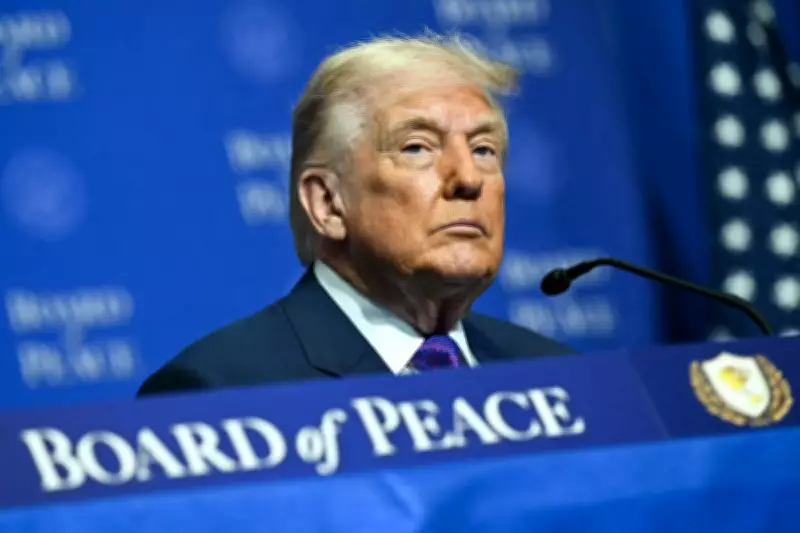
The glittering jewel in Donald Trump's (self-declared) crown was his 'Board of Peace', a multi-country body nominally created to implement a truce plan for war-ravaged Gaza, but with a global remit. Inaugurated in a grand ceremony in January in Switzerland, signatories heralded from 19 countries including Hungary's former authoritarian leader Viktor Orbán, the head of Gulf states, Mongolia and Azerbaijan. Among the glaring absences were some of America's closest Nato allies, including the UK, alarmed by Russia's potential membership and the board's role 'beyond Gaza'. Concerns were that the charter was so broad it amounted to an attempt by Trump to replace the United Nations (an institution he has made no secret of hating) with his own private members' club. Trump had declared: 'We can do pretty much anything we want to do.' But fast forward to May, and as Trump overcomplicates an already impossibly hard peace deal in Iran, his Board of Peace brainchild is flailing. It seems a bit broken: promised US funding has reportedly yet to materialise, other funds are frozen and its mission is 'stuck in limbo'.
Could it be that the president's big plans are more about photo calls and glitzy ceremonies than the tedious practicalities? At the time of its inauguration, Trump claimed lifetime membership of the Board of Peace could be bought for a hefty price tag of $1 billion. By February, states had pledged around $7 billion for a Gaza relief package. Trump promised a further $10 billion in US funding, although he did not say where that money would come from. To date, 'zero funds have been deposited' into the official fund which is administered by the World Bank, and endorsed by the United Nations, according to the Financial Times. Instead, the board has received donations directly via its JP Morgan account, where 'no independent transparency requirements are in place', the paper adds. That includes the widely reported $100 million that the UAE provided to train a new police force for Gaza: although that programme has yet to emerge and the funds are understood to be frozen. Into this same JP Morgan account, Morocco is said to have contributed around $20 million to help fund the office of Nickolay Mladenov, the 'high representative' for post-war Gaza, and the Palestinian technocratic committee that the board formed to govern the strip. But again, that committee has not started work. No contracts have yet been awarded for the reconstruction of Gaza, mostly because Hamas militant group that runs Gaza has yet to disarm. The US State Department reportedly intends to reallocate $1.2 billion of aid spending for projects but that has also reportedly yet to materialise.

What had been announced as a moment to end the war in Gaza, rebuild the destroyed strip and bring peace to the world has stuttered to a halt. At the same time, Trump appears somewhat distracted by new 'wins' on his horizon that are equally precarious. Trying to resolve the disastrous war in Iran, he stipulated on Truth Social this week that any peace deal between the US, Israel, Lebanon and Iran, must be contingent on different nominally-involved Muslim-majority states signing the Abraham Accords: diplomatic and trade deals with Israel. This is despite the fact that countries like Qatar and Saudi Arabia did not instigate or want this war that exploded over their skylines. Trump also included Pakistan, although Islamabad is only involved as mediator (and has already rejected the suggestion).

Trying to find common ground for a peace deal over Iran already seems impossible. Among the major existential sticking points are: who is going to control the Strait of Hormuz, the future of Iran's nuclear programme, and the Iranian regime itself. Trump is meeting his cabinet today to discuss the war, which according to recent polls is vastly unpopular in the US. He has insisted they are closing in on a deal. But it appears that, much like the Board of Peace for Gaza, the critical issues and desperately-needed details are to be bashed out later. And so a pattern is emerging where, amid glittering ceremonies and bombastic press conferences, Trump tries to take centre stage in the resolution of crises he has either supported or even initiated. But the devil is in the detail and the implementation - which requires boring, hard grunt work - is trickier to materialise.