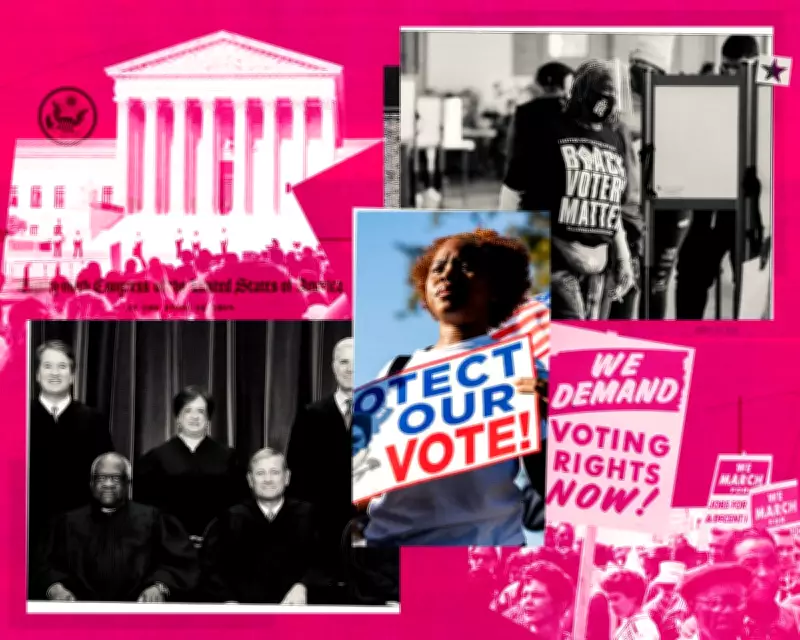
The United States Supreme Court on Wednesday heard oral arguments in a case that threatens to impose new restrictions on the Voting Rights Act, with conservative justices appearing sympathetic to arguments that would make it harder to challenge racial gerrymandering.
Key Case Before the Court
The case, Alexander v. South Carolina State Conference of the NAACP, centers on whether plaintiffs must prove that race was the predominant factor in drawing legislative districts, even when other factors like partisanship are also at play. The outcome could reshape voting rights litigation across the country.
Conservative Justices' Stance
Chief Justice John Roberts and Justice Samuel Alito, both conservative stalwarts, questioned the current legal standard that allows challenges to districts where race is a significant factor. Roberts suggested that the standard should be tightened to require clear evidence that race, not politics, drove the map-drawing process.

Justice Alito went further, arguing that the existing framework gives plaintiffs too much leeway and could lead to federal courts micromanaging state redistricting. 'The Constitution does not require proportional representation,' Alito remarked during the hearing.
Liberal Justices Push Back
Liberal justices, including Elena Kagan and Sonia Sotomayor, countered that weakening the Voting Rights Act would undermine decades of progress in protecting minority voters. Kagan warned that a stricter standard could 'eviscerate' the law's ability to combat discriminatory redistricting.
The case is one of several voting rights disputes before the Court this term, as conservative groups continue to challenge the scope of the landmark 1965 law.
Potential Impact
If the Court rules in favor of South Carolina, it could make it significantly harder for minority groups to prove that electoral maps are racially biased. Voting rights advocates argue that such a decision would disproportionately affect Black and Hispanic voters, particularly in southern states with a history of discrimination.
A ruling is expected by late June. The case is being closely watched as a bellwether for the future of voting rights in America.