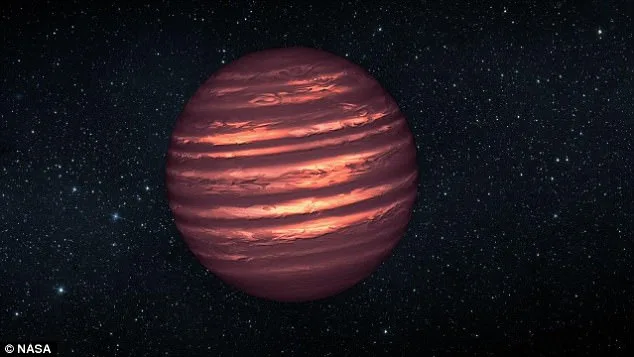
Astronomers have discovered a colossal celestial body orbiting a star 22,000 light years away at the centre of the Milky Way's bulge. The object, designated OGLE-2016-BLG-1190Lb, is 13 times the size of Jupiter, raising questions about whether it is a planet or a failed star known as a brown dwarf.
The discovery was made using Nasa's Spitzer Space Telescope and a technique called microlensing, which uses background stars as flashlights to reveal distant objects. The international team, led by Yoon-Hyun Ryu of the Korea Astronomy and Space Science Institute, reported the find in a paper published on Arxiv.org.
OGLE-2016-BLG-1190Lb's mass places it at the deuterium burning limit, the conventional boundary between planets and brown dwarfs. Brown dwarfs are considered the missing link between planets and stars, with masses up to 80 times that of Jupiter, but they lack the heat and density to sustain nuclear fusion like stars.

The object orbits a yellow dwarf star similar to our Sun, which has 89 per cent of the Sun's mass. It completes an orbit every three years at a distance of about two astronomical units (AU), where one AU is the distance from Earth to the Sun. This places it within the 'brown dwarf desert', a region where fewer than one per cent of Sun-like stars host a brown dwarf within three AU.
The researchers noted that OGLE-2016-BLG-1190Lb is likely the first Spitzer microlensing planet found in the galactic bulge. They wrote: 'Since the existence of the brown dwarf desert is the signature of different formation mechanisms for stars and planets, the extremely close proximity of OGLE-2016-BLG-1190Lb to this desert raises the question of whether it is truly a planet.'