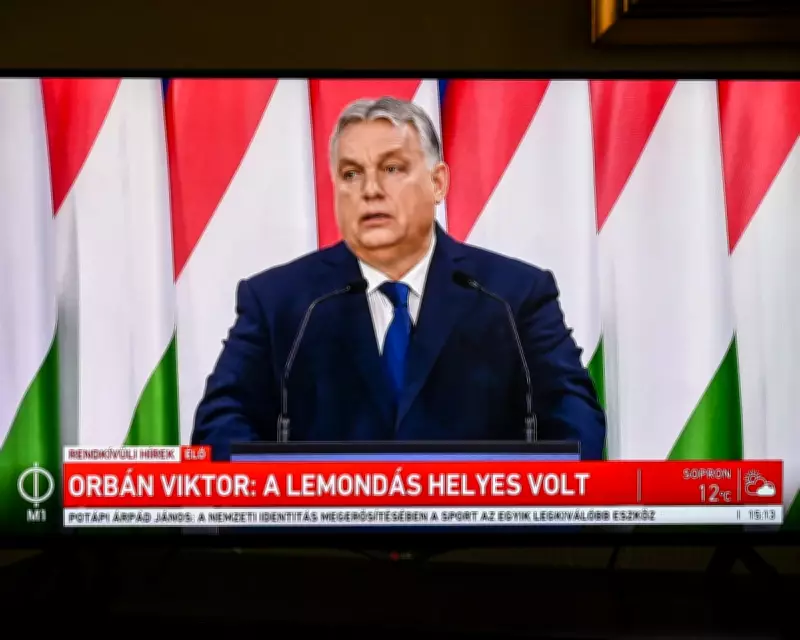
For years, Hungary’s state media operated as government mouthpieces, using their sprawling reach to bolster Viktor Orbán and vilify his enemies. But with Péter Magyar’s swearing-in ending Orbán’s 16-year rule, the once-powerful state media face an uncertain future.
Fear and Uncertainty Among State Media Employees
“Everyone is afraid. How far will this purge go? And to what extent?” one state radio employee told the Guardian. Another added, “Nobody knows what’s going to happen.” The broad transformation expected under Magyar and his Tisza party, which won a supermajority in last month’s elections, includes a particularly tough task for the country’s media.
Since 2010, Orbán and Fidesz reshaped media to promote themselves and demonise opponents, sending press freedom rankings plunging. Magyar, who was smeared by state media during the campaign, vowed to suspend state media coverage, calling it a “factory of lies” akin to propaganda from North Korea and Nazi-era Germany.

A New Press Law and Media Authority
Magyar’s government plans to pass a new press law and create a media authority to allow state media to resume under better conditions. Gábor Polyák, a professor of media law, called this “our best chance in Hungary’s history to reckon with the failures of the past.”
Under Orbán, an estimated 80% of media was controlled by Fidesz loyalists, while independent media struggled against smear campaigns and bureaucratic hurdles. Despite this, independent journalists played a key role in exposing corruption, contributing to Orbán’s downfall.
Independent Media’s Resilience
As Hungarians faced a cost-of-living crisis, many turned to independent reporting. Journalists broke scandals involving zebras imported by Orbán’s brass and servile tones with Moscow, which Magyar incorporated into his campaign as he visited 700 towns.
Several Fidesz-linked private media companies are expected to survive, but Polyák noted, “It will be a smaller empire.” The loyalty of these outlets to Orbán may depend on his future position.
Calls for Editorial Autonomy
Days after Magyar’s victory, over 90 journalists from state news agency MTI signed a letter calling for restored editorial autonomy. Krisztina Balogh, a former state media employee, described how scripts were provided for live coverage, with editors instructed to use specific keywords like “migrant,” “Brussels,” and “terrorism.” She said the goal was to stoke fear rather than inform.
Among state media, emotions are high. One MTI employee said, “Everyone, regardless of political beliefs, is hoping for a normal, impartial news service.” Many stayed on due to few alternatives, while those who left faced retaliation.
A Cautionary Tale for the World
Balogh warned that Hungary faces a gargantuan task: “What remains is unprocessed trauma: a system of lies, constant manipulation, and fear-based communication.” For the wider world, it is a cautionary tale of media hijacked for political purposes. “Recovery will require time and societal effort—media literacy, critical thinking, and a genuine demand for the truth,” she said.