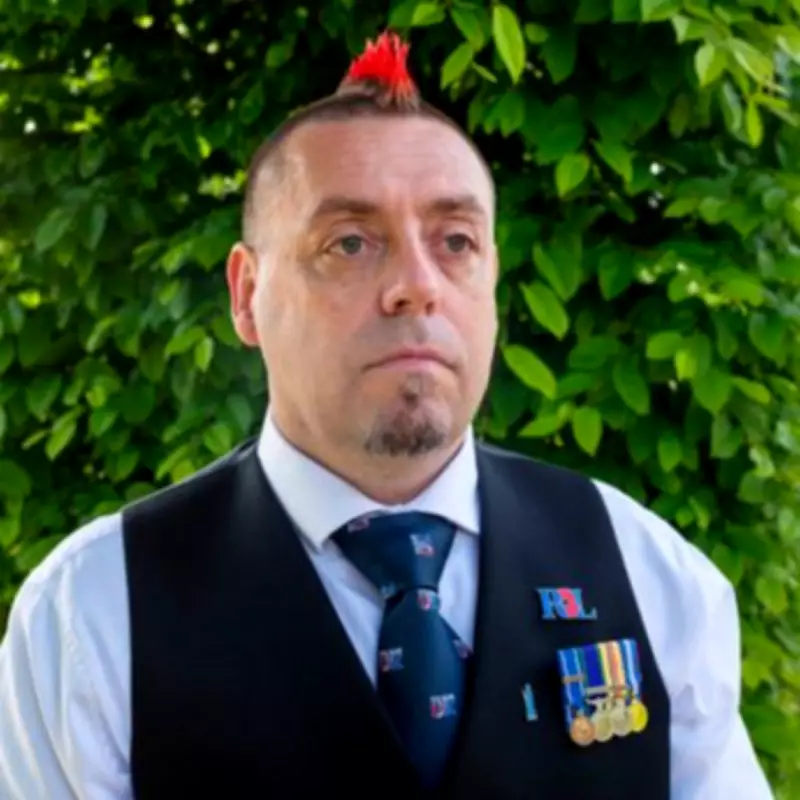
A veteran who served in Iraq has spoken of his ongoing trauma 15 years after the conflict, saying it 'doesn't end when you come home'. Mac McLaren, 49, who served with the 1st Battalion Royal Highland Fusiliers, attended the Royal British Legion's Iraq15 commemorations at the National Memorial Arboretum to mark the 15th anniversary of the end of the Iraq War.
Mac told how he was seconds away from ending his life, ready to pull the handbrake of his car and plunge into the Clyde Estuary. 'I was homeless after I came back from Iraq. I ended up sitting in my car facing the Clyde and deciding whether to release the handbrake to end it,' he said. 'But my OCD got the better of me when the notification went off on my phone. It was offering me a flat.'
Mac suffered a debilitating leg injury during his service in Iraq and endured years of chronic pain before making the difficult decision to have his leg amputated. He emphasised the importance of speaking out to help others: 'It's important for me to speak about it to help others. To tell them there is help out there from charities such as the Royal British Legion and The Stoll Foundation.'

He described how after returning from Iraq he was left homeless, living in his car in Dumbarton near Glasgow. He drove to Dumbarton Castle and parked overlooking the Clyde. 'I just thought I'm done with it. I'm going to take some paracetamol, release the handbrake and go to sleep. For me it's emotional to speak about it but I want to help others.'
A Day of Remembrance
Mac was among 1,500 veterans and families at the National Memorial Arboretum service to mark the 15th anniversary of the end of the Iraq War. The conflict saw 179 British armed forces personnel killed and 6,000 injured. One of those who died was Lieutenant Commander Darren Chapman, 40, whose Lynx helicopter was shot down over Basra on May 6, 2006. The crash killed all five personnel on board in one of the deadliest incidents for British forces during the war.
His widow, Liz Chapman, 61, and their children Chloe, Ben, and Georgina visited the Basra Memorial Wall where Darren's name is engraved. Chloe, from Yeovilton in Somerset, recalled the day of the knock on the door that changed everything. 'Our youngest was only a few months old then. Darren had actually already completed one tour, come home briefly, and then gone back out for what was only supposed to be a couple of weeks. He was really doing someone a favour - taking a new commanding officer around and helping out with the squadron. That's how he ended up in the helicopter that day.'
She remembered the day vividly: 'It was a Saturday. I saw reports of a helicopter crash on CNN and immediately tried to get hold of the squadron. I managed to get through eventually, and they seemed surprised that I'd heard about it already. I tried Darren's mobile but there was no answer, which was unusual. The children were all at home from school, and I spent the entire day waiting, not knowing anything for certain.'
'The strangest thing was that Darren had phoned us earlier that day from the helicopter while he was flying. The connection was terrible... but we were all in the car chatting away to him on our old Nokia car phone. At the time it just felt funny and odd. Looking back now, it feels incredibly significant that he called us then.'
Later that night, around eleven or midnight, she heard people arriving outside the house. 'I remember hearing footsteps everywhere and thinking how strange it was. The padre and the officer of the watch came in. Friends arrived too. Everything suddenly felt very real.'
Her eldest daughter remembered hearing the knock at the door from upstairs. 'She said she heard everyone go into the lounge and the silence that followed felt wrong somehow. Eventually she came downstairs and immediately realised something terrible had happened when she saw familiar faces there.'
Liz added: 'I honestly can't remember the exact words that were said to us. I just remember the feeling of sitting there while people talked, and knowing our lives had changed forever.'
She noted that the 'firsts are always hard, passing driving tests, those sort of things'. Her children have followed in their father's footsteps, serving and protecting the public. Ben is a fireman, Georgina a nurse, and Chloe a police officer who is expecting her first child in six and a half weeks.

'This year marks twenty years since we lost him. We'd been married seventeen years when he died. We met when I was eighteen, so I've now spent longer without him than I ever spent with him. That's a very difficult milestone to reach. But I know he would be incredibly proud of our children. Absolutely proud. They've all gone into caring and public service roles in different ways... They haven't fallen far from the tree at all. They're hardworking, empathetic and committed to helping people, just like their dad was.'
Remembering the Fallen
National President of the Royal British Legion, Vice Admiral Paul Bennett, said of the commemorations: 'Duty in Iraq came at a high cost. During Op TELIC, 179 British Armed Forces personnel lost their lives. Thousands more were wounded, many with life-changing physical injuries. Others experience emotional or mental ill-health as a result of their service. The motivations behind the invasion of Iraq, the work to stabilise the country, and the war's legacy have been debated. In all of this, what is not in dispute is the professionalism and dedication of the British Armed Forces during the operation.'
Also at the event was Nick Spicer, 42, from Bath, one of the last official British soldiers off the ground in Iraq in 2008. The Major from the 3rd Battalion Yorkshire Regiment was one of the last men to leave Iraq in July 2009 after handing over his weapons and leaving on a Hercules from Baghdad Airport. 'We were supposed to be extracted safely, but a sandstorm put pay to that and we had to stay at an outpost base in Baghdad,' he said. 'We were eventually picked up in the middle of the night by an American convoy and driven in darkness to the airport where a Hercules was waiting.'
Nick grabbed the final British flag flying in Iraq as he left the Middle East. 'The company I commanded - Alma Company - had been one of the first British units over the border during the initial invasion of Iraq, and we became the last combat unit out. First in, last out became our mantra.'
Bill Neely, a former ITV News correspondent who covered the war, hosted the event. He went to Iraq in 2003 and said he was 'apprehensive, yet excited'. He was embedded with 42 Commando, Royal Marines. On the first night of the invasion, a helicopter went down, killing eight British servicemen. He also told how four men from ITN died in those first days, including his close friend Fred Nerac, whose body was never found. 'Those of us who came back were given a gift,' he said.