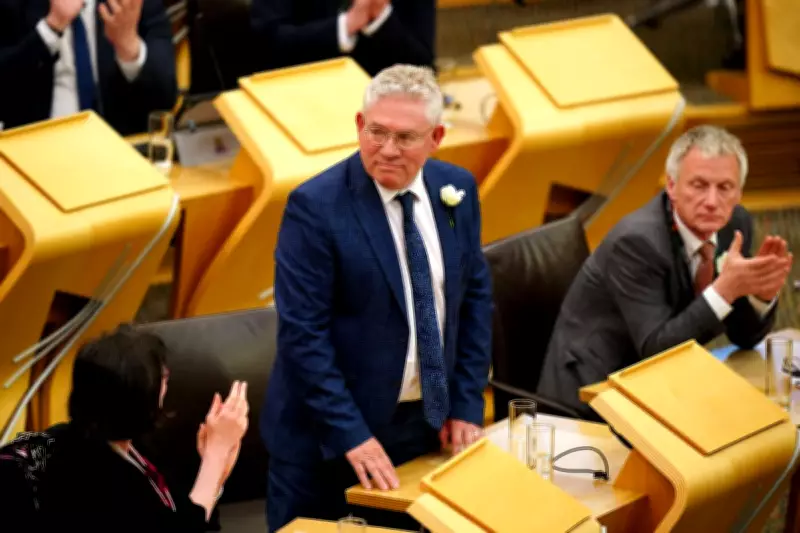
Holyrood's new presiding officer has declared his intention to make the Parliament "more enjoyable," but Kenneth Gibson also cautioned MSPs that there would be "repercussions" for breaching parliamentary behaviour rules. Gibson, formerly convener of Holyrood's Finance Committee, assured MSPs he would be "firm" when chairing proceedings "where necessary."
Election Victory
Gibson secured the role after defeating fellow SNP MSPs Clare Haughey and Stuart McMillan, as well as Liberal Democrat Liam McArthur. The election required three rounds of voting: McMillan was eliminated after the first round, McArthur after the second. In the final round, Gibson received 74 votes against Haughey's 54.
Having previously described Holyrood as "dull," Gibson stated: "I intend to be imaginative, I intend to be innovative, but I will also be firm in the chair where necessary. I want to make everything somewhat more enjoyable than it has perhaps been in the past. It had got dull, so let's hope that era has come to an end."

Critique of Government
During his tenure as Finance Committee convener, Gibson was critical of the Scottish Government, noting last year that ministers needed to place "greater emphasis on longer term financial planning." He remarked on Thursday that his election as presiding officer was "probably" an "unexpected" one for the Government.
Gibson added: "I'm basking in my victory. One of the things I'm so delighted about is I got support from right across the parliamentary chamber, I think that's really important. We're going to be an inclusive Parliament, but also a Parliament that works for everyone – not just for the people of Scotland outside, but also within. I want to make sure every party feels it's got a role to play in this Parliament in making it better."
Deputy Presiding Officers
Alongside Gibson's election, SNP MSP Clare Adamson and Scottish Labour MSP Katy Clark were chosen as the two new Deputy Presiding Officers for the five-year parliamentary term. The ballots followed the formal swearing-in of all 129 MSPs elected in last week's Scottish elections.
Oath-Taking Ceremony
As the largest party at Holyrood, SNP leader John Swinney was the first to take the oath, declaring his "primary loyalty" to the "people of Scotland." Next was Reform UK's Scottish leader Malcolm Offord, whose party shares joint second-largest status with Scottish Labour (both with 17 MSPs). Alphabetical order determined that Lord Offord went next, followed by Scottish Labour's Anas Sarwar.
Prior to the ceremony, Stand Up To Racism Scotland staged a small protest outside Holyrood, branding Reform as "racist through and through." Reform MSPs had already entered the building before protesters arrived, but Scottish Green co-leaders Gillian Mackay and Ross Greer showed support as they walked in.
The Green co-leaders took their oaths after the party achieved its best ever Holyrood result. Mr Greer declared their "ultimate loyalty" is "not to King or Crown, but to the people of Scotland." Similarly, Ms Mackay said: "My oath is to the people of Scotland, who are sovereign."
They were followed by Scottish Conservative leader Russell Findlay and Scottish Liberal Democrat leader Alex Cole-Hamilton. MSPs used various languages for their oaths, including Gaelic, Doric (a form of Scots spoken in the north east), Arabic, British Sign Language, Dutch, French, Mandarin, Hindi, and Polish. New Green MSP Q Manivannan, originally from India and requiring a new visa to serve a full term, described Scotland as "bonnie, bonnie home."