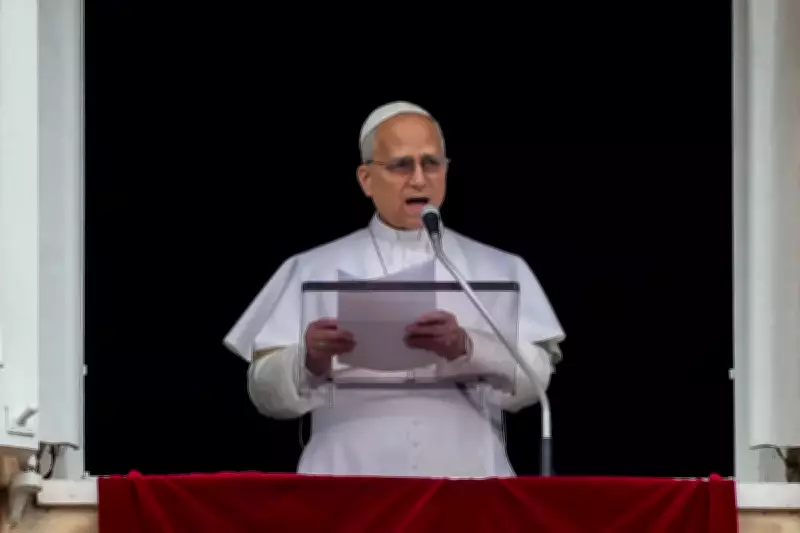
Pope Leo has delivered a powerful declaration, stating that the provision of universal healthcare constitutes a "moral imperative" for any society that wishes to be considered just. The pontiff's use of such a strong and definitive term is notably unusual for a pope, as it frames healthcare access as a fundamental requirement deeply rooted in Catholic social teaching and ethical principles.
Addressing Healthcare as a Core Moral Issue
While Pope Leo did not explicitly name any specific countries during his address, it is significant that he is the first pontiff to hail from the United States, a nation that notably lacks a system of universal health coverage. Speaking at a major healthcare conference organised jointly by the World Health Organization and European bishops, he articulated a clear vision for global health equity.
"Universal health coverage is ... a moral imperative for societies that wish to call themselves just," Pope Leo stated emphatically. He further elaborated, "Healthcare must be accessible to the most vulnerable ... not only because their inherent human dignity requires it but also to prevent injustice from becoming a potent cause of social conflict. Health cannot be, and must never be, a luxury reserved solely for the privileged few."

Continuity and Urgency in Papal Advocacy
Previous popes have also championed the cause of universal healthcare. Pope Leo's immediate predecessor, Pope Francis, called for healthcare systems to be "accessible to all" back in 2021, pointing to Italy's tax-funded national health service as a positive model for other nations to consider.
In his recent address, Pope Leo specifically urged the European bishops present at the meeting to confront and actively tackle the persistent inequalities that exist within their own national healthcare systems. He concluded his remarks with a resonant message of collective human responsibility, stating, "Only together can we build authentic communities of solidarity capable of caring for everyone. Caring for the humanity of others ultimately helps us to live our own lives to the very fullest."
Political Context and Previous Remarks
This strong stance on healthcare follows closely on the heels of another pointed intervention from the pontiff just last week. In those remarks, Pope Leo took what was widely interpreted as a veiled swipe at former President Donald Trump, suggesting that Christian political leaders who initiate or escalate wars should engage in serious self-reflection and go to confession.
"Do those Christians who bear grave responsibility in armed conflicts have the humility and the courage to make a serious examination of conscience and to go to confession?" the pope asked pointedly in a speech delivered to an audience of priests.
While Pope Leo did not mention any individual by name, he has been increasingly vocal in recent days, ramping up his calls for a swift and peaceful end to the ongoing conflict with Iran. That conflict began with joint U.S.-Israeli airstrikes on 28 February. Former President Trump was raised in the Presbyterian Christian tradition, and several of his top deputies, including Vice President JD Vance and Secretary of State Marco Rubio, are practising Catholics, adding a layer of political and religious significance to the pope's comments.