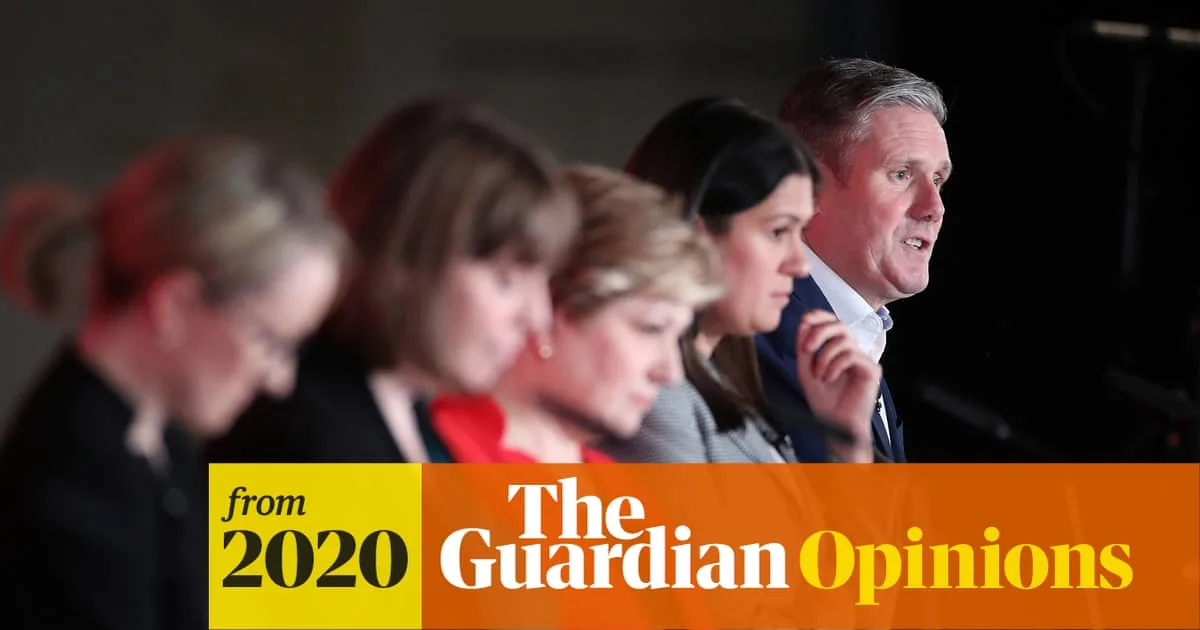
Labour is famous for its factions, divisions which are at their most heated and intense during a leadership election. What most non-members don’t know is how many members have no clue which faction is which either. The shorthand “centrist”, “hard left” and “soft left” is deployed because life, itself, is short, but the common assumptions about each fail to explain almost anything about the way the contest is unfolding.
Why, if the hard left was united and organised enough to see off every challenge to Jeremy Corbyn, did it struggle to choose a candidate, and observably fracture as soon as Rebecca Long-Bailey’s campaign was under way? How has it found itself presenting someone with such a mild political hinterland as the only true-left name on the ballot? She didn’t join the party until 2010, and became an MP after a politically unremarkable career as a solicitor. Why did Clive Lewis, the obvious bridge between hard and soft, fail to make the ballot? How did the soft left, seen as the least reactive element of the compound, the emollient middle child, manage to get three candidates – Lisa Nandy, Emily Thornberry and Keir Starmer – on to the list? Why, if the centrists are so pragmatic and sensible, so all-about-the-win, did they hit upon Jess Phillips, a wildly impractical candidate who has now dropped out?
It makes so little sense that we look for answers among the assorted personalities, and there are indeed plenty of reasons why Jon Lansman, John McDonnell and Len McCluskey might fall out. But that’s only a fragment of the story. Long-Bailey has emerged as the Corbyn-continuity candidate, endorsed by Momentum, with the heavy lifting of her campaign undertaken by Lansman. Unite has yet to endorse, but its support for Long-Bailey is considered inevitable. What’s emerging is a bid that is extremely well-organised in terms of data and resources and yet absolutely riven with internal strife, with former Corbyn and McDonnell staffers joining, then swiftly leaving camp RLB, after clashing with Lansman.

The hurdles her campaign faces are threefold: first, Momentum is not a snug fit with long-standing hard-left groups such as the People’s Assembly, Stop the War and Socialist Action. It draws its members from the student movement and the political movement, the World Transformed, and it contains plenty who reject the first principle of the old school, which is obedience. (This was plain when members were balloted before the Momentum nomination, giving them only one choice: endorse Long-Bailey as leader and Angela Rayner as deputy, or don’t. Both were endorsed, but Rayner very narrowly so, and on a very low turnout.)
Second, McDonnell – whom no one could call a traitor to the Corbyn project – is conspicuously failing to get behind the idea that Labour has only one possible successor in the wake of fractious relations with Unite in the runup to the election. Last, the hangover from Brexit has further shattered the hard-left coalition, as the internationalists in Another Europe is Possible got passionately behind Lewis, and are now divided themselves on whether to rally behind Starmer or Long-Bailey.
The broader pro-Corbyn coalition is more fragile still. The support of the soft left – which accounts for most Labour members – was vital in Corbyn being elected leader. This has been completely erased, pincer-style, by both the centrists, who painted the era as a hard-left takeover, and the hard left, who were happy to take the credit. The soft left has always been decisive, and it is no longer boxed in by limited choice, as it was in 2015. At the grass roots, it is strongly leaning towards Starmer, and it is this, rather than any resurgence of the centre, which explains his early and consistent lead in all members’ polls. He is a highly recognisable figure to Labour activists, going back to the 1980s: anti-militant but also anti-triangulation, socialist but not purist, the antithesis of the career politician who came to define the 00s.

Starmer has also attracted support from the right of the parliamentary party – Jenny Chapman, the former vice-chair of Progress and ex-MP for Darlington, is chair of his campaign. I don’t share the disquiet some on the left feel about that. It is entirely natural for some pragmatists to turn a blind eye to the radicalism of his politics of justice – environmental, social and economic – and to see him as a winner. It is this, not any attempt to triangulate, that makes Starmer the unifying figure Labour needs.