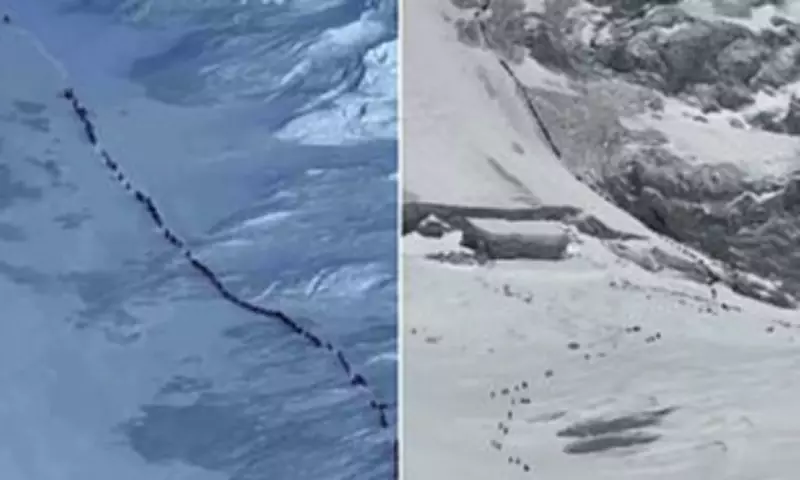
Massive queues are forming on Mount Everest as hundreds of climbers attempt to scale the world's highest peak, despite deadly warnings. Recent images show climbers walking in a long line as they gear up to ascend the nearly 29,000-foot-high mountain this month, during the much-anticipated window of good weather on Everest.
Perilous 'Death Zone' Traffic Jams
The so-called 'traffic jams' have been forming between Everest Camp III and Camp IV, an extremely perilous high-altitude stretch known as the 'Death Zone', where climbers rely on supplemental oxygen. Climbers attempting to cross this zone have a short window of time to make it through before their bodies begin to deteriorate due to the high altitude and freezing conditions.
Almost 500 foreign climbers were granted permits to scale the Nepalese mountain this year and gathered at the base camp last month to begin their journey. After weeks of acclimatising to the altitude, a wave of climbers set off on Sunday to scale the mountain. Several have already reached the top, but the highest number of summits is expected today or Wednesday, according to adventure sports publication Explorers Web.

Unstable Glacier Adds to Risks
Safety concerns have already been raised over the 'traffic jams', primarily caused by a huge unstable glacier that previously blocked the route from Base Camp. 'Icefall doctors' — elite guides deployed by the Sagarmatha Pollution Control Committee (SPCC) — opened the icefall route on April 29 but issued a warning: 'The serac has multiple cracks and may collapse at any time. SPCC strongly urges all expedition operators and climbers to exercise extreme caution.'
The serac is part of the Khumbu Icefall, a constantly shifting glacier with deep crevasses and huge overhanging ice as big as 10-story buildings. It is considered one of the most difficult sections of the climb. A falling serac triggered an avalanche over the Khumbu Icefall in 2014 that killed 16 Nepali guides and workers. This year, the team is reducing loads, minimising exposure time, carefully timing movements through the icefall, and relying on highly experienced Sherpa and guides for risk assessment.
Mountaineer Warns of Crowding Dangers
Mountaineer Jon Krakauer, who climbed Everest in 1996, warned that while it is safer to climb Everest nowadays, 'there is still tremendous risk from mass casualty incidents.' Speaking to broadcaster CNN, he said: 'Everest is still dangerous, this year especially,' explaining that with over 400 climbers given permits, each accompanied by local guides, the number of people on the mountain doubles. 'These 1,000 climbers are all going to be heading for the summit in the same brief windows, and that's dangerous. There's likely to be a lot of crowding, which makes me nervous,' he added.
Recent Deaths Highlight Perils
Earlier this month, Nepali Sherpa guide Phura Gyaljen Sherpa fell into a crevasse and died on Mount Everest, bringing the season's tally among climbers to three. The 21-year-old died after slipping on the snow and falling into a crevasse near Camp III at about 23,620 ft, said Nisha Thapa Rawat, a tourism department official. Another Nepali climber, Bijay Ghimire Bishwakarma, 35, died during an acclimatisation exercise at the Khumbu icefall, while 51-year-old Lakpa Dendi Sherpa died on his way to base camp early this month.
There have been rising concerns over the fast melting of glaciers due to global warming and climate change. U.N. Secretary-General António Guterres flew to a mountain in Nepal in 2023 and warned of the devastating level of melting glaciers in the Himalayan mountains.